By alphacardprocess March 8, 2026
Electrical service businesses move fast. A customer loses power in part of the house, a breaker panel needs attention, a tenant build-out is behind schedule, or a facility manager needs repairs completed before the workday starts.
In many of these situations, the electrical work happens right away, but the payment does not. That gap between finishing the job and receiving the money can create real pressure on a business.
For electricians and electrical contractors, cash flow is not just an accounting concern. It affects payroll, fuel, inventory, supplier relationships, scheduling, and the ability to take on the next job with confidence.
When payments are delayed by paper checks, slow invoice cycles, or outdated billing practices, even a busy company can feel financially stretched. That is why more service businesses are paying close attention to same-day payment solutions for electrical services.
Faster payment tools help electrical businesses reduce collection delays, improve the customer experience, and access working capital sooner. Whether the business is a solo electrician handling residential service calls or a growing contractor managing multiple crews, the right payment setup can make everyday operations smoother.
It can also help customers pay in the way that feels easiest to them, which often leads to fewer awkward follow-ups and better closeout at the end of each job.
This guide explains what same-day payment solutions are, why they matter in electrical work, which payment methods are most useful in the field, and how to choose a solution that fits the way your business actually runs.
It also covers important features, common pitfalls, and practical ways to get paid faster without creating friction for your team or your customers.
What Same-Day Payment Solutions Mean for Electrical Service Businesses
Same-day payment solutions for electrical services are payment tools and processing options that help businesses collect customer payments quickly and access funds faster than traditional billing methods.
In practical terms, this can mean accepting payment at the job site, sending an invoice immediately after work is completed, or using payment processing systems that shorten the time between customer payment and deposit.
For many electrical companies, the older model is familiar. Finish the work, send an invoice later, wait for the customer to pay, and then wait again for the money to clear and settle.
That process may still work for some large projects with formal billing cycles, but it often slows down cash flow on service calls, smaller jobs, maintenance visits, and emergency work. Same-day payments for electricians help close that gap.
A same-day payment setup does not always mean every transaction lands in the bank instantly. In some cases, it means same-day deposits.
In others, it means near real-time confirmation of payment, faster ACH funding, instant card-based settlements, or mobile tools that let customers pay before the technician even leaves the site. The bigger idea is speed, convenience, and fewer steps between completed work and available funds.
This matters because electrical service businesses usually have real operating costs tied to every job. Materials may have been purchased that morning. The van used fuel and mileage.
A technician or crew needs to be paid. If the business has to wait days or weeks to receive payment, the work may be complete but the financial benefit has not yet been realized.
How Same-Day Payments Fit Into Real Electrical Workflows
Electrical service businesses do not all bill the same way. A solo electrician handling residential troubleshooting may collect payment on-site after each call. A commercial contractor may bill by milestone.
A company focused on maintenance agreements may use recurring billing. Because of that, same-day payment solutions should be viewed as flexible tools, not a one-size-fits-all system.
For example, a residential service electrician might use a mobile card reader and text-based invoice link to collect payment before leaving the property. A contractor working on tenant improvements may send progress invoices electronically with payment options built in.
A company with repeat service clients might offer ACH enrollment for recurring work. In each case, the goal is the same: reduce friction and shorten the payment timeline.
Digital payments for electricians also support field operations better than older methods. Technicians are already using mobile phones or tablets for dispatch updates, photos, estimates, and job notes.
Adding mobile invoicing and payment acceptance to that process keeps the closeout step connected to the actual work. That often results in better collections because the payment request happens while the service is fresh in the customer’s mind.
The Difference Between Fast Processing and Fast Access to Funds
It is easy to confuse payment acceptance with payment availability. A customer may pay immediately, but that does not always mean the funds are available immediately. That is why electrical businesses should look closely at how each provider defines same-day funding, instant payouts, or real-time transfers.
Fast payment processing for electricians usually refers to how quickly the transaction is approved and recorded. Fast funding refers to how quickly the money reaches the business account.
Both matter. A card payment taken on-site may be authorized in seconds, but the actual deposit could happen later depending on the provider, cut-off times, and risk controls.
The same distinction applies to ACH and bank-based options. Some bank transfers are still relatively slow, while others move much faster. Real-time payments for electrical businesses are becoming more attractive because they can shorten settlement windows and give contractors better visibility into incoming funds.
A business owner comparing payment solutions should not stop at “we accept cards” or “we send invoices.” The real questions are: How quickly can customers pay? How quickly do funds settle? Are there cut-off times? Are faster deposits optional or included? Are there extra fees for same-day access? Those details shape how useful the solution will actually be in day-to-day operations.
Why Fast Payments Matter in Electrical Work
Electrical work often happens under time pressure. Service calls are urgent, project schedules are tight, and many customers expect quick problem-solving. Yet the billing side of the business can still lag behind.
That disconnect creates strain. Faster payments matter because they turn completed work into available cash sooner, which gives the business more stability and control.
For electrical companies, cash flow is one of the clearest reasons to improve payment speed. A company may be booked solid and still feel constant pressure if invoices stay open too long.
Materials, labor, insurance, software, rent, and vehicle expenses do not wait for customers to get around to paying. Faster contractor cash flow gives the business more room to operate without always chasing the next receivable.
There is also a customer service side to this. Many customers prefer to pay electronically and immediately. They are used to tapping a card, using a digital wallet, or paying from a payment link on their phone.
If an electrical business makes payment simple, it removes one more source of friction from the experience. If the payment process feels dated or inconvenient, the business may end up waiting longer even when the customer intends to pay promptly.
Fast payments also help business owners make better decisions. When incoming funds are easier to predict, it becomes easier to schedule purchases, hire staff, invest in tools, and manage seasonal swings. Payment speed is not just about convenience. It directly affects planning.
Faster Payments Support Job Completion and Reduce Collections Work
Many payment delays happen not because customers refuse to pay, but because the process becomes disconnected from the job itself. The technician leaves. The invoice goes out later. The customer gets distracted. Then someone in the office has to follow up. This cycle adds administrative work and lengthens the time to collect.
Same-day payments for electricians reduce that gap. When the invoice is created immediately and the customer has a built-in way to pay, the chances of quick collection go up. The work and the payment stay tied together, which is especially useful for service calls, repairs, panel upgrades, lighting work, inspections, and maintenance visits.
This also reduces internal friction. Office staff spend less time sending reminders, checking on open balances, and documenting partial payments.
For solo electricians, it means fewer evenings spent chasing invoices after a long day in the field. For growing electrical companies, it can ease the workload on billing teams and support a more professional closeout process.
From the customer’s perspective, paying right away can be easier too. The details are fresh. They can ask for clarification while the technician is there. They can choose a payment method on the spot instead of digging through email later. That convenience often leads to faster action.
Better Cash Flow Helps Electrical Businesses Grow More Safely
Growth can expose cash flow problems quickly. A business that adds vans, hires more technicians, or takes on larger projects usually sees expenses rise before revenue fully catches up. If receivables move slowly, growth can feel risky even when demand is strong. Instant payments for electrical contractors help reduce that lag.
Faster access to funds gives business owners more flexibility. They can restock commonly used parts, cover payroll with less stress, handle unexpected vehicle repairs, or take advantage of supplier opportunities without waiting for a batch of checks to arrive. That is especially valuable in service businesses where work volume can shift from week to week.
Cash flow also affects how confident a business feels when taking on urgent jobs. If the company knows it can invoice quickly and receive payment without a long delay, it may be more willing to prioritize emergency calls or offer more flexible scheduling. The payment process becomes part of operational confidence.
Fast Payment Options Match Modern Customer Expectations
Customer expectations have changed. Whether the customer is a homeowner, property manager, office tenant, or commercial client, many people expect digital convenience. They want payment methods that feel familiar, quick, and secure. That is one reason electrical service payment options have expanded beyond checks and manual invoicing.
Customers may not think deeply about payment systems until they are asked to use one that feels inconvenient. If they have to mail a check, call with card details, or log into a confusing portal, payment may be delayed.
On the other hand, if they receive a simple invoice with a secure payment button, tap their card on a technician’s device, or use a wallet already stored on their phone, the transaction feels effortless.
Offering customer payment methods for electricians that align with current habits can improve more than collection speed. It can shape the overall impression of the business. Fast, easy, professional billing often signals organization and reliability. That matters in service industries where trust plays a major role in referrals and repeat work.
Common Same-Day and Instant Payment Methods Electricians Can Use
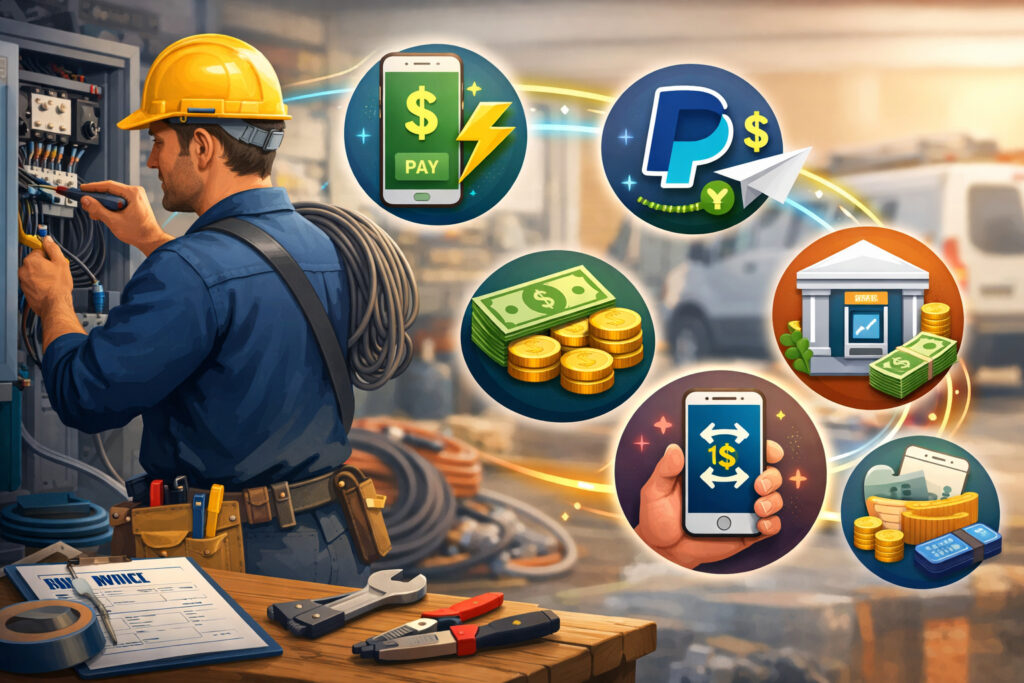
Electrical businesses have more payment tools available today than they did just a few years ago. The best mix depends on job type, customer base, invoice patterns, and how much work happens in the field.
Some methods are ideal for immediate on-site payment. Others are better for remote invoicing or scheduled billing. The strongest setup often combines a few options so customers can pay in the way that feels easiest for them.
Card payments remain one of the most common choices because they are familiar and flexible. ACH can work well for larger invoices or repeat clients. Payment links are useful when a customer is not physically present.
Tap-to-pay supports speed in the field. Digital wallets add convenience. Mobile invoicing ties the whole process together. Each option has strengths and trade-offs.
Electrical businesses do not need every method available. They do need enough flexibility to reduce delays. When a payment method matches the way the job is delivered and the way the customer prefers to pay, collections tend to improve.
Card Payments and Mobile Card Readers
Card payments are often the first step for electricians that want faster collections. A technician can accept a credit or debit card at the job site using a mobile card reader, a tap-enabled phone, or a tablet-based point-of-sale app.
This works especially well for residential service work, repairs, troubleshooting, and smaller commercial jobs where payment is expected when the work is complete.
One major benefit is speed. The customer does not need to remember to pay later, and the business does not have to send follow-up reminders. The transaction can be approved on-site and documented immediately. For many businesses, that alone shortens the collection cycle dramatically.
Mobile payments for electrical companies also improve professionalism. A technician who can provide a clear digital invoice and accept card payment right away creates a smoother closeout experience than one who says the office will send a bill later. Customers often appreciate having a receipt instantly, especially for repairs or time-sensitive work.
The trade-off is that card processing fees can be higher than some other methods. That does not mean card acceptance is a bad fit. It means the business should understand the pricing and weigh it against the value of faster collection, fewer bad debts, and reduced office workload.
ACH, Bank Transfers, and Real-Time Payment Rails
ACH and bank-based payment options are often useful for larger invoices, repeat customers, or commercial accounts that prefer direct account-to-account transfers.
Traditional ACH may not always be immediate, but it can still be an efficient option when integrated into digital invoicing. Some providers also support faster bank transfers or real-time payment capabilities that reduce waiting periods.
For electrical contractors, these methods can be especially helpful on higher-ticket jobs. A customer may be comfortable paying a service repair by card but prefer a bank transfer for a larger installation or project deposit. Giving them that option can prevent delays caused by card limits or hesitation over large card charges.
Invoice payments for electricians become easier when ACH is built directly into the invoice experience. Instead of asking the customer to mail a check or initiate a separate transfer manually, the invoice includes a direct payment path. That simplicity matters.
Real-time payments for electrical businesses are also worth watching closely. Where available, they can improve visibility and speed even more than standard bank transfer methods. Businesses considering these options should look at customer adoption, payment confirmation, funding timelines, and any limits on transaction size.
Payment Links, Mobile Invoicing, and Remote Collection
Payment links and mobile invoicing are some of the most practical tools for service businesses because they work whether the customer is on-site or not.
A technician can complete the job, generate an invoice from a phone or tablet, and send the customer a secure link by text or email. The customer clicks the link, reviews the invoice, and pays immediately.
This method is especially useful when the decision-maker is not present. For example, a property manager may approve the work but not be at the location. A tenant may need the bill sent to an office administrator.
A homeowner may want to pay from inside the house instead of handing over a card at the door. Payment links solve that problem without slowing down the collection process.
Digital payments for electricians become much more practical when invoicing is mobile-friendly. The invoice should load easily on a phone, show clear job details, and make the next step obvious.
Confusing layouts, too many clicks, or poor mobile design can reduce completion rates even if the payment option is technically available.
This approach also creates a clean record. The business can see when the invoice was sent, viewed, and paid. That makes follow-up easier if payment does not happen right away and gives the customer a more organized experience overall.
Tap-to-Pay and Digital Wallets
Tap-to-pay and digital wallets are increasingly useful because they match how many customers already like to pay. A technician can accept contactless card payments or digital wallet payments through compatible hardware, and in some cases directly through a mobile device. For quick service calls, this can be one of the fastest ways to close a transaction.
The convenience matters. A customer may not want to read card numbers aloud, sign paper slips, or take extra steps after the work is done. Tapping a card or phone can feel simple and modern. For electrical companies focused on service efficiency, even small time savings at closeout can add up over a busy week.
Electronic payments for contractors also benefit from wallet compatibility because customers often keep payment credentials ready on their devices. That can reduce payment hesitation and help avoid the “I’ll take care of it later” delay that slows collections.
Still, businesses should not rely on wallets alone. Not every customer uses them, and some larger or more formal invoices may still be better suited to ACH or invoice-based payment. The goal is not to choose one trendy method. It is to offer a set of practical tools that support real customer behavior.
Key Benefits of Faster Payment Processing for Electrical Contractors
Faster payment processing for electricians is not just about getting money sooner. It affects several parts of the business at once. It can strengthen cash flow, reduce billing friction, improve closeout in the field, and support a more polished customer experience.
When a business chooses the right payment solution and uses it consistently, the benefits often show up quickly.
Many electrical companies first look at payment tools because they are tired of waiting on invoices. That is a valid reason, but it is only part of the story.
Faster payments can also reduce back-office strain, improve forecasting, and make growth easier to manage. For companies with field technicians, better payment systems can even improve accountability because billing becomes a standard part of the job completion process.
The most useful payment solutions for service businesses are the ones that create operational advantages, not just payment convenience. When money moves faster, everything else tends to move more smoothly too.
Improved Cash Flow and Easier Day-to-Day Operations
One of the most direct benefits of same-day deposits for service businesses is better cash flow. When revenue reaches the business faster, owners have more flexibility in how they manage daily operations.
That could mean ordering materials sooner, covering payroll with less stress, refueling vehicles without delay, or avoiding short-term cash crunches between larger receivables.
For solo electricians, this can make the difference between feeling in control and feeling constantly behind. A one-person business does not always have a separate billing department or large cash reserves. Faster collections provide breathing room. The owner can focus more on work and less on chasing money.
For larger electrical contractors, better cash flow supports planning. Managers can make decisions with more confidence when incoming payments are more predictable. Instead of wondering when outstanding invoices will be cleared, they can see funds landing faster and manage expenses accordingly.
This is especially important for businesses that handle a mix of service work and project work. Service calls can generate quick revenue if payment tools are in place. That quick revenue can help balance the longer billing cycles that often come with larger jobs.
Better Customer Experience and Fewer Delays
Customers usually want the payment process to be easy. They are more likely to pay quickly when they do not have to jump through extra steps. That is one reason why electrical service payment options matter so much. Payment convenience is part of customer service, even if it is not always described that way.
A customer who receives a professional invoice right away, can pay by card or bank transfer, and gets a receipt immediately is likely to view the business as organized and reliable. That matters for repeat business and referrals. The quality of the payment experience can influence the final impression of the job just as much as punctuality or communication.
Faster payment tools also reduce the awkwardness of collections. Instead of following up days later with reminders, the business creates a simple path to pay when the customer is most ready. This does not guarantee instant payment every time, but it improves the odds significantly.
When customers delay payment, it is often because they got busy, lost the invoice, or meant to come back to it later. Reducing the need for later is one of the strongest benefits of same-day payment solutions for electrical services.
Lower Administrative Burden and Cleaner Billing Processes
Administrative work may not be the first thing people think about when comparing payment tools, but it has a big impact on efficiency. When invoices are sent automatically, payment reminders are tracked, and receipts are generated instantly, the office spends less time doing repetitive manual work.
That is valuable for growing electrical businesses. As job volume increases, manual billing processes become harder to manage. If the company is still relying on phone calls, mailed invoices, or handwritten records, the administrative burden can grow faster than revenue. Contractor payment processing tools help standardize the workflow and reduce errors.
Cleaner billing also means better records. Businesses can see what was billed, when it was sent, what the customer paid, and how long it took to settle. This makes reporting easier and helps owners identify where delays are coming from.
Maybe certain job types collect quickly while others stall. Maybe one payment method performs better than another. Better systems create better visibility.
This visibility also helps with disputes. When invoices, timestamps, authorizations, and receipts are all stored in one system, it is easier to respond to customer questions and reduce confusion.
Features to Look for in a Payment Solution for Electrical Businesses
Choosing a payment system based only on advertised speed can lead to disappointment. Speed matters, but it is not the only thing that makes a solution useful.
Electrical businesses need tools that fit how they schedule work, invoice customers, and collect payment in real operating conditions. A provider that offers same-day funding but has weak mobile tools or confusing pricing may still create friction.
The most effective payment solutions for electrical services combine fast access to funds with practical features that support field work and billing consistency. They should make life easier for technicians, office staff, and customers. That means looking beyond the headline and reviewing the full workflow.
A good solution should help the business accept payment where work happens, send invoices quickly, offer flexible customer payment methods, and keep sensitive payment data secure. It should also be clear about fees and settlement timing.
Speed of Funding, Mobile Compatibility, and Invoice Tools
Start with the basics: how quickly can the business access funds, and how easily can the team use the system in the field? Those two questions eliminate a lot of poor fits right away.
For electricians, mobile compatibility is essential. Technicians need to create invoices, take payments, and send receipts without returning to the office. A payment platform that works well only on the desktop may slow everything down. Mobile invoicing, card acceptance, and payment-link generation should be easy from a phone or tablet.
The invoice tools also matter. The system should let users create clear invoices quickly, include labor and materials, apply taxes where needed, and send reminders automatically. The easier it is to create and deliver an invoice, the more likely the team is to do it promptly.
Funding speed should be reviewed carefully. Ask whether standard deposits are next day, same day, or slower. Check whether same-day funding is automatic or optional. Look at cut-off times and any extra charges.
Some providers advertise fast deposits, but the real timing depends on account setup, transaction type, or approval history.
Security, Transparent Pricing, and Integrations
Security is non-negotiable. Customers need to feel comfortable using the payment method, and the business needs to reduce risk. The payment solution should support secure processing, encrypted transactions, and modern fraud protections.
It should also help the business avoid risky habits such as manually storing card details or accepting sensitive information through insecure channels.
Transparent pricing is another major factor. Payment fees may include a transaction rate, flat fee, monthly platform fee, equipment cost, chargeback fees, or added charges for faster funding.
None of these are automatically a deal-breaker, but they should be clearly disclosed and easy to understand. Hidden pricing causes frustration and makes it hard to measure real cost.
Integrations can also make a big difference. If the payment platform connects with scheduling, estimating, field service software, or accounting tools, it reduces duplicate data entry and helps keep records accurate.
For growing companies, this matters more over time. A disconnected system may work at first, but it can become inefficient as the business scales.
Recurring Billing, Reporting, and Customer Communication Tools
Some electrical businesses have recurring revenue opportunities through maintenance plans, inspection agreements, or scheduled service relationships. In those cases, recurring billing can be extremely useful. It saves time, improves consistency, and makes payment timing more predictable.
Reporting is another often-overlooked feature. Business owners should be able to see which invoices are paid, which methods customers use most, how long payments take to settle, and whether certain technicians or job types close out faster than others. Reporting turns payment data into operational insight.
Customer communication tools also matter. Automatic receipts, payment confirmations, reminders, and branded invoices can improve the experience and reduce misunderstandings. When payment communication is clear, the customer is less likely to miss a step or question what they are being charged for.
These features may seem secondary at first, but they often shape whether the system actually gets used well. A fast funding option does little good if invoices are hard to send or customers are confused by the payment request.
How to Choose the Best Option for an Electrical Business
The best payment solution depends on how the business works. A solo electrician with mostly residential service calls will not always need the same setup as a contractor managing crews, project billing, and recurring commercial accounts. That is why choosing a payment solution starts with operational fit, not brand recognition or marketing claims.
Business owners should look at the types of jobs they perform, where payment typically happens, how often invoices are sent after the fact, and what customers seem to prefer. A strong payment system supports the business model already in place while making collections faster and easier.
The goal is not to adopt every available feature. It is to build a payment process that matches the company’s workflow and reduces avoidable delays.
Choosing for Solo Electricians and Small Service Operators
Solo electricians often need speed, simplicity, and low administrative burden. They usually benefit most from mobile-first systems that let them send invoices, accept cards, and generate receipts directly from the field. Because time is limited, the payment process should be quick to set up and easy to use between jobs.
For this type of business, a practical combination may include card acceptance, tap-to-pay, mobile invoicing, and payment links. That gives the owner flexibility whether the customer wants to pay on-site, remotely, or later the same day. ACH can also be useful for larger invoices or repeat customers.
Small operators should pay special attention to pricing structure. A system with no monthly fee but reasonable transaction pricing may be more manageable than a complex plan with unnecessary features. At the same time, the lowest advertised rate is not always the best deal if the system slows down collection or lacks reliable support.
Ease of use matters more than feature overload. If a payment solution feels clunky, it may not become part of daily workflow, and the business will drift back to delayed invoicing.
Choosing for Growing Electrical Contracting Companies
Growing contractors usually need more than payment acceptance. They need process consistency across technicians, better visibility, and tools that integrate with the rest of the business. A payment solution for this stage should support standardized invoicing, user permissions, reporting, and possibly recurring billing or customer account management.
For field teams, mobile capability is still important. But the office side becomes more important too. Managers may need dashboards, accounting integration, and centralized control over customer payment records. The system should help maintain billing quality as more people are involved.
Growing companies should also evaluate how the provider handles deposits, approvals, dispute support, and training. As transaction volume rises, even small inefficiencies become more expensive. The payment platform should reduce that friction rather than add to it.
For companies handling a mix of service calls and scheduled projects, it may be useful to support both on-site payment tools and structured invoice billing. A blended model often works best.
Best Practices to Get Paid Faster on Every Job
Even the best payment platform will not solve collection issues by itself. Payment speed improves most when the business pairs the right tools with consistent habits. Electricians that get paid quickly tend to follow a repeatable closeout process, communicate clearly about payment, and make it easy for the customer to act right away.
Best practices do not need to be complicated. In many cases, small operational improvements create meaningful results. The key is reducing hesitation, confusion, and delay at each step.
Set Payment Expectations Early and Invoice Immediately
One of the easiest ways to improve collections is to discuss payment expectations before the work is complete. If the customer understands when payment is due and what methods are available, there is less surprise at closeout. This can be built into estimates, service agreements, scheduling confirmations, and technician communication.
Then, invoice immediately. The longer the gap between completed work and invoice delivery, the greater the chance of delay. Even a same-day delay can reduce momentum. The customer gets distracted, loses urgency, or needs reminders. Immediate invoicing keeps the payment tied to the value that was just delivered.
This is especially important for field service work. A technician should not finish a job, pack up, and leave without confirming that the invoice has been sent or payment has been collected if that is the expected process. Making invoice delivery part of job completion can transform collection speed.
Offer Multiple Payment Methods and Keep Invoices Easy to Understand
Customers pay faster when they have options. A business that accepts only one method may create unnecessary delay. Offering cards, ACH, payment links, and mobile-friendly methods improves the odds that the customer can pay immediately in the way that suits them best.
At the same time, the invoice itself should be clear. Confusing descriptions, vague totals, or missing job details can cause hesitation. Customers want to know what they are paying for. A clean invoice with clear labor, materials, service date, and payment instructions supports faster decisions.
This also helps reduce disputes and callbacks. If the customer has to contact the office just to understand the bill, payment may stall. Good invoices save time for both sides.
Businesses should test their own invoice experience occasionally. Open the payment link on a phone. Check how many clicks it takes. Review how the totals are displayed. Small issues in presentation can have a real impact on completion rates.
Use Follow-Up Automation Without Sounding Aggressive
Not every invoice will be paid instantly. That is where smart reminders matter. Automated follow-ups can help keep payments moving without adding constant manual effort. A simple reminder schedule can be very effective, especially when it sounds professional and helpful rather than harsh.
For example, a reminder that says the invoice is ready and includes the direct payment link is often enough. Customers do not always need pressure. They often need convenience and timing. Automation ensures the follow-up happens consistently.
This is particularly useful for electrical businesses with growing service volume. As invoices increase, manual reminders become harder to manage. Automation keeps the process organized while giving office staff more time for higher-value work.
Common Mistakes to Avoid When Setting Up Faster Payments
Electrical businesses sometimes adopt new payment tools with good intentions but still fail to improve collections. The problem is not always the technology. Often, it is the way the system is implemented. Avoiding a few common mistakes can make the difference between a smoother payment workflow and another frustrating layer of admin.
One of the most common mistakes is choosing a payment solution based only on headline rates or marketing language. Another is offering fast payment tools but failing to train staff to use them consistently. Some businesses also overlook settlement timing, underestimate chargeback risk, or make the customer experience more complicated than it needs to be.
A good payment process should feel simple to the team and simple to the customer. If it feels confusing, inconsistent, or hard to trust, adoption will suffer.
Ignoring Total Cost, Settlement Rules, and Chargeback Risk
Processing fees matter, but they should be viewed in context. A low transaction rate may look attractive until the business discovers additional charges for equipment, faster funding, statement fees, or dispute handling. The total cost of ownership matters more than one advertised number.
Settlement rules are another area where assumptions create problems. Some businesses sign up expecting instant access to funds and later realize that deposits depend on cut-off times, risk review, or premium pricing tiers. That does not mean the provider is wrong. It means the details were not fully understood.
Chargebacks are also worth taking seriously. Electrical businesses can reduce risk by using clear invoices, documented approvals, signed work authorizations where appropriate, and prompt receipts. The more complete the transaction record, the easier it is to respond if a payment dispute happens.
Failing to Train the Team and Overcomplicating the Customer Experience
A payment system is only as effective as the people using it. If technicians are unsure when to send invoices, how to accept payment, or how to explain options to customers, adoption becomes inconsistent. Some jobs will close out well, while others fall back into delayed billing.
Training does not need to be complicated. It can be as simple as standardizing the workflow: when to invoice, what payment methods to mention, how to confirm receipt, and when to escalate unpaid balances. Consistency is what matters.
Another mistake is adding too many steps for the customer. If the payment page is hard to navigate, requires unnecessary account creation, or does not work well on mobile, payment completion may drop. Simplicity supports speed. The best customer payment methods for electricians are the ones customers can use with minimal friction.
Frequently Asked Questions
Q.1: What are same-day payment solutions for electrical services?
Answer: Same-day payment solutions for electrical services are tools and payment processing options that help electricians and electrical contractors collect payments quickly and access funds faster than traditional invoice-and-check methods.
These solutions may include mobile card readers, payment links, ACH options, digital wallets, and invoice systems that support faster funding. The exact deposit timing depends on the provider, transaction type, and account setup, but the goal is to shorten the gap between completed work and available cash.
Q.2: Are same-day payments for electricians only useful for small service calls?
Answer: No. Same-day payments for electricians are especially useful for service calls and repair work, but they can also support larger jobs. A business might collect card payments on smaller visits while offering ACH or bank transfer options for higher-ticket invoices, deposits, or progress billing.
The best setup often includes more than one payment method so the business can match the payment experience to the type of work being done.
Q.3: What payment methods should electrical contractors offer customers?
Answer: Most electrical contractors benefit from offering a mix of card payments, ACH or bank transfers, payment links, and mobile-friendly invoice payments. Tap-to-pay and digital wallets can also improve convenience for on-site service calls.
Offering multiple customer payment methods for electricians makes it easier for different types of clients to pay quickly and helps reduce delays caused by limited options.
Q.4: How can fast payment processing for electricians improve cash flow?
Answer: Fast payment processing for electricians improves cash flow by reducing the time between job completion and deposit. That means the business can use revenue sooner for payroll, materials, fuel, software, and other operating expenses.
Faster collections also reduce the amount of time spent following up on unpaid invoices, which improves efficiency and gives owners a clearer view of their available working capital.
Q.5: Are processing fees worth it for faster payments?
Answer: In many cases, yes, but it depends on the business model and how the payment tools are used. Processing fees should be weighed against the benefits of faster contractor cash flow, fewer unpaid invoices, less administrative effort, and a better customer experience.
A payment option with higher fees may still create value if it helps the business collect more consistently and access funds sooner. The key is to understand the full pricing structure and compare it to the operational benefit.
Q.6: What features should an electrical business prioritize in a payment solution?
Answer: Electrical businesses should prioritize speed of funding, mobile compatibility, easy invoice creation, secure processing, transparent pricing, and support for multiple payment methods.
Recurring billing, reporting tools, and software integrations can also be important depending on the size of the business and the types of jobs it handles. The strongest solution is one that supports both field operations and office workflows without making the process harder for customers.
Q.7: Can solo electricians use the same payment tools as larger companies?
Answer: Yes, although the setup may be simpler. Solo electricians often do well with mobile invoicing, payment links, and card acceptance tools that let them collect payment at the job site or immediately after service.
Larger companies may need more advanced reporting, team permissions, and integrations, but the core payment tools can still be similar. What matters most is choosing a system that fits the volume of work, customer mix, and billing process.
Conclusion
Same-day payment solutions for electrical services can do much more than speed up transactions. They can help electrical businesses improve cash flow, reduce invoice delays, simplify collections, and make the payment experience easier for customers.
Whether you run a solo service operation or manage a growing electrical contracting company, faster access to funds can support smoother day-to-day operations and better financial stability.
The best approach is to choose a payment solution that fits how your business actually works. Look at the types of jobs you handle, how often you invoice, where payments usually happen, and which payment methods your customers prefer.
Features like mobile invoicing, card acceptance, ACH options, payment links, same-day deposits, clear pricing, and strong security can make a real difference when they match your workflow.
In the end, the right payment system should support three goals at once: business efficiency, customer convenience, and healthier cash flow. By choosing tools that make it easier to get paid quickly and reliably, electrical businesses can spend less time chasing payments and more time focusing on service, growth, and long-term success.