By alphacardprocess March 8, 2026
Getting paid quickly and reliably is a big part of running a successful electrical business. Whether you handle residential service calls, panel upgrades, commercial jobs, emergency repairs, or larger contract work, customers increasingly expect flexible payment options.
That often means accepting credit cards, debit cards, mobile payments, online invoices, and deposits. To do that smoothly, many businesses need a merchant account.
Understanding the merchant account approval requirements for electricians can save time, reduce delays, and help you avoid preventable issues during the application process. Approval is not only about filling out a form.
Payment providers and underwriters want to understand how your business operates, how you bill customers, how much risk is involved, and whether your company looks stable and legitimate.
This article explains how approval works for electrical businesses, what documents are usually required, what underwriters review, and what practical steps can improve your chances of getting approved faster.
You will also learn how approval standards may differ for solo electricians, established electrical companies, and growing contractors, along with how to choose a provider that fits your business model.
What a Merchant Account Is and Why Electricians Need One

A merchant account is a type of account that allows a business to accept card payments from customers. When a customer pays with a credit or debit card, the money does not always move straight into your checking account instantly.
Instead, the transaction goes through a payment processing system, and the funds are typically routed through the merchant account before being deposited into your business bank account.
For electricians, this matters because payment habits have changed. Some customers want to tap a card onsite after a service call. Others prefer to pay a digital invoice from their phone.
Commercial clients may need a secure way to pay deposits, milestone invoices, or final balances. A merchant account for electricians makes those options possible and helps create a more professional payment experience.
Electrical businesses often have a mix of payment scenarios. You may collect payment immediately after a repair, request a deposit before a larger installation, or invoice a property manager after work is completed. A good setup supports each of these billing situations without forcing you to rely on checks, cash, or manual follow-up.
Why card acceptance matters for service-based electrical businesses
Electrical work is often urgent, specialized, and tied to high-value services. When a breaker panel fails or a wiring issue needs immediate attention, customers do not always want to delay service because of payment friction. Being able to take cards onsite or send a secure invoice quickly can help you close jobs faster and improve cash flow.
Card acceptance also supports customer expectations. Many homeowners and commercial clients now assume businesses can process payments electronically.
If your business cannot do that, you may look less established than competitors who can take payments on the spot or online. That does not just affect convenience. It can influence trust and conversion.
For contractors handling larger projects, modern electrician payment processing also helps with recordkeeping. Digital payments make it easier to track deposits, progress payments, and final invoices.
That can simplify accounting, reduce disputes, and create a clear payment trail if questions come up later. A merchant account for electrical contractors is not just about collecting money. It also supports smoother operations.
Why approval matters before you can start processing payments
Many business owners assume they can sign up for payment processing instantly and start taking transactions right away. In some cases, basic access can be quick. But full approval depends on underwriting.
The provider needs to confirm your business identity, understand your services, and decide whether your account fits its risk guidelines.
This is where electrician merchant account approval becomes important. An approval delay can mean waiting longer to accept cards or launch online invoicing. A flagged application can lead to extra document requests. In some cases, a poorly prepared application can result in denial, even when the business itself is legitimate.
Approval also affects account stability after activation. If a provider approves your account without fully understanding your billing model, future transactions may get flagged later. That is why accuracy matters from the start.
A clean, complete application helps the processor understand your business and reduces the chance of surprises after you begin accepting payments.
How Merchant Account Approval Works for Electrical Businesses
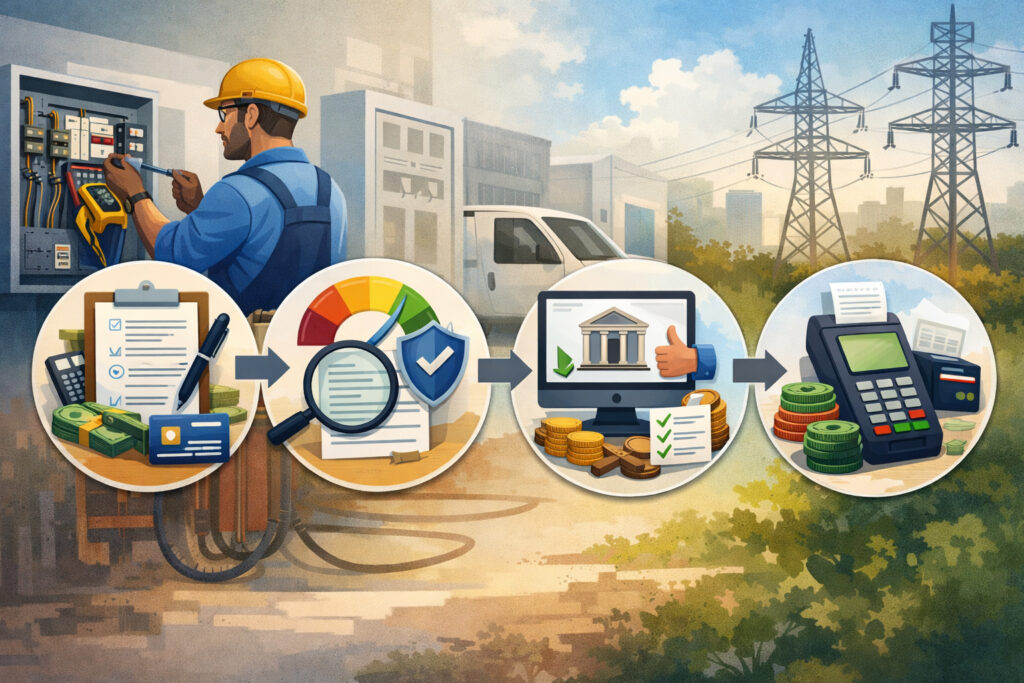
The approval process for electricians usually starts with an application submitted to a payment processor, merchant services provider, or acquiring bank.
That application asks for basic business information, ownership details, expected processing volume, average transaction size, and the way your business collects payments. Once submitted, the file is reviewed by underwriting.
Underwriting is the process where the provider evaluates whether your business is a good fit for the account. This review is not meant to make things difficult.
It exists because payment processors are taking on some risk when they allow businesses to accept card payments. If there are chargebacks, fraud, excessive refunds, or sudden spikes in processing activity, the provider may be financially exposed.
For electrical businesses, underwriting often focuses on the nature of your work and how you bill. A company doing same-day residential service with payment collected immediately may look different from one that takes large prepayments for multi-week commercial jobs. Both can be approved, but the supporting information and risk profile may differ.
The main stages of the approval process
The first stage is the initial application. Here, the provider gathers basic facts about your business. That includes your legal business name, DBA if applicable, entity type, business address, tax information, bank account details, ownership structure, and an estimate of your processing needs. This is also where you may describe your services and how customers pay.
Next comes document review. Depending on the provider and your business type, you may be asked for a business license, identification, bank statements, a voided check, invoices, signed agreements, or website information. The goal is to verify that your business is real, active, and operating as described.
The final stage is the underwriting decision. You may receive standard approval, conditional approval, or a request for more information. Standard approval means the account is approved based on the information submitted.
Conditional approval means the account may be approved with certain limitations or follow-up requirements. A request for more information means the underwriter needs additional details before making a final decision. This is common and does not necessarily mean there is a problem.
Why electricians may be reviewed differently than some other businesses
Electrical services are generally viewed as legitimate, practical, service-based work. That is a positive starting point. But payment processor requirements for contractors can still vary because contractors often have service variability, deposit billing, larger tickets, or a mix of onsite and invoiced transactions.
For example, a solo electrician handling small repairs with low average tickets may be seen as straightforward. An electrical contractor collecting significant upfront payments for remodels or generator installations may require closer review.
The provider may want to confirm how deposits are handled, when work is completed, whether contracts are signed, and how customer disputes are managed.
Some providers also look closely at card-not-present transactions, especially if you accept payments over the phone, through emailed invoices, or via online forms. Those methods are common and useful, but they can carry more risk than card-present payments.
That does not mean you cannot be approved. It simply means your business model needs to be explained clearly during the merchant account application for electrical businesses.
Core Merchant Account Approval Requirements for Electricians

The core merchant account approval requirements for electricians usually center on identity, legitimacy, financial setup, and processing expectations. Providers want to confirm that your business exists, that the owners are known, that you have a valid bank account for deposits, and that your projected payment activity makes sense for the type of work you perform.
This part of the process often feels detailed, but most of the requirements are practical. Payment companies need enough information to verify that you are running a real electrical service business and not misrepresenting your activity. When the information is accurate and complete, approval tends to move more efficiently.
One of the most common mistakes is assuming that only large companies need to prepare carefully. In reality, solo electricians and smaller contractors benefit just as much from strong documentation.
A simple, well-organized application can make a one-person operation look more reliable than a larger company with inconsistent paperwork.
Business registration, tax details, and banking information
Most providers will want to see that your electrical business is properly registered. That may mean a corporation, LLC, partnership, or sole proprietorship with supporting records.
Your legal entity name should match what appears on official documents and bank records. If you use a different public-facing business name, that should be disclosed as a DBA where relevant.
Tax documentation is also a standard part of electrician merchant account approval. Many providers request an EIN or other tax identification details connected to the business.
Sole proprietors may be asked for alternate tax documentation depending on the account structure. The purpose is straightforward: the provider needs to verify who is applying and how the business is registered for tax and compliance purposes.
Banking details are equally important because this is where your processed funds will be deposited and where fees or chargebacks may be withdrawn. You will typically need to provide a business checking account, routing information, and sometimes a voided check or bank letter.
The account name should align closely with the business name on the application. Mismatches between your merchant account application and bank account information are a common reason for delays.
Ownership information, processing estimates, and business model details
Ownership information helps the provider understand who controls the business. Most applications ask for the names of owners, their percentage of ownership, contact details, and identification.
In some cases, providers may also review the background of principal owners as part of standard risk checks. This is common across many industries and does not automatically signal concern.
You will also need to estimate how much you expect to process each month, your average transaction amount, and possibly your highest ticket size.
These figures should be realistic. If you underestimate them too much, future processing may look suspicious when your activity exceeds what you stated. If you overestimate dramatically, the underwriter may ask more questions about whether the numbers are accurate.
Business model details are especially important for payment processing for electrical contractors. Underwriters may want to know whether you do residential, commercial, emergency, subcontracted, or project-based work.
They may ask whether you collect deposits, whether work is completed the same day, and whether customers sign estimates or service agreements. This helps them assess timing, dispute risk, and transaction patterns.
Documents Electricians May Need During the Application Process
Even when the initial application seems short, document requests can become a major part of approval. The exact list varies by provider, but many electricians are asked for similar types of supporting records. These documents help verify identity, business activity, financial stability, and operational transparency.
The good news is that most of the requested materials are things your business should already have or be able to create fairly easily.
The challenge is often organization. When records are scattered across email threads, old folders, and accounting software, simple requests can turn into long delays. Preparing early can shorten the path to approval and reduce back-and-forth with the provider.
For businesses seeking contractor merchant services, it helps to think in categories: identity documents, business formation documents, banking records, and operational proof such as invoices, website details, or customer agreements.
Common documents that support a cleaner application
A payment processor may ask for a combination of the following:
- Business formation documents
- Tax identification documentation
- Business license or trade license where applicable
- Government-issued photo ID for owners
- Voided business check or bank verification letter
- Recent business bank statements
- Sample invoices or receipts
- Signed service agreements or proposals for larger jobs
- Website URL or online business presence
- Proof of business address
- Existing processing statements if you already accept cards elsewhere
For electricians, invoices and work orders can be especially useful because they show how the business bills customers in the real world.
They can help underwriters understand your average ticket sizes, service descriptions, and whether deposits or progress payments are part of your business model. This can be valuable when your pricing varies from service calls to larger installation jobs.
Bank statements also play an important role. They can demonstrate that the business is active and financially functional. Underwriters may compare the activity shown in your statements with the revenue expectations listed in the application. Large inconsistencies may trigger questions, so accuracy matters.
Why licenses, website details, and service records matter
For an electrical business, licensing can strengthen credibility during underwriting. Not every provider requires a copy of your license in every case, but having it ready can help support legitimacy, especially if your business performs regulated trade work, higher-value projects, or specialized installations. It helps show that the company is operating in a professional and compliant way.
Website details matter more than many electricians expect. A simple but complete website can help confirm what services you offer, where you operate, how customers contact you, and whether your billing practices appear transparent. Even a basic site with clear service pages, contact information, and terms can support smoother approval.
Service records such as invoices, estimates, and signed customer agreements become more important when you collect deposits or handle larger contracts.
These records help the underwriter see that there is a structured business process behind your transactions. They can also show how you describe services, when you request payment, and whether your policies are documented in writing.
What Underwriters Look at Before Approving an Electrician Merchant Account
Underwriters are not simply checking whether a form has been filled out. They are reviewing risk. Their goal is to determine whether your electrical business is likely to process transactions in a stable, transparent, and manageable way.
That review usually includes the nature of your services, how and when you bill customers, how much chargeback exposure may exist, and whether your supporting documents tell a consistent story.
This is why merchant account approval requirements for electricians go beyond a checklist. The underwriter is trying to understand the full picture. A business that looks organized, easy to verify, and honest about its operations is generally easier to approve than a business with missing details and inconsistent records.
For electricians, many risk decisions come down to billing structure and customer expectations. Fast repair jobs paid at completion often look different from projects involving deposits, special-order materials, or delayed completion timelines. Neither is automatically a problem, but each one affects how the application is evaluated.
Service type, transaction patterns, and dispute exposure
Underwriters often begin by looking at what type of electrical work you perform. Routine residential repairs, troubleshooting, and maintenance may be viewed as more straightforward because the work is often completed quickly and payment is collected at or near the time of service.
Larger commercial or installation-heavy jobs may involve longer timelines, milestone billing, and more contract detail.
Transaction patterns also matter. If your average ticket is modest and your monthly processing volume is spread across many jobs, that may look more predictable.
If you process a smaller number of high-value transactions or take sizable deposits before work begins, the provider may want to know more about your workflow. This helps them understand potential refund risk and customer dispute exposure.
Chargebacks are a key concern in underwriting for electricians. Customers may dispute charges if they believe work was incomplete, if there was confusion about change orders, if a deposit was nonrefundable but not clearly disclosed, or if the billing descriptor on the card statement was unfamiliar.
Underwriters look for signs that your business can reduce these risks through documentation, communication, and billing clarity.
Business history, consistency, and overall account fit
A longer business history can support approval because it suggests operational stability. That said, new businesses can still be approved. The difference is often in how well the business is documented.
A newer electrical company may need to provide stronger supporting information, such as licenses, a professional website, signed estimates, and a clear explanation of services.
Consistency is one of the most important factors. The underwriter compares your application, website, invoices, bank statements, and any existing processing records.
If your application says you do residential service calls but your website highlights large commercial contracting, that inconsistency may raise questions. If you list low ticket sizes but submit invoices showing much larger jobs, the file may need more review.
Overall account fit also matters. Some providers are comfortable with contractors and service businesses. Others prefer simpler retail-style processing models.
If your electrical business needs field payments, invoice billing, deposit collection, and mobile card acceptance, a provider without contractor-friendly underwriting may not be the best match. Approval is not only about whether your business is good. It is also about whether it fits the provider’s appetite and systems.
Common Approval Problems and How to Avoid Them
Many merchant account applications do not get denied because the business is unqualified. They get delayed, flagged, or stalled because of preventable issues. Incomplete applications, inconsistent business details, weak online presence, and unclear billing models are among the most common reasons underwriting takes longer than expected.
For electricians, these problems often show up when the business is growing quickly. The company may be doing real work and generating revenue, but its paperwork, website, and internal processes have not fully caught up.
That creates friction during review. The provider is left trying to piece together how the business operates, which usually leads to more document requests.
The good news is that most approval issues can be reduced with preparation. Knowing what triggers extra scrutiny can help you fix weak spots before you apply.
Inconsistent information, weak documentation, and unclear websites
One of the most common approval problems is inconsistent information across documents. Your legal entity name may not match your bank account. Your application may show one address while your website shows another.
Your invoices may list services that are not explained anywhere online. These issues do not always mean denial, but they can easily trigger review.
Weak documentation is another common obstacle. If the underwriter requests invoices, bank statements, or identification and the files are missing, outdated, or hard to read, the process slows down.
This is especially true for businesses that want approval for payment processing setup for electricians involving both onsite and remote transactions. The provider needs confidence in how your business really operates.
Website quality also matters more than many applicants realize. A website does not need to be fancy, but it should clearly explain your services, business name, service area, contact details, and how customers work with you.
If you accept deposits, offer estimates, or invoice after service, that should be reflected in a way that feels transparent. Missing contact information, vague service descriptions, or a site that looks unfinished can make approval harder.
Billing red flags, refund concerns, and unrealistic projections
Billing practices can create concern when they are not documented clearly. If you collect deposits before work begins, underwriters want to know the terms.
If you bill large final invoices after a long project, they may want to see sample agreements or proposals. When there is no clear paper trail between the customer’s authorization and the charge, dispute risk appears higher.
Refund concerns are closely related. You do not need to offer broad no-questions-asked refunds for electrical work, but your payment and cancellation terms should be visible and reasonable. A provider wants to see that customers can understand what they are paying for and what happens if a job changes or is canceled.
Unrealistic processing projections can also delay approval. If a new solo electrician states an extremely high monthly volume with no supporting business history, the provider may ask how those numbers were determined.
Likewise, if an established contractor understates volume too severely, future activity may fall outside the approved profile. Honest, supportable estimates are one of the best approval tips for electricians.
Tips to Improve Merchant Account Approval Odds
Improving approval odds is less about gaming the system and more about presenting a complete, credible business profile. Payment providers want businesses that are easy to verify, easy to understand, and likely to process in a stable way. When your records, website, and billing practices support that picture, approval usually becomes easier.
This matters whether you are a solo electrician just starting to take cards or a growing contractor looking for a better processing relationship. A well-prepared application can reduce delays, avoid unnecessary document requests, and help you find a provider that supports your actual business model instead of forcing you into a poor fit.
If you want better results, focus on business clarity. The more understandable your company appears from an underwriting perspective, the stronger your approval position tends to be.
Steps you can take before submitting an application
Start by reviewing your business information across all platforms. Make sure your legal name, DBA, business address, phone number, email, and website all align. If you have moved offices, changed names, or updated banking, fix those issues before applying.
Next, prepare your core documents in advance. Gather identification, tax records, banking information, invoices, and licenses. If you already process cards with another provider, have recent statements available. Existing processing history can be helpful because it shows actual transaction behavior rather than estimates alone.
It also helps to review your website like a customer and an underwriter at the same time. Ask whether someone unfamiliar with your company could tell what you do, how to contact you, what areas you serve, and how payments work.
Include service descriptions, contact information, and policy details where relevant. This small effort can improve electrician merchant account approval more than many business owners expect.
Operational habits that support easier approval and fewer issues later
Clear estimates, signed approvals, and organized invoicing can help not only with approval but with account stability after activation. If customers receive clear descriptions of the work, payment timing, and final charges, there is less room for confusion. That reduces chargeback risk and helps support your account over time.
Using consistent billing descriptors also matters. When the name that appears on a customer’s card statement matches the name they know from your business, disputes are less likely. Many chargebacks happen simply because customers do not recognize a statement descriptor, especially when a legal entity name differs from a public brand name.
Finally, be realistic about your needs. If your business collects deposits, sends digital invoices, accepts mobile payments onsite, and sometimes runs large tickets, choose a provider that supports all of that openly.
Trying to fit a contractor-style business into a processor designed for very simple retail payment flows can create future problems even if initial approval goes through.
How to Choose the Right Merchant Account Provider
Not every provider is a good fit for electrical service businesses. Some are built around storefront retail, while others are more flexible for field service, invoicing, recurring billing, or contractor workflows. Approval is only one part of the decision. You also want a processor that supports the way your business actually collects payments.
A merchant account for electricians should fit the realities of the trade. That may include mobile card readers for service calls, invoice links for larger projects, deposit collection before scheduled work, and the ability to key in payments when needed.
The best provider is usually the one that matches your billing model while giving you clear terms and reliable support.
It is also important to think beyond the setup phase. A provider may approve your account, but if it cannot support your growth or handle your transaction mix well, you may end up facing funding holds, support issues, or the need to switch later.
Features and support that matter for electricians and contractors
When comparing providers, start with practical functionality. Ask whether they support onsite payments, mobile devices, virtual terminals, invoice sending, and customer payment links. These tools matter for electrician credit card processing setup because electrical businesses often operate in the field rather than at a fixed counter.
You should also ask about deposit timing, risk review procedures, and how account changes are handled if volume grows. For example, if you start as a solo service electrician but later add crews and larger jobs, will the provider still fit your business? Growth is good, but sudden changes in volume can cause review if the provider is not prepared for them.
Support quality matters too. Contractors often need real help with equipment, payment disputes, customer receipts, and account questions. A provider that understands payment processing for electrical contractors may be more helpful than one offering generic support with little understanding of field service businesses.
How risk classification and pricing can affect your decision
Many electricians wonder whether they fall into a high-risk or low-risk category. In many cases, electrical businesses are not inherently considered high risk. However, certain factors can move a contractor closer to moderate risk, such as large upfront deposits, high average tickets, custom project work, card-not-present billing, or limited business history.
That is why understanding high-risk vs low-risk merchant accounts for contractors matters. A provider may not label your business high risk, but it may still impose reserve requirements, processing caps, or added documentation if your billing structure creates more exposure. This is not always bad. Sometimes it simply reflects a provider being careful and transparent.
Pricing should be reviewed alongside approval fit. Low advertised rates do not help much if the provider is a poor operational match or has strict limits that do not align with your business.
Look for clear fee disclosures, honest support, and a comfortable fit with your service model. In the long run, the best merchant account for electrical contractors is one that balances approval stability, useful tools, and predictable service.
Merchant Account Considerations for Solo Electricians, Established Companies, and Growing Contractors
Not every electrical business applies for merchant services from the same starting point. A solo electrician running a service van has different needs and approval considerations than an established company with office staff, multiple crews, and steady monthly processing.
Growing contractors often fall somewhere in between, with expanding payment needs and a business profile that is changing quickly.
Understanding where your business fits can help you present the strongest application and choose the right solution. It can also help you anticipate what an underwriter may look at more closely based on your stage of growth.
The goal is not to make your business seem bigger or more complex than it is. The goal is to present it accurately and professionally, with the right context for your size and payment flow.
Solo electricians and newer businesses
Solo electricians often worry that they will have a harder time getting approved because they are small or newly established. That is not necessarily true. Many individual operators qualify successfully when their documentation is clean and their business is easy to verify.
For a solo business, the focus is often on legitimacy and clarity. You may need to provide registration records, identification, banking details, invoices, and a simple website or business profile that shows what services you offer.
If you are new, realistic processing estimates are important. It is better to describe a modest, believable start than to submit inflated numbers that raise questions.
A newer business can strengthen its application by showing operational maturity. That may include professional estimates, service descriptions, a business email tied to your domain, and clear contact information. These details help show that even if the company is new, it is being run professionally.
Established electrical companies and scaling contractors
Established companies often have an advantage because they can show processing history, stronger banking records, a longer operating history, and a clearer business track record. However, they can also face more complex underwriting if their transaction mix includes larger tickets, commercial work, multiple payment methods, or rapid growth.
Growing contractors should pay attention to how their current systems match their next stage of business. A provider that worked well when you handled mostly residential service calls may no longer fit if you now collect project deposits, send milestone invoices, or manage multiple crews in the field. In this stage, choosing a scalable provider becomes just as important as getting approved.
For companies with larger jobs, documentation becomes more important too. Signed service agreements, organized invoicing, clear deposit terms, and a professional web presence help support both approval and long-term account health. As volume grows, providers want to see that your internal processes are keeping pace with your transaction activity.
FAQ
Q.1: Do electricians need a merchant account to accept credit card payments?
Answer: In many cases, yes. A merchant account is often part of the system that allows an electrical business to accept card payments and receive funds into its business bank account.
Some payment platforms simplify the process behind the scenes, but underwriting and account review still usually play a role. If you want stable, professional payment acceptance for onsite jobs, invoices, and deposits, a merchant account setup is often an important part of the solution.
Q.2: What documents are usually needed for electrician merchant account approval?
Answer: Most providers ask for basic business and identity documents. That may include business registration information, tax documentation, owner identification, bank account details, a voided check, recent bank statements, and sample invoices.
Some may also ask for your website, service agreements, or proof of licensing. The exact list depends on the provider and how your business operates.
Q.3: Can a solo electrician get approved for a merchant account?
Answer: Yes, solo electricians can often get approved as long as the application is accurate and the business can be verified.
A newer or one-person business may need to provide stronger supporting documents, especially if there is little or no previous processing history. A professional website, organized invoices, and realistic processing estimates can help.
Q.4: Why would an electrician merchant account application get delayed?
Answer: Delays often happen because of missing documents, inconsistent information, unclear service descriptions, or questions about billing practices.
For example, an application may be slowed down if the business name does not match the bank account, the website is incomplete, or the underwriter needs more detail about deposits or large-ticket work. These issues are common and often fixable.
Q.5: Are electrical businesses considered high risk by payment processors?
Answer: Not automatically. Many electrical businesses are viewed as standard service-based companies.
However, some factors can increase risk from an underwriting standpoint, such as large upfront deposits, high average tickets, extensive card-not-present billing, custom project work, or limited operating history. Risk classification depends more on the business model and transaction pattern than the trade name alone.
Q.6: Does website quality really affect merchant account approval?
Answer: Yes, it can. Your website helps an underwriter verify that your business is real and understand what services you provide.
A clear website with contact details, service descriptions, and transparent payment or refund information can improve confidence in your application. It does not need to be elaborate, but it should be complete and professional.
Q.7: What is the difference between standard approval and conditional approval?
Answer: Standard approval means the account is approved based on the information submitted, with no unusual added requirements beyond the normal account terms.
Conditional approval means the provider is willing to approve the account, but may request additional documents, set processing limits, or require extra review as activity grows. A request for more information simply means underwriting needs more detail before making a final decision.
Conclusion
The merchant account approval requirements for electricians are not just about paperwork. They are about showing that your business is real, understandable, and prepared to process payments responsibly.
When your application reflects how your electrical business actually operates, approval tends to go more smoothly and future account issues are less likely.
For most electricians, the process comes down to a few core areas: accurate business registration, tax and banking details, ownership information, realistic volume estimates, and documents that support your billing model.
Underwriters also pay close attention to your website, service clarity, invoices, and how you manage deposits, customer communication, and billing transparency.
Whether you are a solo electrician, an established company, or a growing contractor, preparation can make a major difference. Organize your documents, tighten up your website, use clear customer paperwork, and choose a provider that understands contractor payment flows.
A strong setup does more than help you get approved. It gives your business a more stable foundation for getting paid quickly, serving customers well, and growing with confidence.