By alphacardprocess March 8, 2026
Electrical contractors do not get paid in a single setting. One payment may happen in a customer’s driveway after an emergency service call. Another may happen at a jobsite trailer during a multi-phase project. A third may come through the office after a final invoice is reviewed.
Because payment collection happens across so many environments, the card reader an electrical business uses needs to do more than just process a transaction. It needs to be secure, reliable, portable when necessary, and easy for both technicians and customers to use.
That is where EMV-compliant card readers for electrical contractors matter. An EMV-capable device is built to accept chip cards and, in many cases, contactless payments as well.
For electrical businesses, that means better protection against certain types of card fraud, a more modern checkout experience, and fewer awkward moments when a customer wants to pay on the spot but the equipment is outdated or unreliable.
It also supports a more polished brand image, which matters when customers are already trusting your company with high-value work inside homes, offices, retail spaces, and commercial properties.
This guide breaks down what EMV compliance actually means, how EMV card readers for electricians work in real service environments, and what features matter most when selecting hardware.
It also explains the difference between chip acceptance, tap-to-pay, magstripe fallback, and mobile card reader technology, so you can make better decisions without getting lost in payment jargon.
Whether you are a solo electrician, a growing service company, or a larger contractor managing multiple field techs, this article will help you choose a payment setup that fits the way your business operates.
What EMV Compliance Means for Electrical Contractors
EMV compliance refers to a payment device’s ability to accept chip-enabled cards using the EMV standard. In practice, that means the reader can process transactions through the chip embedded in a payment card rather than relying only on the magnetic stripe.
Chip transactions use dynamic data, which adds a stronger layer of protection during the payment process and helps reduce the risk tied to counterfeit card fraud.
For electrical contractors, this matters because card-present transactions often happen in unpredictable environments. A technician may collect payment in a garage, at a service panel, in a storefront, or from a property manager in a parking lot.
In those situations, secure payment terminals for electrical businesses help reduce exposure to avoidable issues. A customer also tends to feel more comfortable paying when they see a modern device that supports chip and contactless transactions rather than an outdated swipe-only reader.
EMV compliance is not the same thing as “all-in-one payment security,” and it does not eliminate every risk. It simply means the card reader is designed to process chip card transactions according to industry standards.
Electrical businesses still need to think about secure software, PCI-conscious workflows, employee training, and proper device handling. Still, EMV is one of the most important building blocks of a safer card-present payment setup.
EMV chip acceptance vs. magstripe fallback
When a customer inserts a chip card into a terminal, that is EMV chip acceptance. The card stays inserted while the device communicates with the chip and processes the transaction. This is different from swiping a magnetic stripe card, which uses older card data storage and is generally more vulnerable to certain fraud risks.
Magstripe fallback happens when a chip card cannot be processed through the chip and the terminal allows the transaction to continue by swipe instead. That fallback option can be useful in a real-world service environment when a card’s chip is damaged or unreadable. However, fallback should be treated as the exception, not the standard workflow.
For electricians and contractors, this distinction matters because many payment disputes begin with inconsistent handling of card-present transactions. If your technicians regularly swipe cards that should be inserted, you are not getting the full benefit of EMV-enabled card readers for contractors.
A properly trained team should know when to insert, when to tap, and when fallback is appropriate. That reduces confusion in the field and supports a more consistent payment process across every job.
How contactless payments and mobile readers fit into EMV
Many EMV payment terminals for electrical contractors also support contactless transactions. That includes tap-to-pay cards, mobile wallets, and other near-field communication payments.
While people often think of chip and tap as separate features, both are commonly built into modern terminals. For many electrical service businesses, contactless acceptance is no longer a bonus feature. Customers increasingly expect it.
Mobile card readers for electricians are different from contactless-only solutions. A mobile reader typically pairs with a phone or tablet or works through a dedicated wireless connection, allowing technicians to accept payments from virtually anywhere service is performed.
Some mobile readers accept chip, contactless, and magstripe in one compact unit. Others are part of a broader field service platform that includes invoicing, work orders, and customer signatures.
The important point is this: EMV compliance is about the secure acceptance standard for chip cards, but modern payment hardware for field service businesses often includes several acceptance methods in one device. That gives electrical contractors more flexibility without sacrificing professionalism at checkout.
Why EMV-Compliant Card Readers Matter in Electrical Service Businesses
Electrical service work is built around trust, responsiveness, and professionalism. Customers may call because of a failed panel, a wiring issue, a lighting retrofit, or an urgent safety concern.
Once the work is completed, the payment experience becomes part of how they judge the overall service. If the checkout process feels clumsy, outdated, or insecure, it can undercut the confidence you built during the job.
EMV-compliant card readers for electrical contractors help solve that problem by making payment collection feel secure and professional. Customers recognize chip insertion and tap-to-pay as standard ways to pay.
They are more likely to complete payment quickly when the experience feels familiar. That matters for electricians because delayed payment collection can create extra office work, more follow-up, and a longer cash flow cycle.
There is also a risk management reason to prioritize modern terminals. Electrical contractors often work on higher-ticket service calls and project-based jobs where card payments may be substantial. A secure, properly configured terminal helps the business handle those transactions more responsibly.
Even if many of your payments still arrive through invoices or ACH, having dependable EMV credit card readers for electricians gives your company a better option for deposits, same-day service completion, and on-site collections.
Reducing fraud risk and strengthening payment security
One of the main reasons businesses upgrade to chip card readers for contractors is the added protection against counterfeit card fraud.
EMV chip transactions are designed to be more secure than traditional magnetic stripe swipes because the transaction data is dynamic. That does not make fraud disappear, but it does reduce exposure in a meaningful way when cards are presented in person.
For electrical contractors, this is especially useful in field environments where transactions happen quickly and staff may not have time to investigate unusual payment behavior.
A technician is focused on solving electrical problems, answering customer questions, and wrapping up the work order. The last thing that person needs is a payment setup that increases risk or encourages workarounds. Secure payment terminals help keep the process structured.
There is also a trust benefit. Customers notice when your business uses updated equipment. A modern terminal signals that your company takes payments seriously and respects customer data.
In a service business where reputation is everything, small operational details can influence repeat work and referrals more than owners realize.
Creating a smoother and more professional checkout experience
A strong payment experience does more than collect money. It supports the close of the service interaction. When customers can insert, tap, or confirm payment quickly, the technician can finish the appointment cleanly and move to the next call without extra friction.
This is one reason tap-to-pay devices for electricians and portable payment terminals for service businesses have become so useful.
They allow the payment conversation to happen naturally at the end of the job, rather than forcing the customer to call the office, wait for an invoice link, or read card details aloud. Those methods may still be useful in some cases, but they are not always the best default for field work.
A more professional checkout also helps with collections. Customers are more likely to pay immediately when the process is easy. That can reduce aging receivables and make life easier for office staff.
Over time, reliable point-of-sale devices for electrical contractors become part of a cleaner operating system, not just another piece of hardware.
Types of EMV Card Readers Electricians Can Use
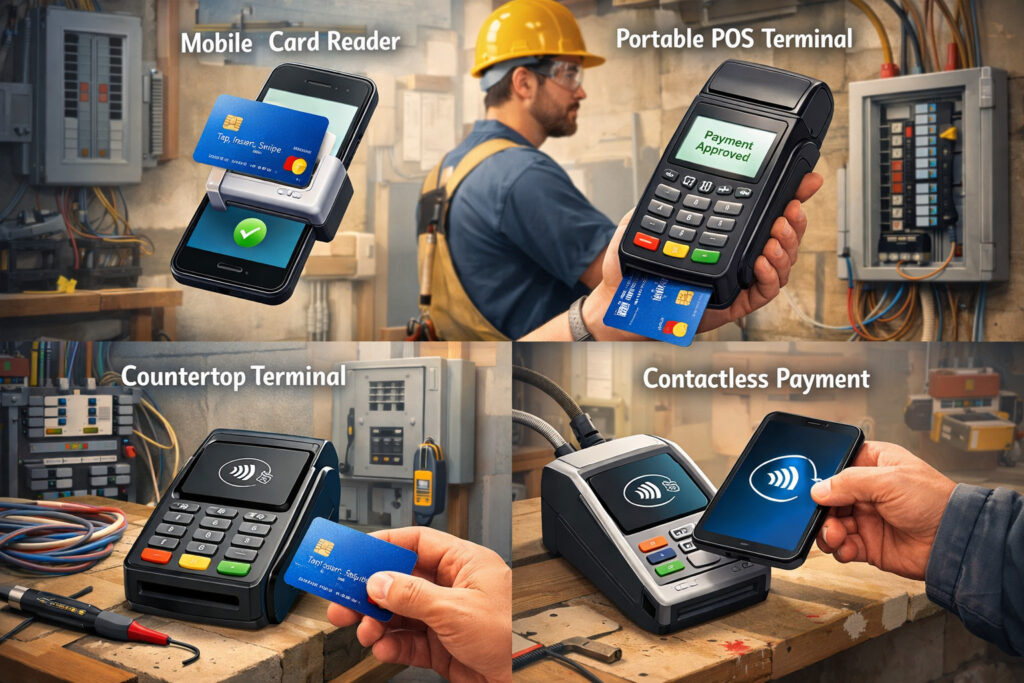
Not every electrical business needs the same kind of payment hardware. A solo electrician handling residential service calls may need a compact reader that fits in a pocket and pairs with a phone.
A larger contractor with dispatch, project managers, and an office billing team may need multiple device types working together. The best EMV card readers for electricians depend on how and where payment is collected.
The good news is that today’s market includes several practical options. Some are built for mobility first. Others are designed for front-desk or office use. Some smart terminals combine payment acceptance with invoicing and customer management tools.
Others are simple, durable card readers that do one thing well. The right setup often depends less on the label of the device and more on the operational role it needs to play.
Below are the main categories electrical contractors should understand before choosing a solution.
Handheld and mobile card readers for field service work
Handheld and mobile card readers are often the best starting point for service-focused electrical businesses. These devices are designed to go where the technician goes.
They may connect by Bluetooth to a phone or tablet, or they may have their own built-in screen and wireless data connection. Most modern versions support chip, tap, and magstripe acceptance in one portable format.
For electricians, the biggest advantage is obvious: you can take payment immediately after the work is complete. That works well for troubleshooting calls, minor repairs, same-day installs, maintenance visits, and residential service jobs.
Instead of sending an invoice and hoping for quick payment, the technician can close out the visit on-site. This improves cash flow and reduces follow-up.
That said, not every mobile device is equally practical. Battery life matters. Screen readability matters. Connectivity matters. So does how well the reader works with your invoicing and field service tools. The best mobile card readers for electricians feel durable, quick to use, and easy for techs to learn without adding friction to the job.
Countertop terminals and office-based payment devices
Some electrical contractors still collect a significant share of payments through the office. That may include customer deposits, final project payments, scheduled billing calls, or in-person transactions at a service counter. In those cases, countertop terminals still have a place.
A countertop terminal is typically more stable than a mobile unit and may offer a larger screen, printed receipt options, and stronger always-on connectivity.
It works well when office staff regularly take payments or when a customer comes in to settle an account. These EMV payment terminals for electrical contractors are also useful as a backup if field devices are unavailable or if a payment needs more hands-on review.
Office-based terminals are not as flexible for field collection, but they can strengthen the overall payment system when paired with mobile options.
For example, techs may use portable readers for jobsite payments while the office uses a countertop unit for deposits and account management. That blended setup is common in growing electrical companies.
Smart terminals and integrated field payment devices
Smart terminals sit somewhere between a traditional reader and a broader business tool. They often include touchscreen interfaces, app support, wireless connectivity, digital receipts, customer prompts, and integrations with business software.
Some are part of field service platforms that connect estimates, work orders, invoices, and payments in one system.
For electrical contractors, integrated field payment devices can be especially valuable when workflow consistency matters. A technician can complete the job, review the invoice, take a signature, process the card, and issue a receipt all from one device.
That kind of all-in-one flow helps reduce errors and shortens the time between work completion and payment collection.
These devices are often a strong fit for growing service teams and multi-tech operations that want tighter visibility into who collected what, when it was collected, and how it flows into accounting. They may cost more than simple readers, but the efficiency gains can make them worthwhile when transaction volume and team size increase.
Key Features to Look for in an EMV-Enabled Card Reader
Choosing a terminal is not just about whether it says “EMV.” Electrical contractors need to look at the full set of features that affect daily use.
A card reader that works well in a retail checkout lane may not be the right match for service work in basements, rooftops, utility rooms, unfinished spaces, and customer driveways. The most useful payment hardware for field service businesses is designed around real operational conditions, not just payment acceptance.
That means focusing on the details that influence speed, reliability, and technician adoption. The device should fit your workflow, not force your team into a more complicated process. It should also support the payment experience your customers expect now, including tap-to-pay and digital receipt delivery.
When reviewing EMV-enabled card readers for contractors, pay close attention to the features below.
Payment acceptance methods, mobility, and battery performance
At a minimum, most electrical businesses should look for a device that accepts chip cards, contactless payments, and magstripe fallback. Chip acceptance handles standard EMV card transactions.
Contactless support gives customers the option to tap a card or phone. Magstripe fallback provides a backup path when needed, though it should not be the primary method.
Mobility is just as important. Portable payment terminals for service businesses need to be easy to carry and simple to activate at the point of service. If the reader requires too many steps or depends on fragile connections, technicians may stop using it consistently.
A strong mobile workflow usually includes quick pairing, stable connection options, and a clear interface.
Battery life is another major consideration. An electrician may be in the field for a full day with limited charging opportunities. A device that dies midway through service calls creates frustration and delays collections.
Look for readers that can hold up through a normal shift and recharge quickly between jobs. Ruggedness also matters if the device will live in vans, tool bags, or active jobsite environments.
Receipts, reporting, integrations, and business controls
The payment does not end when the card is approved. Electrical contractors also need to think about what happens after the transaction.
Can the device send a digital receipt by text or email? Can it print one if needed? Does the payment sync cleanly with invoicing, field service software, or accounting tools? These post-transaction details have a big effect on office efficiency.
Reporting tools are especially helpful for growing teams. Owners and managers should be able to see which technician took payment, how much was collected, what type of transaction it was, and whether the payment has settled. Good reporting also makes it easier to handle disputes, confirm deposits, and understand revenue trends.
Some businesses may also want specific controls, such as tipping settings, custom itemization, taxes, or customer signature capture.
Tipping may be unnecessary for many electrical contractors, but some service companies prefer the option to disable or customize prompts to avoid confusion. The goal is to choose credit card machines for electricians that support the way your company actually bills and gets paid.
How to Choose the Right Card Reader for an Electrical Contracting Business
The best card reader for an electrical business is the one that fits how your jobs are sold, completed, billed, and closed out. That sounds obvious, but many contractors choose payment hardware based on general popularity rather than specific workflow needs. A device can look impressive in a demo and still be a poor fit for real field use.
Start by mapping out how payment happens in your company today. Do most customers pay at the end of a service call? Do you collect deposits before work begins? Are technicians expected to request payment on-site, or does the office follow up later? Do you handle mostly residential work, project-based commercial jobs, or a mix of both? Your answers will point toward the kind of reader and payment setup that will work best.
EMV-compliant card readers for electrical contractors should support your most common payment moments first. From there, you can build around edge cases and growth plans.
Choosing based on job type, service model, and team size
Solo electricians often need simplicity more than anything else. A compact mobile reader that supports chip and tap, works with a phone, and connects to invoicing may be enough. The main priorities are low friction, portability, and fast payment collection after each call.
A growing service company may need something more structured. If multiple technicians are taking payments, you need visibility, consistency, and easier reconciliation.
In that case, smart terminals or integrated field payment tools may make more sense. These options can help standardize the payment process across the team and reduce confusion about who collected what.
For larger electrical contractors or multi-tech field service teams, scalability becomes a bigger issue. Device management, user permissions, reporting, and software integration matter much more at that stage.
The goal is not just to accept cards, but to build a repeatable payment system that works across service calls, jobsite visits, office billing, and final invoicing.
Choosing based on connectivity, office workflow, and future growth
Connectivity is one of the most overlooked issues when evaluating card processing equipment for contractors. Some electricians work in locations with weak cellular service, limited Wi-Fi, or intermittent signal.
If that describes your service area, you need to ask hard questions about how the reader behaves when coverage is poor. Some devices handle this better than others.
Office workflow also matters. If a large share of your payments still passes through invoicing, your card reader should complement that process rather than compete with it.
For example, your business may use mobile readers for same-day collections and invoice links for bigger project balances. In that case, it helps if both payment channels live within one reporting environment.
Future growth should stay in the picture too. A cheap device may look appealing now, but if it cannot support more users, more vehicles, or more integrated workflows later, you may outgrow it quickly.
The right payment hardware for electrical businesses should work now and still make sense as your company adds technicians, dispatch complexity, and volume.
Common Setup and Usage Challenges
Even the best hardware can become frustrating if setup is rushed or the workflow is unclear. Payment devices tend to look simple from the outside, but adoption problems usually come from process gaps rather than the terminal itself.
Electrical contractors often discover that the hardest part is not buying a reader. It is making sure the team uses it correctly, consistently, and confidently in real job conditions.
Some challenges are technical. Connectivity issues, software compatibility problems, and device replacements can interrupt payments if there is no backup plan. Other challenges are operational.
A technician may forget to charge the device, fail to request payment before leaving the site, or skip the chip process and default to swipe too often. These issues are common, but they are also manageable with the right planning.
If you treat your EMV credit card readers for electricians as business infrastructure instead of side equipment, setup tends to go much more smoothly.
Training, software compatibility, and technician adoption
Technician adoption matters more than many owners expect. A card reader may check every box on paper, but if the field team finds it awkward or slow, usage drops. That leads to workarounds such as taking card numbers verbally, sending invoices later for jobs that should have been closed on-site, or relying too heavily on office follow-up.
Training should cover more than button pushing. Techs need to understand when to ask for payment, how to guide a customer through insert or tap, when magstripe fallback is acceptable, how to issue receipts, and what to do if the reader fails. A short, clear workflow is usually better than a long manual. Consistency is the real goal.
Software compatibility is another common challenge. If the reader does not sync properly with your invoicing, dispatch, or accounting tools, office staff may end up doing manual cleanup.
Before rolling out a device, test how the full payment path works from the field through settlement and reconciliation. That is where many setup mistakes surface.
Device costs, fees, replacements, and connectivity issues
Electrical contractors should also plan for the practical side of ownership. That includes device cost, transaction fees, accessory costs, and replacement cycles.
A payment terminal that travels in a service van and moves through active work environments will eventually need maintenance or replacement. Treat that as normal planning, not as a surprise expense.
Transaction fees matter, but they should be evaluated in context. The lowest rate is not always the best value if the reader is unreliable or creates more unpaid invoices. A slightly more expensive setup may still be the better business decision if it improves same-day collections and reduces administrative time.
Connectivity issues deserve a clear backup plan. If a technician reaches a property with weak signal, what happens next? Can the payment be retried later? Is there an approved invoice alternative? Can the office complete the payment securely after the visit?
Electrical businesses that think through those situations ahead of time tend to collect more efficiently and avoid awkward conversations with customers.
Best Practices for Accepting EMV Payments in the Field
Field payment success is about more than carrying a device. It depends on timing, communication, and consistency.
Electrical contractors who collect cards efficiently in the field usually follow a repeatable process that feels natural to both the technician and the customer. They do not wait until the end of a stressful interaction to improvise the payment step.
One of the best habits is to set expectations early. If a service call is likely to end with on-site payment, mention that before or during the work. Customers generally appreciate knowing what to expect.
It removes surprise and makes it easier to transition into payment when the job is done. This is especially useful for residential service work, emergency repairs, and smaller commercial calls where same-day payment is common.
Using contactless card readers for electricians and other portable devices in a professional way also means being prepared. Devices should be charged, updated, and ready to use before the tech arrives on-site. When payment tools are treated like any other essential field equipment, collections tend to improve.
How to handle the customer payment moment professionally
The customer payment moment should feel like a normal final step, not an uncomfortable request. Once the work is complete, the technician can review what was done, confirm the total, answer any final questions, and then present the reader clearly. A simple, confident handoff matters.
Customers should be guided toward the correct payment method. If the device accepts chip and tap, let them know those options first. If they attempt to swipe a chip card out of habit, the technician should know how to redirect them without sounding uncertain.
That small detail helps reinforce that your company uses secure payment terminals for electrical businesses in a deliberate, professional way.
Receipt delivery should also be part of the process. Ask whether the customer prefers a text or email receipt and make sure it is sent before leaving the property. That reinforces trust and gives the customer immediate documentation for their records.
Security and operational habits that protect the business
A few basic habits go a long way in protecting both the business and the customer. Devices should stay in company control, not be left loose in trucks without care. Access should be limited to authorized users. Lost or damaged devices should be reported quickly and replaced through an established process.
It is also wise to standardize how technicians handle unusual situations. For example, if the device cannot connect, the team should know whether to retry, switch networks, use an invoice link, or involve the office.
If a customer wants to pay with a damaged chip card, the technician should understand when magstripe fallback is acceptable and how to document the transaction properly.
For electrical contractors, payment best practices are part of broader jobsite professionalism. The smoother and more secure your payment routine is, the more confidence customers place in the rest of your operation.
How EMV Card Readers Fit Into a Complete Payment Workflow
A card reader is important, but it is only one part of a healthy payment system. Electrical contractors often accept money through several channels: on-site card payments, emailed invoices, ACH transfers, deposits before work begins, and occasional stored payment methods for repeat clients.
The goal is not to force every customer into one method. It is to build a payment workflow that makes sense for different job types while staying consistent and secure.
EMV-compliant card readers for electrical contractors play a major role in that system because they handle the immediate, in-person payment scenario better than most alternatives.
When the work is done and the customer is present, a chip or tap transaction is often the fastest way to close out the job. But for larger projects, scheduled draws, and office-managed billing, invoices and ACH may still be the better choice.
The smartest payment strategy usually combines both. You use the card reader where speed and convenience matter most, while maintaining other options for larger balances and more formal billing situations.
Combining card readers with invoices, ACH, and stored payments
Invoices are still essential for many electrical businesses. Large installs, phased work, tenant improvement projects, and commercial accounts often require a documented billing process rather than immediate point-of-service collection. In those cases, your card reader should work alongside your invoicing system, not replace it.
ACH can also be a strong fit for higher-value payments where customers prefer bank transfer over card acceptance. Some contractors encourage ACH for larger balances while keeping card readers available for deposits, service calls, and urgent work. That combination gives flexibility without making the workflow confusing.
Stored payment methods may be useful for recurring maintenance clients, property managers, or service agreement customers. If your business uses them, the supporting process should be clear, authorized, and easy to track.
The benefit of a complete payment workflow is that every payment channel has a role. Credit card machines for electricians are one part of that bigger strategy, but often a very important one.
Building a payment system for solo electricians and multi-tech teams
For a solo operator, the payment workflow can be relatively simple. You may use one mobile reader, one invoicing platform, and one bank deposit process. The biggest win is reducing delays between finishing work and getting paid. In that environment, a compact, dependable reader paired with digital invoices may be enough.
For growing businesses, the system needs more structure. Multiple technicians taking payments means you need user-level visibility, standardized receipts, and better reporting. At that stage, integrated field payment devices become more valuable because they help connect work orders, invoices, and collections in one process.
For multi-tech teams, the focus should be on consistency and oversight. Every technician should know when to collect, how to present the device, what to do if the signal fails, and how payments appear in the system afterward. This is where payment hardware for field service businesses becomes operational infrastructure rather than just checkout equipment.
Frequently Asked Questions
Q.1: Do electrical contractors really need EMV-compliant card readers?
Answer: Yes, for most electrical service businesses, EMV-compliant card readers are a smart baseline. If you accept cards in person, a chip-capable reader supports a more secure and modern payment process than a swipe-only device.
It also helps customers feel more comfortable paying on-site because the transaction method matches what they are used to seeing elsewhere.
For electricians who mainly invoice customers, an EMV reader can still be valuable for deposits, service calls, and final payments collected at the job location. It is not the only payment tool you need, but it is often a core part of a more complete setup.
Q.2: What is the difference between EMV, contactless, and magstripe payments?
Answer: EMV refers to chip card acceptance through a compatible reader. The customer inserts the card, and the chip is used to process the transaction. Contactless payments let the customer tap a card or phone on the device instead of inserting it.
Magstripe payments happen when a card is swiped using the stripe on the back. That method is older and is often kept as a fallback for cases where the chip cannot be read. For most electrical businesses, chip and tap should be the primary methods, while magstripe should be used only when necessary.
Q.3: Are mobile card readers a good fit for electricians?
Answer: In many cases, yes. Mobile card readers for electricians are often an excellent fit because they support payment collection at the point of service. That is helpful for residential visits, repair calls, maintenance work, and smaller commercial jobs where same-day collection improves cash flow.
The best mobile setup depends on how you work. Some contractors prefer a simple reader paired with a phone, while others want a smart terminal with built-in connectivity and a screen. The right choice comes down to mobility, ease of use, and integration with the rest of your payment tools.
Q.4: Can EMV card readers work in places with weak internet or cellular service?
Answer: Some do better than others, but connectivity should always be tested before full rollout. Electrical contractors often work in locations where signal is inconsistent, including mechanical rooms, remote properties, basements, and unfinished buildings. If your team regularly faces those conditions, connectivity should be a top selection factor.
It is also wise to define a fallback process. That might mean retrying the transaction in a better signal area, sending an invoice link, or completing payment through the office using an approved workflow. The point is to plan for weak connectivity before it causes field frustration.
Q.5: What features matter most in EMV card readers for electricians?
Answer: The most important features usually include chip acceptance, contactless support, battery life, portability, digital receipt options, and software compatibility. For many electrical contractors, ruggedness and reliable mobile connectivity matter just as much as payment acceptance itself.
Reporting tools are also useful, especially for businesses with multiple technicians. The easier it is to trace payments by user, job, and date, the easier it becomes to manage the office side of collections and reconciliation.
Q.6: Should a growing electrical company use one type of reader or multiple types?
Answer: Many growing businesses benefit from using more than one type. A portable reader or smart terminal may be ideal for field technicians, while a countertop device works better in the office for deposits, call-in payments, or backup use. Trying to make one reader handle every possible scenario can create unnecessary friction.
A blended setup often gives electrical contractors more flexibility while keeping the payment process consistent. The key is to make sure all devices support the same broader workflow and reporting environment whenever possible.
Q.7: Do EMV-enabled card readers replace invoices and ACH payments?
Answer: No, and they do not need to. EMV-enabled card readers for contractors are most useful for in-person collections and immediate payment moments. Invoices and ACH still play an important role, especially for larger projects, progress billing, and office-managed accounts.
The strongest payment strategy usually includes multiple options. Card readers help you capture money quickly in the field, while invoices, ACH, and stored payment methods support the broader needs of your customer base and billing process.
Conclusion
The right payment hardware does more than accept cards. It helps electrical contractors get paid faster, reduce avoidable friction, and deliver a more professional customer experience at the end of every job. That is why EMV-compliant card readers for electrical contractors deserve careful consideration rather than a quick, price-only decision.
At the most practical level, EMV support means your business is equipped to accept chip cards in a more secure way. In many cases, it also means you can accept tap-to-pay transactions that customers increasingly expect.
For electricians working in the field, that combination can improve collections, reduce payment delays, and create a smoother handoff when the job is done.
The best choice depends on how your business operates. Solo electricians may do well with a compact mobile device that pairs with invoicing tools.
Growing service companies may benefit from smart terminals or integrated field payment devices that create more structure and visibility. Larger teams often need a broader system that connects technicians, office staff, and reporting.
As you compare EMV card readers for electricians, focus on the factors that matter in real use: chip and contactless acceptance, battery life, durability, connectivity, receipt options, software compatibility, reporting, and ease of use in the field.
Think about where payment happens most often, what causes delays today, and how the device will fit into your larger payment workflow alongside invoices, ACH, and office billing.
A reliable card reader will not solve every payment challenge on its own. But the right setup can make your business easier to run, easier to pay, and easier for customers to trust. That is what makes a strong EMV payment terminal not just a payment tool, but an operational advantage for a modern electrical contracting business.