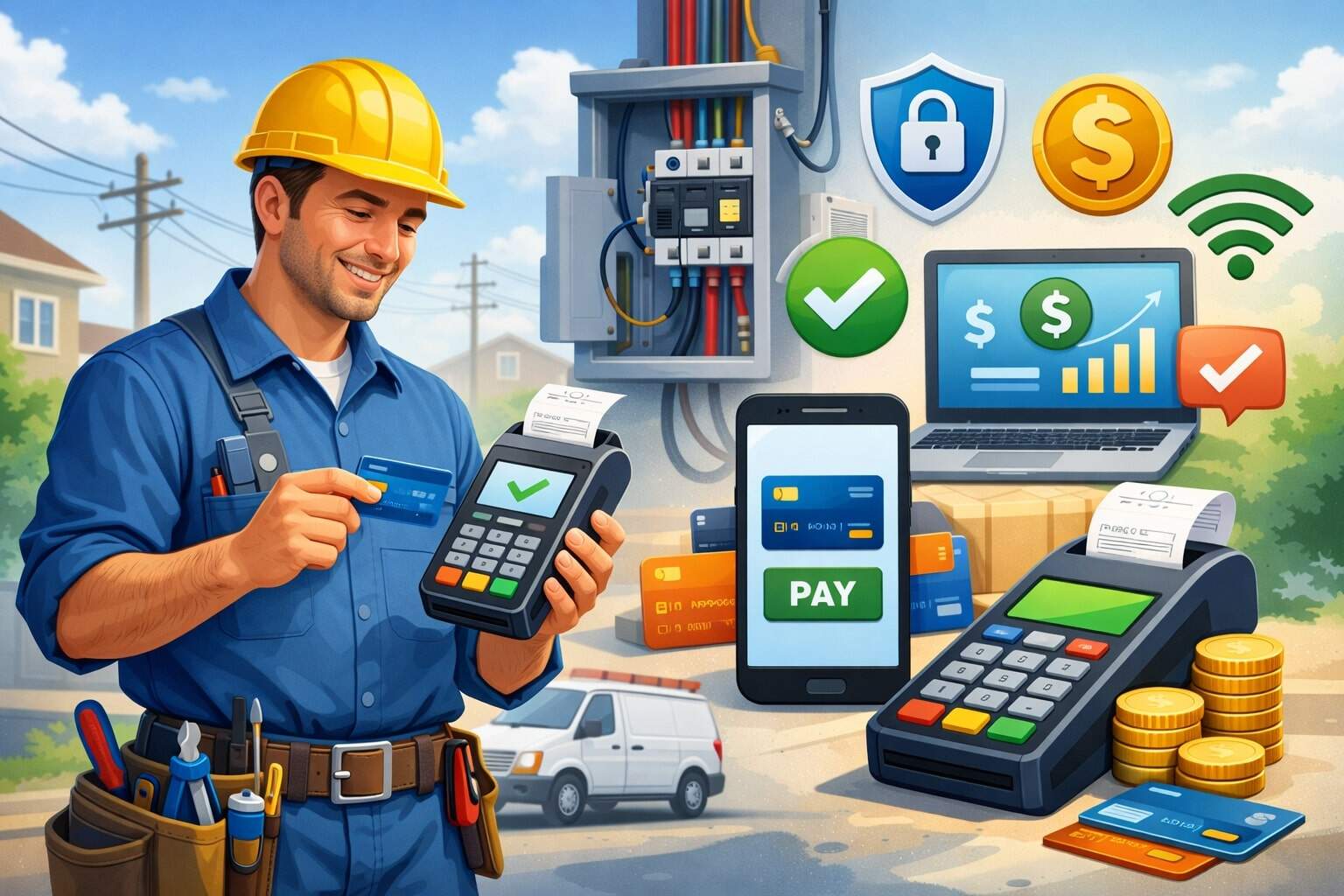
Running a service business in the field means you win jobs by showing up fast, doing clean work, and making it effortless for customers to pay. That’s exactly why credit card processing for electricians has become a must-have instead of a “nice to have.”
Customers increasingly expect to tap a card or phone the moment the work is finished, whether you’re replacing a panel, troubleshooting a breaker, or installing EV charging equipment. When you make payments convenient, you get paid faster, reduce awkward collection follow-ups, and look more professional.
But credit card processing for electricians is not one-size-fits-all. The right setup depends on your average ticket size, how often you take deposits, how many technicians you dispatch, and whether you bill on-site, by invoice, or both.
It also depends on how you want fees handled, what hardware you prefer, and how you’ll protect customer data while staying compliant with current security standards. The goal isn’t just “accept cards.” The goal is to build a payment system that supports growth, reduces risk, and improves cash flow.
This complete guide breaks down how credit card processing for electricians works, what it costs, how to choose the right provider, and how to future-proof your setup with modern tools like contactless acceptance, digital invoicing, and phone-based tap payments.
Along the way, you’ll also see practical tips to minimize chargebacks, streamline accounting, and create a smoother customer experience from estimate to final payment.
Why Credit Card Processing for Electricians Matters in the Field

Electricians often work in time-sensitive situations: no power, safety issues, failed inspections, or urgent upgrades. In those moments, customers want the fastest path to “problem solved,” and payment is part of that experience.
Credit card processing for electricians lets you collect payment immediately after the job, instead of waiting for checks, chasing transfers, or sending multiple reminders. Faster payment cycles can be the difference between stable cash flow and constantly feeling behind on payroll, fuel, and material costs.
There’s also a trust factor. A professional payment experience—clearly itemized invoice, secure card acceptance, emailed receipt—signals that your business is legitimate and organized.
Customers are more comfortable approving additional work when the billing process is clear and modern. That can raise your average ticket size over time, especially when you offer options like deposits for scheduled projects, partial payments for phased work, or card-on-file for maintenance plans.
Finally, customer preferences have shifted hard toward contactless and digital wallets. Phone-based payments and tap-to-pay are now common expectations, and many small businesses can accept contactless payments with only a smartphone through supported payment apps.
Apple describes “Tap to Pay on iPhone” as a way to accept contactless cards and digital wallets using only an iPhone and a payment app, without extra hardware. That kind of mobility is a major advantage for field technicians and service vans, and it’s becoming an important part of credit card processing for electricians going forward.
The real cost of slow payments and manual collections
When you don’t take payment on-site, you create a chain of delays: invoice creation, delivery, customer attention, approval, and then the actual payment step. Each delay increases the odds that the invoice gets forgotten, disputed, or pushed to “later.”
For service work, “later” can turn into 30–60 days, which is brutal when you’re buying wire, breakers, conduit, and tools every week. Credit card processing for electricians shortens that chain to one step: swipe, tap, or keyed entry with a receipt.
Slow collections also increase admin workload. Office staff spend time calling, emailing, re-sending invoices, and reconciling partial payments.
For owner-operators, that workload lands on you after hours. A streamlined card acceptance workflow reduces that overhead and gives you better visibility into daily revenue. You can finish a job, take payment, and move on.
There’s a hidden brand cost too. Customers remember friction. If paying you feels inconvenient compared to other contractors, it can affect reviews and referrals. In competitive areas, convenience is a serious differentiator.
Done right, credit card processing for electricians becomes part of your customer service, not just a back-office function.
How card acceptance improves close rates and average ticket size
On-site card acceptance changes the psychology of approvals. When a customer knows they can pay instantly, they’re more likely to say yes to recommended upgrades—surge protection, dedicated circuits, panel labeling, or replacing unsafe components.
This is especially true when you can present options in a clean estimate format and take a deposit immediately. Credit card processing for electricians supports a smoother “estimate → approve → pay” flow.
It also helps with larger projects. Many customers prefer credit cards for big-ticket work because of rewards points, purchase protections, and budgeting flexibility. If your business can handle higher tickets reliably, you’ll close more of the profitable jobs.
The key is having a processing setup that supports higher authorization amounts, uses secure methods, and reduces declines.
Recurring revenue is another major opportunity. Maintenance agreements, service plans, and periodic inspections become easier when you can store a customer payment method securely (through tokenization) and bill on schedule.
That turns unpredictable income into steadier monthly revenue and makes your business more valuable over time. In short, credit card processing for electricians can directly support growth when you treat it as part of your sales and service workflow.
How Credit Card Processing for Electricians Works
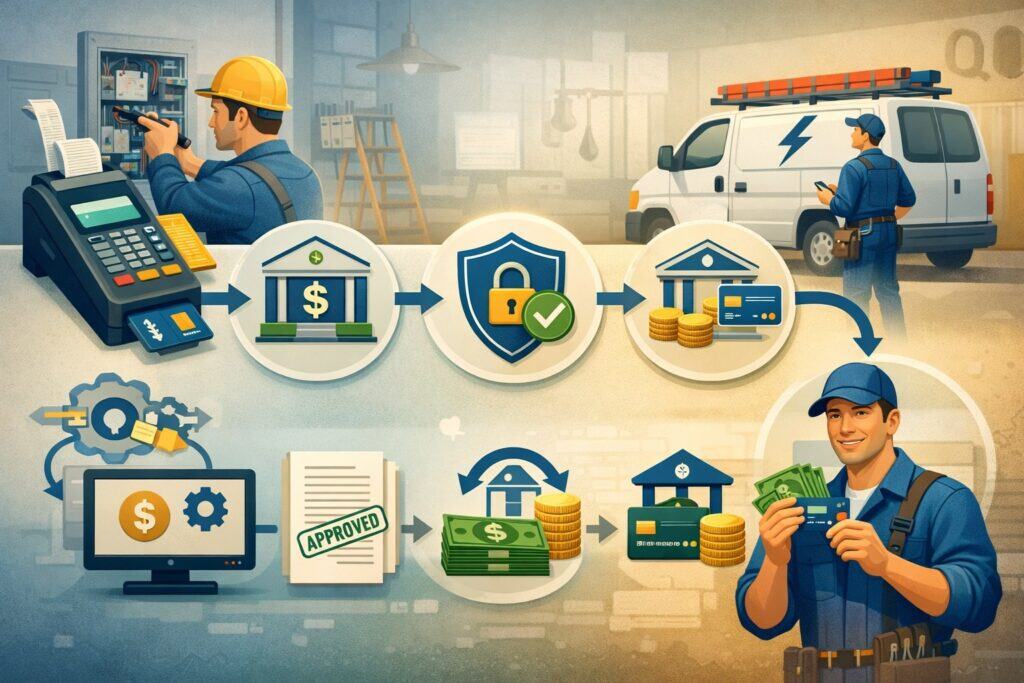
At a practical level, credit card processing for electricians is the set of tools and agreements that let you accept card payments and deposit funds into your business bank account.
Under the hood, it’s a network of parties: the customer’s card brand, the issuing bank, the acquiring bank (your processor’s bank partner), and the payment processor/gateway that routes data securely. Understanding the flow helps you troubleshoot issues like declines, funding delays, and chargebacks.
When a customer pays, your system sends an authorization request. If approved, you capture the transaction (immediately or later), and the funds settle into your merchant account or payment platform balance before being deposited to your bank.
Some providers bundle everything into one platform; others separate the merchant account from the gateway and hardware. Either way, you’re paying processing fees that include interchange (set by networks), assessments, and the provider’s markup.
For electricians, the important part is matching the payment flow to your job flow. Do you take deposits for scheduled work? Do you invoice after completion? Do you need multiple users and permissions for a crew? The best credit card processing for electricians setup supports your real workflow, not the other way around.
The payment flow: authorization, capture, settlement, funding
Authorization is the “approval check.” It verifies available credit and basic risk signals. Capture is when the authorized transaction is finalized for settlement.
Settlement is when transactions are grouped and sent through networks to transfer funds. Funding is when your provider deposits money into your bank account, often on a predictable schedule.
Electricians should care about timing. Some systems fund in one to two business days, while others offer faster funding for a fee. Weekend and holiday timing can affect deposits, which matters if you run payroll weekly or buy materials frequently.
If you do emergency calls, you may also care about late-night authorizations and how quickly those payments become usable funds.
You also need to understand “card-present” versus “card-not-present.” Card-present (tap, chip, swipe) is typically lower risk than keyed-in payments, and it usually has lower overall costs and fewer disputes.
If you invoice and take payments remotely, you’ll do more card-not-present transactions, so credit card processing for electricians should include strong tools like secure payment links and customer authentication options where available.
Merchant accounts vs all-in-one payment platforms
Some providers give you a dedicated merchant account underwritten for your business. Others offer an all-in-one payment platform where you sign up quickly and start taking payments with minimal setup. Both approaches can work for credit card processing for electricians, but the best choice depends on scale and needs.
All-in-one platforms are often fast to deploy and simple for solo electricians. They may include a mobile reader, app-based invoicing, and basic reporting.
For small volumes, convenience can outweigh everything else. The tradeoff can be less customization, more standardized pricing, and sometimes stricter risk controls that can hold funds if transactions change suddenly.
Dedicated merchant accounts can offer more tailored pricing, stronger support for higher volumes, and more stable long-term relationships. They’re often preferred when you have multiple techs, larger tickets, or consistent monthly volume.
The underwriting process may take longer, but you can get a setup that fits your business and grows with you. In either case, credit card processing for electricians should include clear terms for funding, chargebacks, and equipment.
Pricing Models and What Credit Card Processing for Electricians Really Costs
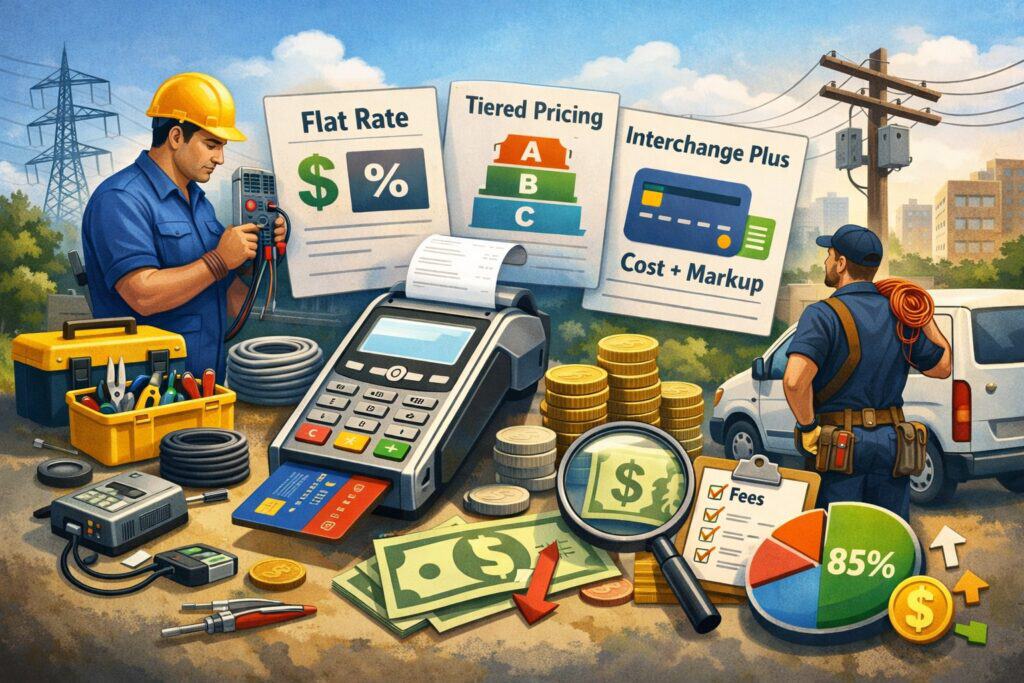
Fees are where many electricians get burned—not because processing is “a scam,” but because pricing can be confusing.
Credit card processing for electricians usually includes a mix of non-negotiable costs (interchange and network assessments) plus negotiable provider markup. The way those costs are presented depends on your pricing model.
You’ll commonly see interchange-plus, flat-rate pricing, or tiered pricing. Interchange-plus is often the most transparent because you see the base cost plus a consistent markup.
Flat-rate is simple and predictable, but it can cost more at higher volume. Tiered pricing is the hardest to evaluate because categories can be vague, and many transactions end up in expensive tiers.
Electricians also need to pay attention to “hidden” costs: monthly minimums, gateway fees, statement fees, batch fees, PCI fees, equipment leases, and chargeback fees. The best credit card processing for electricians solution gives you a full, readable fee schedule—and support that explains it in plain language.
Interchange-plus vs flat-rate vs tiered pricing
Interchange-plus pricing typically looks like “interchange + X% + $Y.” Interchange changes based on card type, method (tap/chip vs keyed), and other factors. Your provider’s markup stays consistent. For many service businesses with steady volume, this model can be cost-effective and easier to audit.
Flat-rate pricing offers one simple rate for most transactions, like “X% + $Y.” It’s easy to understand and budget, which is attractive for newer businesses.
The downside is that when your actual interchange is low, you still pay the same flat rate, which can become expensive as you grow. Still, for a small team, credit card processing for electricians via flat-rate can be a smart starting point if you value simplicity.
Tiered pricing groups transactions into buckets like “qualified,” “mid-qualified,” and “non-qualified.” The problem is that many normal transactions can fall into more expensive tiers depending on how you accept the card or how data is entered.
This can make monthly costs unpredictable. If a provider pushes tiered pricing without transparency, that’s usually a sign to slow down and compare options for credit card processing for electricians more carefully.
Common extra fees electricians should watch for
Beyond the rate, read the fine print. Monthly account fees can be reasonable if they include support, reporting, or integrations. But some fees add no value. Equipment leases are a frequent trap: leasing a terminal for years can cost far more than buying it outright. If you use mobile readers, ensure replacement costs are clear.
Gateway and virtual terminal fees matter if you take payments by invoice or phone. If you do lots of keyed-in payments (not ideal, but sometimes necessary), your costs and risk go up. Chargeback fees are another key point: even if you win a dispute, you may still pay a fee for the process.
Also ask about funding schedules and “reserve” policies. Some providers can delay or hold funds under certain risk triggers. A transparent provider will explain those triggers upfront. In short, smart shopping for credit card processing for electricians means evaluating the whole cost structure, not just the headline rate.
Choosing the Right Provider for Credit Card Processing for Electricians

The “best” processor is the one that fits how you actually operate: your ticket size, job types, customer base, and how you invoice. Credit card processing for electricians should be evaluated like a tool, not like a commodity. A cheap rate is meaningless if it causes funding delays, poor support, or awkward payment steps that slow down technicians.
Start with your non-negotiables: mobile acceptance that works reliably, easy invoicing, strong receipts, and clear reporting. Then consider growth needs: multi-user access, role permissions, multiple locations, and integrations with accounting or field service software.
If you dispatch techs, you may want each technician to accept payments under their own login with controlled permissions.
Finally, look at support. Electricians don’t have time for long ticket queues when a payment fails in a customer’s driveway. A good provider for credit card processing for electricians offers fast support, clear documentation, and practical troubleshooting.
Questions to ask before you sign a processing agreement
Ask how pricing is structured and request a full fee schedule in writing. Ask about contract length, auto-renewal, and early termination fees. If a provider won’t answer clearly, that’s a red flag. Also ask about funding timelines and whether there are circumstances where funds can be delayed.
Ask about dispute handling: how chargebacks are notified, how evidence is submitted, and what tools exist to reduce disputes. Ask about security: tokenization, encryption, and compliance support. If you’ll be taking payments through invoices, ask how payment links work and what fraud tools exist.
Also ask about your specific workflow: deposits, partial payments, refunds, tips (if applicable), and recurring billing. The best credit card processing for electricians setup supports these without awkward workarounds. Your goal is to avoid “we can do that if you manually…” answers.
What “electrician-friendly” features look like in practice
Electrician-friendly payment processing is built for field work. That means offline capability or at least reliable mobile performance, fast receipts, and simple tipping/authorization options if you do service calls. It means invoices that can be created from an estimate, signed on-site, and paid immediately.
It also means job-based reporting. You should be able to reconcile payments by technician, job type, or date range without spreadsheet chaos. If you use scheduling tools, integrations can reduce double entry and improve accuracy. Some platforms also support customer profiles and card-on-file tokens so repeat customers can pay fast.
In the future, electrician-friendly also means more phone-based acceptance. Apple notes you can accept contactless payments with only an iPhone and a supported app. That’s a big deal for technicians who don’t want extra devices to charge. Forward-looking credit card processing for electricians should keep that kind of flexibility in mind.
Hardware and Mobile Setups for Credit Card Processing for Electricians
Hardware choices can make or break your workflow. The right setup makes payment fast and professional. The wrong setup leads to dead batteries, poor connectivity, and frustrating customer interactions.
Credit card processing for electricians in the field usually relies on one of three approaches: a smartphone with a reader, a dedicated handheld terminal, or phone-based tap acceptance where the phone itself acts as the contactless reader.
Smartphone readers are common because they’re affordable and easy. Handheld terminals can be more rugged and may support receipts and cellular connections without relying on a phone. Phone-based tap acceptance can reduce gear and simplify training, as long as your device and payment app support it.
Your ideal choice depends on your environment. If you work in new construction with dust and rough conditions, ruggedness matters. If you work in residential service calls, speed and appearance matter. A thoughtful hardware plan is core to credit card processing for electricians.
Tap, chip, swipe: what you should support in 2025 and beyond
At minimum, support EMV chip and contactless tap payments. Chip reduces counterfeit fraud risk compared to swipe, and contactless is what many customers prefer. Supporting digital wallets (phone and smartwatch payments) is also important for customer convenience and perceived professionalism.
Swipe is still relevant in some scenarios, but it’s generally the weakest method from a fraud standpoint. If you can, treat swipe as a backup. Prioritize tap and chip whenever possible. If your customers commonly pay via phone, contactless acceptance becomes a competitive advantage.
Phone-based acceptance is also expanding. Apple describes Tap to Pay on iPhone as accepting contactless cards and digital wallets using only an iPhone and a payment app.
This reduces reliance on extra readers, which can simplify credit card processing for electricians for small crews. As adoption grows, customers will increasingly expect that “just tap” experience.
Reliability in the field: battery life, connectivity, and offline mode
Field reliability is about power and signal. Choose hardware with strong battery life and plan for charging in the van. If you use a smartphone + reader, ensure both devices are charged and that Bluetooth pairing is stable. If you use cellular terminals, verify coverage in your service area.
Offline mode can help if you work in basements, rural areas, or buildings with poor reception. Offline transactions carry risk because the card isn’t verified in real time. Some systems allow offline capture with limits. If you use offline mode, set clear internal rules: only for trusted customers or only under certain dollar amounts.
Also think about receipts. Email and SMS receipts are standard and reduce paper clutter. But ensure your system captures customer contact info cleanly and stores it appropriately. Reliable tools reduce friction, which is the whole point of credit card processing for electricians—get paid fast, without drama.
Invoicing, Deposits, and Remote Payments for Electricians
Not every payment happens on-site. Larger projects often require deposits, progress payments, and final balances. Service calls sometimes end with “email me the invoice,” especially for landlords or property managers. That’s why modern credit card processing for electricians must handle invoicing and remote payments just as well as tap-and-go transactions.
The best invoicing tools let you create professional estimates, convert them into invoices, accept partial payments, and send automated reminders. Payment links should be secure, mobile-friendly, and easy for customers to use without creating accounts. Receipts should be automatic and clearly itemized.
Remote payment acceptance also helps reduce scheduling friction. When you can take a deposit instantly, customers commit. That reduces last-minute cancellations and keeps your calendar healthier. Done well, invoicing becomes a profit tool, not just paperwork.
How to structure deposits and progress payments
For scheduled work, deposits protect your time and cover material costs. A common approach is to take a deposit upon approval, a second payment at a milestone (rough-in, inspection, trim-out), and the final payment upon completion.
Your credit card processing for electricians platform should support partial payments without awkward math or manual tracking.
Make deposit terms clear in your estimate: what it covers, when it’s due, and how refunds work if plans change. Clear terms reduce disputes. If customers request changes mid-project, update the invoice before collecting the next milestone payment. That transparency reduces chargeback risk.
Also consider convenience fees and surcharge/cash discount approaches carefully, because rules differ by card networks and by state. If you plan to pass fees to customers, do it with compliant signage and correct receipt labeling.
A provider experienced in credit card processing for electricians can guide you through compliant options without exposing you to unnecessary risk.
Payment links, text-to-pay, and card-on-file best practices
Payment links and text-to-pay are powerful because they fit how customers communicate. Many customers will pay instantly if you text them a link the moment the invoice arrives. Make sure your link page is branded, secure, and easy to understand. Avoid forcing customers through too many steps.
Card-on-file can be useful for repeat customers and maintenance plans, but it must be handled securely. You should never store raw card numbers yourself. Instead, use tokenization offered by your processor so the system stores a token, not the card data. This reduces your exposure and simplifies compliance.
Use confirmation messages and receipts to document customer consent. Clear documentation matters if there’s ever a dispute. Strong invoicing tools are a major reason electricians upgrade their systems, and it’s a core part of modern credit card processing for electricians.
Security, Compliance, and Risk Control in Credit Card Processing for Electricians
Taking card payments means handling sensitive financial data, even if you never “see” the card numbers. Security isn’t optional. It protects your customers, your reputation, and your ability to keep accepting cards.
Credit card processing for electricians should minimize your security burden by using encrypted devices, tokenized storage, and compliant payment apps.
A key concept is PCI DSS (Payment Card Industry Data Security Standard). PCI rules apply to businesses that accept card payments, and your responsibilities depend on how you accept cards. Using approved hardware and payment apps can drastically reduce your compliance scope.
PCI DSS v4.0 introduced future-dated requirements that become effective March 31, 2025, and the PCI Security Standards Council has emphasized organizations should adopt those requirements and be ready for that date.
For electricians, the practical takeaway is simple: use modern, supported payment solutions and avoid manual card storage or insecure processes.
PCI DSS in plain language for field service businesses
PCI compliance sounds intimidating, but for most electricians it’s manageable. If you use a reputable processor with secure hardware and you don’t store card data, your responsibilities are typically limited to completing a short self-assessment and maintaining secure business practices.
The biggest mistakes happen when businesses write down card numbers, store them in notes, or use unapproved tools for “convenience.” Don’t do that. Use tokenized card-on-file tools if needed. Keep devices updated.
Use strong passwords and multi-factor authentication on your payment and email accounts. Train technicians to avoid taking card details through insecure channels.
As PCI standards evolve, the best defense is staying within “low-scope” payment acceptance. That means using point-to-point encryption, tokenization, and hosted payment pages. With these tools, credit card processing for electricians becomes safer and simpler.
Chargebacks, fraud, and proof: how electricians can protect revenue
Chargebacks are disputes where a customer’s bank reverses the payment. Some are legitimate, many are misunderstandings, and some are fraud. Electricians can reduce chargebacks by setting expectations clearly, documenting work, and using signatures and detailed invoices.
Always provide itemized descriptions, not vague “service calls.” Note the date, location, and materials used. Take before-and-after photos when appropriate. For larger jobs, keep written change orders. If you take remote payments, keep records of invoice delivery, customer acknowledgment, and payment confirmation.
Also pay attention to transaction methods. Card-present payments (tap/chip) generally carry lower fraud risk than keyed-in transactions. If you must key in a card, use tools like AVS (address verification) and require customer confirmation.
Solid documentation is a major part of credit card processing for electricians risk control—because when disputes happen, evidence wins.
Taxes, Reporting, and Bookkeeping: Making Payments Easy to Reconcile
Payments aren’t truly “done” until they’re reconciled in your books. The more payment methods you accept, the more important clean reporting becomes. Credit card processing for electricians should support accurate transaction reporting, clear fee visibility, and exports or integrations that reduce bookkeeping time.
One topic that confuses many contractors is third-party reporting forms for payment volume. The IRS updates guidance about Form 1099-K, which relates to payment card and third-party network transactions.
In October 2025, the IRS issued Fact Sheet FS-2025-08 and a newsroom announcement (IR-2025-107) tied to updated FAQs and reporting thresholds. The practical point: keep clean records, separate business payments from personal transfers, and treat payment reports as informational—not as your full accounting system.
For electricians, the best approach is simple: reconcile deposits to invoices, track fees properly, and keep job-level notes for each payment. That’s how you stay audit-ready without stress.
Separating labor, materials, tax, and tips in your payment records
Your invoices should clearly break out labor and materials, and separately track any applicable sales tax on taxable items (rules vary by state and job type). A well-structured invoice reduces customer confusion and supports accurate accounting.
From a payment processing standpoint, make sure your receipts match your invoice totals and that partial payments are recorded correctly. If you run service calls where tips are possible (some electricians do for emergency calls), ensure tips are tracked separately and that your payroll handling aligns with your accountant’s guidance.
Also track refunds carefully. Refunds happen for overpayments, changes in scope, or customer satisfaction issues. Your credit card processing for the electrician’s system should link refunds to the original transaction so your books and customer records stay clean.
Integrating payments with accounting and field service software
If you’re using accounting software, payment integrations can save hours each month. Look for systems that sync payments, fees, and payouts automatically. If you use field service management tools for scheduling, estimates, and job notes, payment integration can reduce double entry and eliminate errors.
Even without full integrations, you can build a clean process: issue invoices from one system, accept payments through consistent methods, and reconcile deposits weekly. Make sure your payment provider offers exports that include transaction IDs, dates, customer names, and fee details.
Clean systems reduce tax-season stress. They also help you spot profitable job types and underpriced services. Over time, strong reporting turns credit card processing for electricians into a source of business intelligence, not just a way to get paid.
Future Trends and Predictions for Credit Card Processing for Electricians
Payments are evolving quickly, and electricians benefit when they adopt tools that reduce friction and improve security. The biggest trend is the continued rise of contactless payments and phone-based acceptance.
Apple highlights that Tap to Pay on iPhone allows businesses to accept contactless payments with only an iPhone and a payment app. That’s a major shift because it lowers hardware barriers for small crews and makes it easier to equip every technician.
On the broader industry side, major networks and research firms expect continued innovation in digital security, real-time payment experiences, and new ways to authenticate transactions. Mastercard’s published outlook on payment trends for 2025 and beyond emphasizes ongoing transformation in how people pay and how security evolves with technology.
Capgemini’s payments trend reporting has also discussed developments like biometric payments in retail contexts, signaling a wider move toward new authentication methods. While electricians won’t adopt every trend immediately, these shifts influence the tools your customers expect and the security standards processors will require.
For credit card processing for electricians, the future is likely to be more mobile, more software-driven, and more integrated with your scheduling and invoicing systems.
What to expect next: phone-as-terminal, better fraud tools, faster funding
“Phone as terminal” acceptance is a practical upgrade: fewer devices to buy, charge, and replace. As more payment apps support phone-based tap acceptance, technicians can accept payments with the device they already carry. This improves closeout speed and reduces the “I forgot the reader” problem.
Fraud tools will also improve, especially for remote payments. Expect more behind-the-scenes risk scoring, better detection of suspicious behavior, and smoother customer verification that doesn’t feel like friction. For electricians who invoice landlords, property managers, and repeat customers, better fraud tools reduce chargebacks and payment failures.
Faster funding options will likely expand too. Many providers already offer faster deposit choices, and competition tends to push funding speed forward. The key is balancing speed with reasonable costs and stable risk policies. Forward-looking credit card processing for electricians will give you flexible funding without unpleasant surprises.
How to future-proof your electrician payment setup
Future-proofing is less about chasing every new gadget and more about choosing flexible systems. Pick a provider that supports multiple acceptance methods: tap/chip/swipe, invoices, payment links, and phone-based acceptance where available. Use software that updates regularly and hardware that meets modern security requirements.
Keep your compliance posture “low scope” by avoiding card storage and using tokenized tools for recurring billing. Follow PCI guidance and pay attention to major compliance deadlines.
The PCI Security Standards Council has clearly noted new PCI DSS v4.0 requirements become effective after March 31, 2025. Staying current protects your ability to accept payments reliably.
Finally, build payments into your workflow: deposits, change orders, receipts, and follow-ups. When payment is a smooth part of the job, you look more professional and you get paid faster. That’s the real future of credit card processing for electricians: less friction, more trust, and better cash flow.
FAQs
Q.1: What is the best credit card processing for electricians who do mostly service calls?
Answer: For service calls, the best credit card processing for electricians is usually the setup that lets you accept payments instantly on-site with minimal steps. That typically means a mobile app with contactless support, quick invoice creation, and the ability to send receipts by text or email.
Since service calls often happen in driveways, basements, and tight spaces, reliability matters as much as price. Look for a system that works well on cellular data, has strong battery performance, and supports tap/chip payments to reduce declines and disputes.
Service-call electricians also benefit from features like saved customer profiles, job notes, and fast refunds if needed. Because the work can be urgent, you don’t want to lose time on payment friction at the end of the job.
A phone-based tap option can also be attractive because it reduces extra hardware. Apple describes Tap to Pay on iPhone as accepting contactless payments using only an iPhone and a payment app. If your chosen provider supports that, it can simplify day-to-day operations for a small crew.
The final factor is support. When a payment fails in front of a customer, fast help matters. For most service-call teams, the “best” credit card processing for electricians is the one that balances speed, reliability, and simple invoicing—not just the lowest advertised rate.
Q.2: Can electricians pass credit card fees to customers?
Answer: In many areas, electricians can use compliant methods to recover some card acceptance costs, but rules vary by card brand requirements and by state.
The safest approach is to use a provider that offers compliant surcharge or cash-discount programs and provides correct receipt language and signage guidance. Doing this incorrectly can create customer complaints, disputes, or compliance problems.
If you want to recover fees, focus on transparency. Customers should see the price clearly before they pay, and the receipt should reflect the correct labeling. For invoice payments, the fee disclosure should appear before the customer submits the payment. For on-site payments, signage and verbal confirmation help avoid misunderstandings.
Because compliance details can change and vary locally, treat this as a policy decision and get professional guidance from your payment provider and your legal/tax advisors.
The goal is to keep credit card processing for electricians smooth and professional while staying within applicable rules. A rushed or unclear fee strategy can cost more in lost trust than it saves in processing costs.
Q.3: Do I need a PCI compliance program for credit card processing for electricians?
Answer: If you accept card payments, PCI DSS applies in some form. The good news is that most electricians can keep PCI responsibilities simple by using approved, secure payment tools and avoiding any storage of card data.
Modern payment providers use encryption and tokenization so you don’t handle sensitive card data directly, which reduces your compliance burden.
PCI DSS v4.0 has future-dated requirements that become effective after March 31, 2025, and the PCI Security Standards Council has highlighted that organizations should adopt and be ready for those requirements.
For electricians, the practical move is to stay on updated apps, keep devices secure, and complete the self-assessment your provider requires. Also use strong passwords and multi-factor authentication on payment dashboards.
So yes, PCI matters, but it doesn’t have to be scary. The simplest strategy for credit card processing for electricians is to choose reputable tools and keep your processes clean: no written card numbers, no storing cards in notes, and no unapproved “quick fixes.”
Q.4: How fast will I get paid with credit card processing for electricians?
Answer: Funding speed depends on the provider, your bank, and your processing history. Many providers deposit funds in one to two business days for standard funding, while some offer faster funding options for an additional fee.
Weekends and holidays can delay deposits. If you run a busy service schedule, you should evaluate funding speed carefully because cash flow affects payroll, fuel, and supply purchases.
Also understand that some providers apply risk controls that can delay certain transactions—especially if ticket size changes abruptly or volume spikes. This is more likely when a business is new, when transactions are unusually large, or when patterns change quickly. A transparent provider will explain funding policies upfront.
If fast access to funds is critical, ask about same-day or next-day funding options and what the requirements are. The right credit card processing for electricians setup should match your cash flow needs without creating unpredictable holds.
Q.5: Is Tap to Pay on a phone a good option for electricians?
Answer: For many electricians, phone-based tap acceptance is a strong option because it reduces gear. Instead of carrying a separate reader, you can accept contactless payments using a compatible phone and a supported payment app.
Apple explains that Tap to Pay on iPhone allows acceptance of contactless cards and digital wallets using only an iPhone and an enabled payment app. That’s convenient for technicians who already carry a phone on every call.
The main considerations are compatibility, customer preference, and backup options. You’ll want to confirm your payment provider supports phone-based tap, that your technicians’ devices are compatible, and that you have a fallback method if a phone battery dies or signal is weak.
Also consider job environments—construction sites can be tough on devices, so protective cases and charging habits matter.
As contactless expectations grow and tools improve, phone-based acceptance will likely become an even bigger part of credit card processing for electricians. For many teams, it’s a practical upgrade—especially when combined with invoicing and payment links for customers who prefer to pay remotely.
Conclusion
A strong payment setup is one of the simplest ways to make your business run smoother. Credit card processing for electricians isn’t only about accepting cards—it’s about getting paid faster, reducing admin work, and delivering a more professional customer experience.
When customers can tap, chip, or pay from an invoice link without friction, you shorten the time between “job done” and “money in the bank.”
The best approach is to match your tools to your workflow: mobile acceptance for service calls, invoicing for scheduled projects, deposits for calendar protection, and clean reporting for bookkeeping.
Watch pricing models carefully, avoid confusing contracts, and choose hardware that works reliably in the field. Keep security simple by using modern, compliant tools and avoiding any storage of card data.
Looking ahead, the payment experience will keep getting more mobile and more software-driven. Phone-based acceptance is becoming more practical for small teams, and Apple’s description of Tap to Pay on iPhone shows how the phone itself can function as a payment acceptance device through supported apps.
At the same time, security standards continue to evolve, and PCI guidance makes it clear that newer PCI DSS v4.0 requirements take effect after March 31, 2025—so staying current matters.