Electricians do not just sell labor. They sell trust, safety, expertise, fast response, and reliable completion of essential work. Whether the job is a troubleshooting visit, emergency repair, panel upgrade, generator installation, EV charger setup, inspection repair, or commercial electrical service, payment collection affects cash flow, customer experience, and office workload.
That is why understanding debit vs credit card payments for electrician businesses matters. The payment method a customer chooses can influence processing costs, chargeback risk, settlement timing, documentation needs, and how quickly your team gets paid after the work is complete.
For electrical contractors, card payments are especially useful because work often happens away from the office. Technicians may need to collect deposits, final balances, diagnostic fees, or service-call payments at the jobsite.
Office teams may need to send online invoices for electricians after a project is approved or completed. Customers may want to pay by debit card, credit card, contactless wallet, payment link, or invoice portal.
The best approach is not choosing only one option. It is understanding how each payment type works, when each one fits, and how to build a secure electrician payment processing workflow that protects your business while making payment easy for customers.
Why Card Payments Matter for Electrician Businesses
Card payments help electrician businesses collect faster and reduce the delays that often come with checks, manual invoicing, and follow-up calls. When a customer can pay immediately after a service call, your team does not have to wait for a mailed check, send repeated reminders, or spend extra time reconciling unpaid balances.
For field service work, card payments for electrical contractors are especially practical. A technician can complete a repair, review the invoice, collect payment through a mobile card reader, and send a receipt before leaving the property. This creates a cleaner workflow for the customer and a better record for the office.
Card payments also support larger billing workflows. For example, an electrician business may use deposits for installation projects, progress payments for commercial jobs, and final online invoices for completed work. These payment methods for electrician businesses can reduce friction between estimating, scheduling, completion, billing, and reconciliation.
They also improve customer convenience. Many customers do not carry checkbooks. Others prefer using a debit card for routine service calls or a credit card for larger electrical service payments. Some customers may want rewards points, extra time to pay, or a digital receipt for their records.
Useful card payment workflows may include:
- Mobile card payments at the jobsite
- Tap, chip, and contactless payments
- Online invoices for electricians
- Payment links for remote balances
- Card-on-file options for repeat customers
- Deposits for larger jobs
- Digital receipts and automatic payment records
For more detail on field and office workflows, this guide to payment processing solutions for electricians is a useful supporting resource.
Debit vs Credit Card Payments for Electrician Businesses: Key Differences
The main difference between debit and credit payments is where the money comes from. Debit card payments draw directly from the customer’s bank account, while credit card payments use a line of credit issued to the cardholder. That simple difference affects authorization, customer preference, risk, cost, and disputes.
For electrician businesses, debit cards often work well for smaller service calls, routine repairs, diagnostic fees, and customers who prefer not to borrow. Credit cards are often useful for higher-cost jobs, emergency repairs, upgrades, installations, and projects where the customer wants more payment flexibility.
Processing costs can vary. Debit card payments for contractors may sometimes cost less than certain credit card transactions, but pricing depends on the processor, card network, transaction type, card-present status, rewards level, and pricing model. A tapped debit card at the jobsite may price differently than a keyed credit card payment taken over the phone.
Dispute handling also matters. Credit card payments may have stronger customer dispute behavior because customers are using borrowed funds and often expect purchase protections. Debit disputes can still happen, but customers may be more aware that funds are leaving their bank account immediately.
| Category | Debit Card Payments | Credit Card Payments | What Electricians Should Consider |
| Funding source | Customer’s bank account | Customer’s credit line | Credit may help customers handle larger or urgent jobs |
| Common use | Routine repairs, service calls, smaller invoices | Larger projects, emergency repairs, deposits, upgrades | Offer both when possible |
| Authorization | PIN, chip, tap, or signature depending on setup | Chip, tap, signature, online, or keyed authorization | Card-present methods usually create stronger records |
| Customer preference | Good for customers avoiding debt | Good for customers wanting flexibility or rewards | Let the customer choose |
| Fees | May be lower in some cases, but not always | Often varies by card type and rewards level | Review statement-level costs, not just advertised rates |
| Dispute risk | Still possible | Often more common for high-ticket service disputes | Use signed estimates and clear invoices |
| Settlement | Depends on processor and batch timing | Depends on processor and batch timing | Same-day or next-day funding may be available |
| Best fit | Smaller jobs, in-person payment, quick checkout | Deposits, final balances, high-cost repairs, invoice links | Match method to job size and customer need |
How Debit Card Payments Work
Debit card payments pull funds from the customer’s bank account after authorization. The customer may insert, tap, swipe, or enter card details through a secure payment form. Depending on the setup, the transaction may be authorized with a PIN, signature, contactless wallet, or online credential.
For electricians, debit card payments are useful when customers want a direct, simple way to pay without using credit. A homeowner may prefer a debit card for a troubleshooting visit, outlet repair, ceiling fan installation, inspection correction, or smaller residential job. A property manager may also use debit for routine maintenance invoices.
Debit can work well at the jobsite because the customer is present, the technician can confirm the invoice, and the payment can be completed immediately. That reduces the risk of unpaid service calls and keeps the office from chasing small balances.
However, debit still requires secure processing. Electricians should avoid writing down card numbers, storing card photos, or asking technicians to collect sensitive details manually. Use secure terminals, mobile card readers, or hosted invoice links instead.
How Credit Card Payments Work
Credit card payments use the customer’s available credit rather than funds directly from a bank account. The issuing bank authorizes the payment, the processor routes the transaction, and the electrician business receives funds after settlement according to the processor’s funding schedule.
Credit card payments for electricians are especially helpful when the job is urgent or expensive. A customer may not have immediate cash available for an emergency breaker issue, panel repair, rewiring project, generator connection, or EV charger installation. A credit card can let them approve the work quickly instead of delaying a necessary repair.
Credit cards also support online invoices, deposits, and remote approvals. For example, the office can send an estimate, collect a deposit by payment link, schedule the job, and collect the final balance after completion. This is useful for both residential and commercial electrical service payments.
The tradeoff is cost and dispute exposure. Some credit cards, especially rewards or commercial cards, may carry higher processing fees. Clear documentation becomes more important as ticket size increases.
Processing Fees and Cost Differences
Payment processing fees depend on several variables, not only whether the card is debit or credit. The card network, card type, transaction method, processor pricing model, business category, fraud risk, and card-present status can all affect the final cost.
A tapped or chip-read card-present transaction often carries less risk than a keyed card-not-present transaction. When a technician manually keys a card number because the reader is unavailable, fees may increase and dispute defense may become harder. Online invoices can also price differently depending on the gateway and how the transaction is classified.
Credit cards with rewards programs may cost more to accept than basic cards because reward economics are often built into interchange. Debit cards may be more cost-effective in some cases, but the exact outcome depends on your merchant services setup.
Electrician businesses should monitor:
- Effective rate across all card sales
- Debit vs credit volume
- Card-present vs card-not-present volume
- Keyed transaction percentage
- Chargeback fees
- Gateway or invoice fees
- Monthly minimums
- PCI-related fees
- Batch, statement, or equipment fees
For deeper cost planning, review this resource on credit card processing fees for electricians.
Benefits of Debit Card Payments for Electrical Contractors

Debit card payments can be a strong fit for smaller electrical jobs because they feel familiar, direct, and controlled for many customers. When a homeowner pays for a repair with a debit card, they know the money is coming from their account and they are not adding to a credit balance.
This can be helpful for routine work such as diagnostics, outlet replacements, fixture installs, switch repairs, breaker troubleshooting, inspection corrections, and small maintenance calls. These jobs often need quick payment at completion, and debit offers a convenient alternative to cash or check.
Debit card payments for contractors can also support cleaner jobsite payments. A technician can present the invoice, accept a tap or chip payment, and issue a receipt immediately. The office receives a digital record connected to the job, making reconciliation easier.
Another benefit is customer comfort. Some customers avoid credit cards for budgeting reasons. Others may have a debit card connected to a household or business account they use for maintenance expenses. Offering debit allows those customers to pay in their preferred way.
Debit payments can also reduce friction compared with checks. Checks may bounce, get lost, arrive late, or require manual deposit. Debit authorization gives the business a faster answer on whether the transaction is approved.
Benefits of Credit Card Payments for Electricians

Credit cards give customers flexibility, which can help electrician businesses close jobs faster and collect payment sooner. Electrical work is often urgent, unexpected, or costly. When a customer needs a repair now, the ability to pay by credit card can remove a major barrier.
Credit card payments for electricians are also useful for deposits and staged billing. For example, a business may collect a deposit for a panel upgrade, a progress payment after rough-in, and a final balance after inspection or completion. Online invoices for electricians make this easier because the customer can pay from a secure link without calling the office.
Credit cards also improve the customer experience for larger electrical service payments. Customers may prefer to use a card for rewards, budgeting, warranty protections, or cash flow timing. In commercial settings, purchasing cards may be part of the client’s normal expense process.
From the business side, credit cards reduce reliance on checks and manual collections. The office can send reminders, track paid invoices, reconcile deposits, and reduce accounts receivable aging. When connected to billing software, card payments can also reduce duplicate data entry.
However, credit card acceptance requires discipline. Higher-ticket transactions need strong documentation, clear authorization, and careful communication. Disputes can be costly if the business cannot prove what was approved, completed, and accepted.
Helpful for Emergency Repairs
Emergency electrical repairs often cannot wait. A customer dealing with a dangerous breaker issue, partial power loss, burning smell, failed panel component, or urgent code-related concern may need immediate service even if they did not plan for the expense.
Credit cards can help bridge that gap. Instead of delaying the repair until funds are available, the customer can approve the work and pay securely at the jobsite or through a payment link. This helps the electrician business complete essential work without turning the situation into a collection problem.
Emergency jobs also tend to involve stress. A smooth payment process can reduce anxiety for the customer and make the experience feel more organized. The technician should clearly explain the diagnostic fee, repair estimate, authorization, and payment options before work begins.
Documentation is especially important for emergency work. Make sure the invoice describes the issue, the work performed, parts used, labor, after-hours charges if applicable, and customer approval.
Useful for Larger Installations and Upgrades
Larger electrical projects often require more financial flexibility. Panel upgrades, rewiring, generator installs, EV charger installations, lighting retrofits, tenant improvements, and commercial electrical work can involve significant labor, materials, permits, inspections, and scheduling.
Credit cards can make these projects easier for customers to approve. A customer may use a card for the deposit, another payment method for the balance, or a combination of card and bank payment depending on the invoice size. Offering multiple payment methods for electrician businesses gives customers more room to choose.
For the electrician business, card payments can speed up deposits and reduce schedule delays. Instead of waiting for a check before ordering materials, the office can send a secure invoice link and confirm payment faster.
For high-value work, consider setting clear payment milestones. A structured billing plan may include deposit, material draw, rough-in payment, inspection milestone, and final balance. This helps protect cash flow throughout the project.
Card-Present vs Card-Not-Present Payments for Electricians
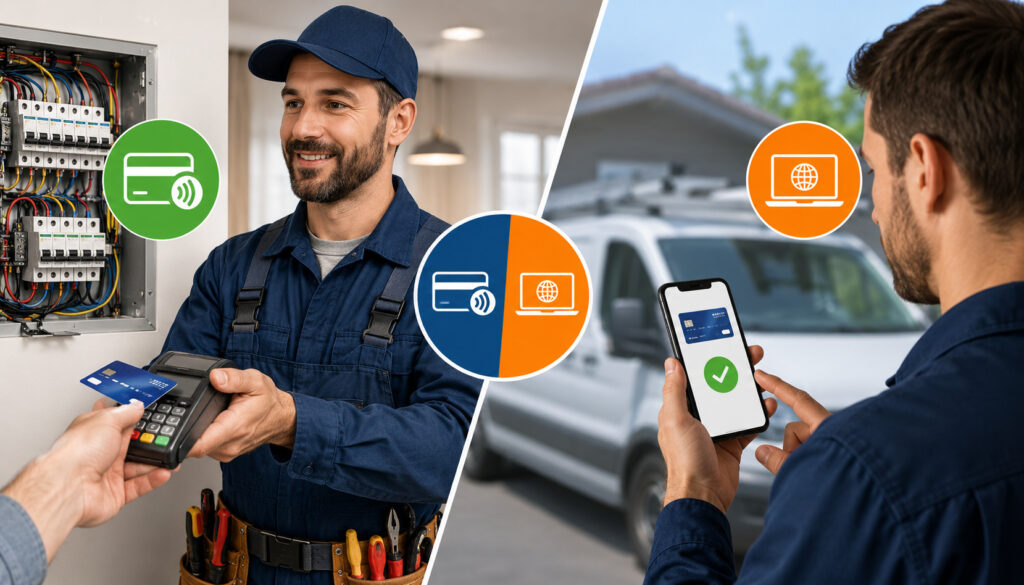
Card-present payments happen when the card or digital wallet is physically used with a terminal, mobile reader, or tap-to-pay device. For electricians, this usually means payment is accepted at the jobsite after the customer reviews the invoice.
Card-not-present payments happen when the card is not physically read by a secure device. Examples include online invoices, payment links, phone payments, manually keyed card numbers, and remote deposits. These are common for office billing, deposits, commercial clients, and balances paid after the technician leaves.
Both methods are useful, but they carry different costs and risks. Card-present transactions generally provide stronger evidence that the customer authorized the payment. They may also qualify for more favorable pricing than keyed payments, depending on the processor and card type.
Card-not-present payments are convenient, but they require better documentation. A customer may pay an online invoice from home, approve a deposit remotely, or call the office with a card. In those cases, the business should rely on secure payment links or hosted forms instead of writing down card details.
Mobile card payments are valuable because they reduce the need for keyed transactions. A technician with a secure reader can accept chip, tap, or wallet payments before leaving the property. This helps close the loop on service calls and reduces unpaid invoices.
For jobsite workflows, this article on getting paid in the field provides additional practical context.
Payment Security for Debit and Credit Card Transactions
Payment security is critical for both debit and credit card transactions. Electrician businesses may not think of themselves as technology companies, but accepting cards means handling sensitive payment workflows. A weak process can create risk for customers, employees, and the business.
Secure electrician merchant services should include encryption, tokenization, PCI-aware workflows, secure terminals, user permissions, and controlled refund access. The goal is to avoid exposing card data while still making payment simple.
Encryption helps protect card data while it is being transmitted. Tokenization replaces sensitive card details with a token that can be used for future authorized transactions without storing the actual card number. Secure terminals and hosted payment pages reduce the amount of sensitive information your team touches.
User permissions are also important. Technicians may need to collect payments, but they usually do not need access to refund controls, settlement settings, bank account changes, or full reporting. Office managers may need invoice and reconciliation access, while owners may need administrative settings.
The FTC notes that businesses accepting credit or debit cards must take steps to ensure charges are authorized, including in mobile payment situations. That makes documentation and secure authorization part of responsible payment operations.
Protecting Customer Payment Information
Protecting customer payment information starts with reducing how much sensitive data your team handles. The safest workflow is usually one where the customer enters, taps, or inserts the card through a secure tool, and your staff never sees the full card number.
At the jobsite, technicians should use approved mobile readers or secure tap-to-pay tools. For remote payments, send a payment link or online invoice. For phone payments, enter details directly into a secure virtual terminal while following company policy, and never write the number down for later.
Training matters. Every employee who touches payments should know what not to do. That includes not storing card numbers, not sharing login credentials, not using personal payment accounts for business transactions, and not processing refunds without authorization.
Electrical businesses should also review device security. Phones, tablets, and terminals used for payments should have passcodes, updates, and access controls. Lost devices should be reported quickly.
Reducing Chargebacks and Disputes
Chargebacks can happen with both debit and credit payments, but credit card disputes are often more common for larger service transactions. A customer may claim they did not authorize the charge, did not receive the service expected, were billed incorrectly, or were dissatisfied with the work.
Good documentation is your best defense. Signed estimates, clear invoices, job photos, customer approvals, change orders, technician notes, permits, inspection records, and receipts all help show what happened.
For electrical contractors, dispute prevention starts before payment. Make sure the customer understands the diagnostic fee, scope of work, labor rate, material charges, warranty terms, refund policy, and payment timing. Confusion creates disputes.
Strong invoices should include:
- Customer name and service address
- Invoice number and date
- Description of work performed
- Parts and labor details
- Deposit or prior payments
- Final balance
- Payment terms
- Refund or cancellation policy
- Technician or office contact details
Choosing the Right Payment Methods for Electrician Businesses
Choosing payment methods for electrician businesses should depend on job size, customer expectations, cost tolerance, cash flow needs, field workflow, and office billing process. There is no single best method for every job.
For small service calls, speed matters. Debit cards, credit cards, contactless wallets, and mobile card readers can help collect payment immediately. For larger projects, online invoices, deposits, ACH, credit cards, and staged billing may be better suited.
A strong payment setup gives customers options while protecting margins. For example, an electrician business might encourage debit or ACH for large invoices while still accepting credit cards when the customer needs flexibility. The key is to explain payment terms before work begins.
Office workflow matters too. If your team sends estimates, collects deposits, schedules crews, orders materials, and invoices after completion, your payment system should support each step. Billing software integration can help connect job details, payments, receipts, and accounting records.
Customer type also affects payment choice. Residential customers may prefer cards and digital wallets. Commercial clients may prefer ACH, purchasing cards, checks, or invoice terms. Property managers may need recurring billing records and multiple service addresses.
For Small Service Calls
Small service calls need fast, simple payment collection. When a technician completes a diagnostic visit, outlet repair, fixture replacement, GFCI correction, breaker troubleshooting, or minor installation, it is usually best to collect payment before leaving the site.
Debit cards work well here because many customers are comfortable using them for everyday expenses. Credit cards and contactless wallets should also be available because customers may prefer speed, rewards, or digital receipts.
Mobile card readers are practical for these jobs. They allow technicians to accept tap, chip, and wallet payments while the customer is present. This reduces invoice aging and eliminates many follow-up calls.
Keep the process consistent. The technician should review the invoice, confirm the total, collect payment, and send a receipt. If the customer is not present, the technician or office can send a secure payment link.
For Larger Projects
Larger projects need more structure. A panel upgrade, rewiring job, generator installation, EV charger setup, commercial buildout, or service upgrade may require deposits, staged billing, material payments, permits, inspections, and final approval.
Credit cards can be useful for deposits or urgent approvals, but ACH or other bank-based payment options may be better for very large balances because of processing costs. Some customers may still choose credit cards for convenience or cash flow, so offering both can help close the job.
Online invoices are especially useful for larger projects. They create a written record, allow customers to pay remotely, and help the office track outstanding balances.
For best results, define payment milestones in the estimate. Include deposit amount, progress payment timing, final balance due date, and accepted payment methods. This reduces confusion and supports better cash flow.
Common Mistakes Electricians Should Avoid
One of the biggest mistakes electrician businesses make is accepting only checks or cash. While those methods may still have a place, relying on them can slow cash flow and create unnecessary office work. Customers increasingly expect digital payment options, especially for service calls and urgent repairs.
Another mistake is keying card numbers unnecessarily. Manual entry may increase processing costs and create weaker dispute evidence. If the customer is present, use a secure card reader whenever possible. If the customer is remote, send a secure payment link.
Unclear invoices also create problems. If the invoice only says “electrical work,” the customer may not remember what was done or may question the amount later. Itemized invoices help customers understand the value of the work and help your business defend the charge if needed.
Poor communication about fees and payment terms can also damage trust. If you charge deposits, late fees, convenience fees, or other payment-related charges, explain them before collecting payment. Surprises at checkout can lead to complaints and disputes.
Other common mistakes include:
- Letting technicians use personal payment apps
- Not sending receipts
- Failing to document customer approval
- Taking card numbers by text
- Storing card data insecurely
- Processing refunds without controls
- Ignoring chargeback notices
- Not reviewing monthly processing statements
- Using the wrong payment setup for high-ticket invoices
Best Practices for Managing Card Payments
The best card payment workflows combine convenience, security, documentation, and cost awareness. Electrician businesses should offer both debit and credit options, but they should also guide customers toward the most practical method for the job.
Start with secure mobile terminals. Technicians should be able to accept card-present payments at the jobsite whenever possible. This reduces unpaid invoices and keeps payment tied to the completed service.
Next, use online invoices for electricians who need remote payment collection. A secure invoice link is better than asking for card details by phone, email, or text. It also creates a clean record of invoice delivery and payment.
Documentation should be part of every payment. Estimates, signed approvals, photos, change orders, receipts, and service notes should be stored with the job. This protects your business if a customer disputes the transaction later.
Review payment processing fees regularly. Do not look only at the headline rate. Compare your total fees to total card volume, and break down costs by debit, credit, keyed, card-present, card-not-present, gateway, and monthly fees.
Train your team on payment scripts. Technicians should know how to ask for payment professionally, explain invoice totals, send receipts, and escalate unusual requests to the office.
Useful best practices include:
- Use secure mobile readers for jobsite payments
- Offer debit, credit, ACH, and invoice links where appropriate
- Send itemized invoices
- Collect written approval for deposits and change orders
- Reconcile payments daily
- Review processing statements monthly
- Restrict refund and admin permissions
- Avoid storing card data
- Respond quickly to disputes
- Keep customer receipts and job records together
What is the difference between debit and credit card payments for electricians?
Debit card payments draw money directly from the customer’s bank account. Credit card payments use a line of credit issued to the customer.
For electricians, debit often works well for smaller service calls and routine repairs. Credit cards are often helpful for emergency repairs, larger installations, deposits, and customers who want more payment flexibility.
Should electricians accept both debit and credit cards?
Yes, most electrician businesses benefit from accepting both. Customers have different preferences, and job types vary.
A customer may want to use debit for a small repair and credit for a larger installation. Offering both can improve customer convenience, support faster payment collection, and reduce reliance on checks.
Are debit card payments cheaper than credit card payments?
Sometimes, but not always. Debit card payments may cost less in certain situations, but pricing depends on the card network, transaction method, processor, card-present status, and pricing structure.
Electricians should review actual processing statements instead of assuming debit is always cheaper. Keyed payments, online payments, rewards cards, and commercial cards can all affect the final cost.
Are credit cards useful for large electrical projects?
Yes. Credit cards can help customers approve larger or urgent projects when they need flexibility.
They may be useful for deposits, progress payments, final balances, emergency repairs, panel upgrades, EV charger installs, generator work, and commercial service. For very large balances, it may also make sense to offer ACH or another lower-cost option.
Can electricians accept card payments at the jobsite?
Yes. Electricians can use mobile card payments, portable terminals, tap-to-pay tools, or secure payment apps to collect at the jobsite.
This is useful for service calls, emergency repairs, and completed work where the customer is present. A jobsite payment workflow should include invoice review, secure card acceptance, and an immediate receipt.
How can electricians reduce payment disputes?
Electricians can reduce disputes by using clear estimates, signed approvals, itemized invoices, photos, completion notes, receipts, and written change orders.
Customers should understand the scope, cost, payment timing, and refund policy before payment is collected. The clearer the documentation, the easier it is to prevent and respond to chargebacks.
Are online card payments secure?
Online card payments can be secure when they use hosted payment pages, encryption, tokenization, secure invoice links, and controlled access. They are much safer than sending card numbers through email, text, or paper notes.
Electrician businesses should use reputable payment tools and train staff not to store sensitive card details manually.
What payment methods should electrician businesses offer?
A practical setup usually includes debit cards, credit cards, contactless payments, mobile card payments, online invoices, payment links, and ACH for larger invoices.
The best mix depends on job size, customer type, field workflow, office billing needs, and processing cost tolerance.
Conclusion
Understanding debit vs credit card payments for electrician businesses helps owners, office managers, billing teams, and technicians make better payment decisions. Debit cards can be practical for smaller jobs, routine repairs, and customers who prefer direct payment. Credit cards can help with emergency repairs, larger projects, deposits, and customers who need flexibility.
The strongest approach is offering both options within a secure, documented payment workflow. Use mobile card payments for jobsite payments, online invoices for remote balances, clear estimates for approvals, and strong records to reduce disputes.
Card payments for electrical contractors are not just about convenience. They affect cash flow, customer experience, processing fees, chargebacks, payment security, and office efficiency. When your electrician business combines secure processing, clear invoices, smart payment options, and consistent staff training, it becomes easier to get paid on time while giving customers a smoother experience.