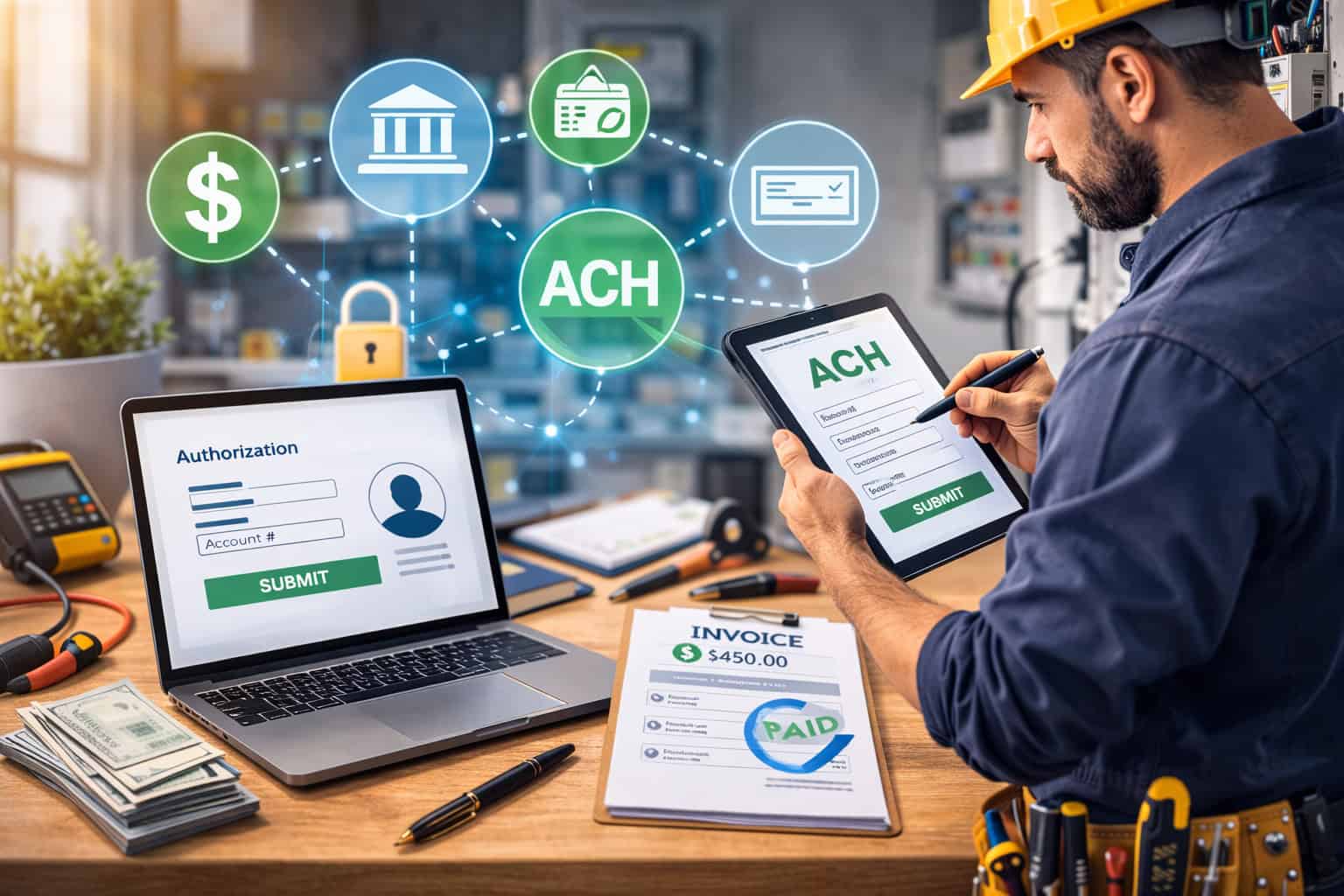
Getting paid should not be the hardest part of running an electrical business. Yet for many electricians, payment collection still creates delays, extra admin work, and unnecessary stress.
You finish a job, send an invoice, and then wait for a check to arrive, follow up on a card payment, or remind a customer again that the balance is due. That gap between completed work and collected payment can affect cash flow more than most contractors realize.
That is one reason more service businesses are looking at ACH as a practical way to get paid. If you want to accept ACH payments as an electrician, you are essentially giving customers a way to pay directly from their bank account through a secure electronic transfer.
For larger invoices, deposits, progress billing, and recurring service plans, that can be a very efficient option. ACH payments often cost less than card payments, make invoicing easier, and fit naturally into the way electrical contractors already bill for work.
This guide breaks down how ACH payments work, why they make sense for electricians, and how to start using them with confidence.
You will learn where ACH fits best in real electrical service workflows, what tools to look for, how ACH compares with cards and checks, and what best practices help you get paid faster with fewer headaches.
Whether you are a solo electrician handling residential service calls or a growing contractor managing larger projects and commercial accounts, this article will help you build a smarter payment process.
What ACH Payments Are and How They Work for Electricians
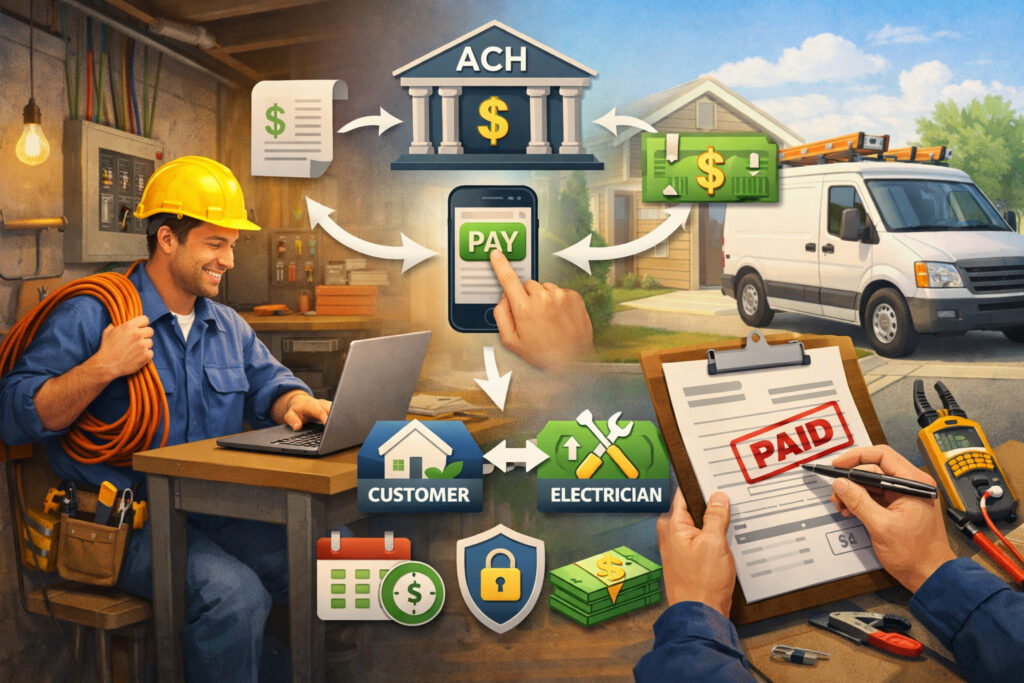
ACH stands for Automated Clearing House, which is the network used to move funds electronically between bank accounts. In practical terms, ACH payments for electricians let customers pay invoices directly from their checking or business bank account without mailing a paper check or paying by credit card.
You may also hear ACH described as an electronic bank transfer or electronic check payment. While the terminology can vary by provider, the basic idea is the same: money moves from the customer’s bank account to yours through an authorized transfer.
For electricians, ACH payment processing can fit into several common situations. A homeowner might use it to pay for a panel upgrade after receiving an emailed invoice. A property manager might authorize recurring ACH payments for ongoing maintenance work.
A commercial client might pay a larger project invoice through a secure payment link instead of mailing a check. In each case, ACH provides a bank-based payment option that can feel more efficient than traditional methods.
The ACH process usually starts when the customer gives authorization. That authorization might happen through an online invoice, a digital payment form, a signed agreement, or a recurring billing setup.
Once approved, the payment processor submits the transaction. Funds do not usually move instantly, so ACH is not the same as real-time bank transfer services. Processing often takes a few business days, although exact timing depends on the provider, your account setup, and when the payment was initiated.
This matters for electricians because job timing and payment timing are not always the same thing. You may complete work today, but funds may settle later. That does not make ACH a poor choice. It simply means you should use it strategically and set customer expectations clearly.
How the ACH payment flow typically works on an electrical invoice
When an electrician sends an invoice with ACH enabled, the customer usually clicks a payment button or payment link and enters bank account details into a secure form.
In some systems, the customer can save that information for future payments or authorize repeat billing for maintenance plans. Once the authorization is completed, the ACH payment begins processing through the provider’s system.
From the electrician’s side, the process can be quite manageable when the right tools are in place. Your invoicing platform may show the payment as pending first, then later mark it as paid after settlement.
That distinction is important. Pending does not always mean cleared. If you release materials, schedule more work, or close out a job before funds settle, you need to know whether your system confirms the payment as initiated or fully completed.
ACH invoicing for electricians works best when each payment step is clear. The customer should know how to pay, what account they are using, and when the payment is considered complete.
You should be able to see the payment status, reconcile it with the invoice, and track it in reports. For businesses that handle multiple jobs at once, this visibility can make payment management much easier.
The difference between ACH, card payments, and paper checks
ACH payments sit in a useful middle ground between traditional checks and card payments. Like a check, the funds come directly from a bank account.
But unlike a check, the transfer happens electronically, which can reduce delays caused by mailing, deposit trips, or manual handling. Compared with credit cards, ACH often has lower processing costs, especially on higher invoice amounts, but it usually does not settle as quickly as a card transaction.
For electrical businesses, this difference matters because payment method choice affects cost, timing, and customer convenience. Cards are often great for fast point-of-sale transactions or emergency service calls.
Checks still appeal to some customers, especially for larger jobs. ACH can be an excellent option when you want a digital payment method that keeps costs more controlled and works well with invoicing.
That does not mean ACH replaces everything else. Most electricians benefit from offering more than one payment option. Some customers prefer cards for convenience or rewards.
Others are more comfortable with direct bank payments for electricians when invoice totals are higher. The goal is not to force one method on every customer. It is to offer payment options that fit the job and make collection simpler.
Why ACH Payments Make Sense for Electrical Service Businesses
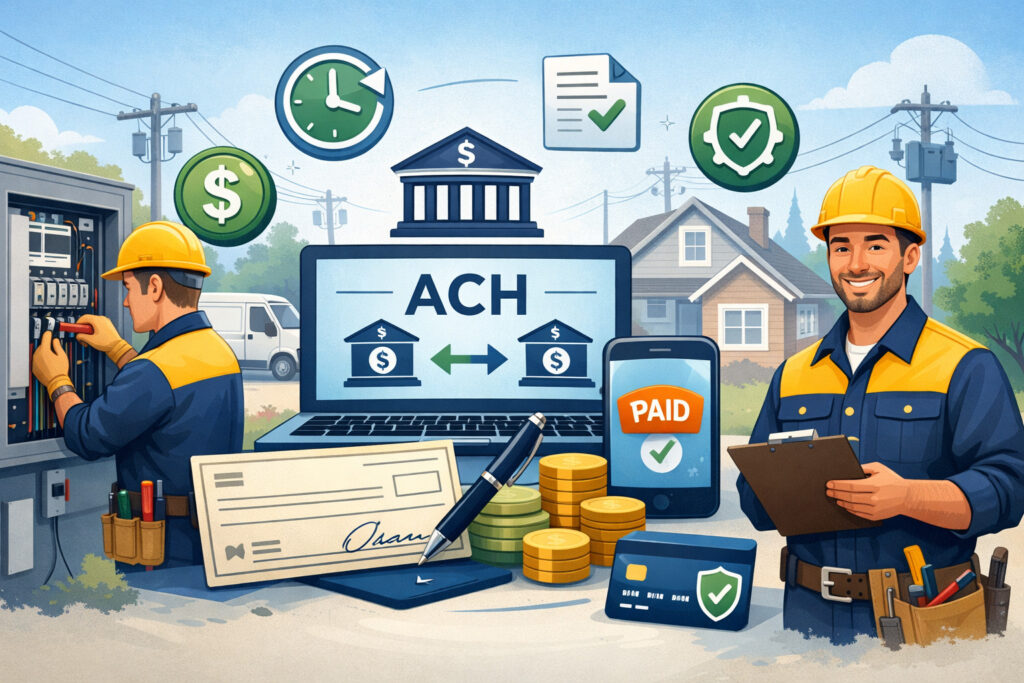
Electricians deal with a wide range of billing situations. One day you might be collecting a small payment for a quick repair. The next day you may be invoicing a large balance for a rewiring project, tenant improvement, generator installation, or ongoing service agreement.
Not every payment method works equally well across those situations. ACH payments for electrical contractors are often appealing because they line up well with how many service businesses actually invoice and collect payments.
One of the biggest reasons electricians look into ACH is cost control. Card processing fees can take a noticeable bite out of margins, especially on larger tickets. If you invoice several thousand dollars for a job, percentage-based card fees can add up quickly.
ACH payment processing for electricians may offer lower transaction costs in many cases, which can help preserve profitability without making your billing process feel outdated or inconvenient.
ACH can also help reduce friction for customers who prefer paying directly from their bank account. Many residential and commercial clients are comfortable with bank transfer payments for electricians when they receive a professional invoice and secure payment link.
In fact, some customers see ACH as a more natural option for larger service invoices because it feels similar to how they pay rent, vendors, or other business bills.
Another reason ACH makes sense is administrative efficiency. Instead of waiting for checks, making manual deposits, or calling customers for card details, you can often send a digital invoice and let the payment process happen online. That can save time for solo electricians and office staff alike.
Lower processing costs can protect margins on larger jobs
For electrical contractors, pricing is rarely just about labor hours. Materials, permits, travel time, subcontracting, callbacks, and overhead all affect profitability.
When payment processing fees stack on top of that, even a good job can become less profitable than expected. That is why low-cost payment processing for electricians is such a practical concern.
ACH often becomes especially attractive when invoice amounts are higher. Think about service upgrades, EV charger installs, lighting retrofits, generator work, or commercial electrical improvements.
These jobs can involve invoices large enough that card fees feel significant. Offering ACH payments for electrical services gives customers another way to pay while helping you hold onto more of the revenue you earned.
This is not just about cutting expenses for the sake of it. It is about matching your payment method to the size and type of the invoice. Many customers are comfortable paying small invoices by card, but on larger balances they may prefer direct bank payments.
That can work in your favor. When ACH is built into your invoice process, you can present it as a secure, convenient option instead of treating it like a special exception.
Over time, this can improve how you quote and bill work. If a meaningful share of customers choose ACH for larger invoices, you may feel less pressure around payment costs and more confidence in offering digital payment options consistently.
ACH can improve invoicing, collections, and customer convenience
Electrical businesses do not just need payments to be affordable. They need them to be easy to request, easy to track, and easy for customers to complete.
That is where ACH invoicing for electricians can make a real difference. Instead of creating separate steps for bank payment collection, many ACH systems let you include bank transfer payment options directly on the invoice.
That simple change can improve collections. Customers are more likely to pay when the invoice is clear and includes a direct action button.
A professional invoice with ACH and card options creates less confusion than sending a PDF and asking the customer to call the office or mail a check. It also helps reduce the back-and-forth that slows down payment collection.
For repeat clients, ACH can be even more useful. Property managers, builders, commercial clients, and maintenance customers often appreciate a predictable way to pay.
Recurring ACH payments for contractors can streamline service agreements, routine inspections, or scheduled maintenance plans. Instead of generating manual reminders every month, you can build a system that supports consistent billing and payment collection.
Step-by-Step Guide to Accepting ACH Payments as an Electrician
If you want to accept ACH payments as an electrician, the setup process does not need to be complicated. The key is choosing tools that fit how your business already works.
A solo electrician who sends a few invoices a week may need a simple invoice-and-payments platform. A growing contractor with office staff, multiple crews, and recurring service accounts may need a more complete system with reporting, recurring billing, and accounting integrations.
At a basic level, you need a business bank account, a payment processor or merchant service that supports ACH, and a way to send invoices or payment requests to customers. From there, the real work is deciding how ACH should fit into your workflow.
Will you use it mostly for final invoices? Deposits? Commercial jobs? Recurring maintenance plans? Defining that upfront makes setup easier because you can configure your payment tools around real use cases instead of vague goals.
It is also important to think about customer experience. The process should feel professional and trustworthy from the first payment request. Customers should know how to authorize the transfer, when the payment will process, and how they will receive confirmation. That level of clarity is part of what makes ACH payment processing for electricians successful in practice.
Step 1: Open or confirm a dedicated business bank account
Before you start accepting electronic payments, make sure your business bank account setup is solid. ACH payments move funds directly between bank accounts, so using a dedicated business account is important for clean recordkeeping, reconciliation, and professionalism. If you are still mixing business and personal transactions, this is a good time to separate them.
A dedicated account helps you keep payment activity organized. When ACH deposits come in, you want them landing in the same account tied to your bookkeeping and invoicing process.
That makes it easier to match payments to invoices, review cash flow, and prepare records for taxes or financial reporting. It also reduces confusion when dealing with refunds, returned payments, or payment disputes.
Some payment processors may verify your business account during onboarding, so having your banking details, business formation records, and identification documents ready can help the process go more smoothly.
Depending on the provider, you may also need to supply your business type, estimated processing volume, and other standard underwriting information.
For electricians who are just formalizing payment systems, this step lays the foundation. It is not the most exciting part of setup, but it makes everything else cleaner and more manageable.
Step 2: Choose an ACH payment processor that fits your workflow
Not every provider is built for contractor payment needs. When comparing contractor ACH payment solutions, look beyond whether ACH is technically available. The real question is how well the system fits your invoicing, customer communication, and job payment flow.
Some providers are better for invoice-based service businesses. Others focus more on e-commerce or retail. As an electrician, you likely need a processor that supports online invoices, payment links, optional recurring billing, and good payment tracking. If you already use field service software or accounting software, integration may matter too.
Review how the processor handles payment status updates, settlement timing, and customer authorizations. Ask whether the platform supports one-time ACH payments, stored payment methods, recurring debits, and branded invoice pages.
You also want to understand pricing, return handling, support responsiveness, and how easily office staff can use the dashboard.
Electrician ACH payment processing works best when the system reduces steps instead of adding them. If the platform feels confusing to your team, customers may feel that too. A simpler process usually leads to faster payment adoption.
Step 3: Enable ACH on invoices and payment requests
Once you have a provider, the next step is making ACH visible wherever customers already pay. For most electricians, that means enabling ACH as a payment option on digital invoices, emailed payment links, or customer payment pages. If ACH is hidden or only available by special request, fewer customers will use it.
Think through your most common invoice moments. Are you sending an estimated deposit request before scheduling a job? Do you invoice on completion for service calls? Do you bill in stages for larger projects? ACH should appear naturally in those workflows. The customer should not have to call for instructions or ask whether bank transfer is accepted.
This is also the right time to review your invoice language. Payment instructions should explain accepted methods, due dates, and what the customer can expect after authorizing a bank payment.
Clear instructions help reduce hesitation and errors. For example, if ACH payments usually take a few business days to settle, say so in a professional way.
You may also want to test the experience yourself. Send a sample invoice, click through the payment flow, and make sure the process feels smooth on desktop and mobile. Small usability issues can have a surprisingly large impact on whether customers complete payment.
Step 4: Set up customer authorization and recurring payment options
Authorization is a core part of secure ACH payment methods for service businesses. Customers must agree to the bank debit, and your system should capture that authorization clearly.
This may happen through a digital checkbox, signed agreement, or payment form language built into the processor. However it is handled, the authorization process should be easy to document and easy to retrieve later.
This becomes even more important for recurring ACH payments for contractors. If you offer maintenance plans, service subscriptions, or scheduled billing, you need a clean process for getting customer consent, storing the billing schedule, and notifying the customer appropriately. A good ACH system will support that without forcing you to manage recurring debits manually.
For electrical contractors working with repeat commercial accounts or property managers, saved payment methods can also be useful. Instead of collecting bank details every time, you may be able to securely store payment credentials for future authorized use.
That can make payment collection faster and reduce admin work, especially when billing happens on a regular cycle.
Step 5: Train your team and update your payment policies
Even the best payment tools will underperform if your team does not know when and how to use them. If you have office staff, project managers, or technicians involved in customer communication, make sure they understand what ACH is, when to offer it, and how to explain it confidently.
Customers are more likely to adopt ACH when it is presented as a normal, professional payment option rather than an unfamiliar extra.
Update your payment policies as well. Decide which invoices are eligible for ACH, whether deposits can be paid that way, how you handle returned payments, and when a job is considered paid in full. If you offer both cards and ACH, think about how you present those choices.
The goal is not to pressure customers, but to guide them toward convenient payment options that also work well for your business.
This step is especially valuable for growing electrical businesses. As payment volume increases, consistency matters more. A clear internal process can reduce mistakes, shorten collection time, and help customers get a better experience no matter which team member they interact with.
Tools and Features to Look for in ACH Payment Processing

Choosing ACH payment processing for electricians is not only about finding a provider that can move funds from one bank account to another. The best solution should support the full payment experience, from invoice creation to payment reconciliation.
Electricians do not operate like online stores. They estimate work, collect deposits, send progress invoices, complete jobs on-site, and sometimes manage recurring service plans. Your ACH tools should reflect that reality.
A good payment setup should help you send invoices quickly, give customers easy ways to pay, and reduce manual follow-up. It should also support visibility.
You need to know when an ACH payment has been initiated, when it has settled, whether it failed, and how it ties back to a specific job or customer account. Without that visibility, even lower-cost payment processing can create extra administrative work.
As you compare contractor ACH payment solutions, think beyond headline pricing. Features like recurring billing, payment links, reporting, and accounting integrations often matter just as much as transaction cost.
A system that saves your office hours every week may be more valuable than one that looks cheaper on paper but creates more friction in daily use.
Secure payment forms, online invoicing, and payment links
For most electricians, the customer-facing tools are where ACH either succeeds or falls flat. If the payment page feels confusing, outdated, or untrustworthy, customers may hesitate. That is why secure payment forms and professional online invoicing matter so much.
Look for a provider that lets you send branded invoices with ACH enabled directly from the invoice. Customers should be able to open the invoice, review the work, and choose a bank payment option without jumping through multiple screens.
Payment links can also be useful when you want to collect a deposit quickly or text a customer after work is completed.
The best systems make payment feel simple. They should work well on mobile devices, clearly explain what the customer needs to do, and provide confirmation once payment is submitted.
Features like auto-filled invoice references, customer notes, and downloadable receipts can make the process feel more polished and reduce follow-up questions.
Security is critical here as well. Customers are sharing bank information, so the process should feel legitimate and protected. You do not need to overload them with technical details, but you do want a platform that uses strong security standards and gives customers confidence that their information is handled properly.
Recurring billing, reporting, and software integrations
Recurring ACH payments are especially useful for electricians who offer maintenance agreements, routine inspections, service retainers, or monthly commercial support.
If that is part of your business, look for a system that lets you automate recurring billing without making the setup cumbersome. You should be able to define billing intervals, payment amounts, customer notifications, and authorization tracking in one place.
Reporting is another major feature area. As your volume grows, you will want visibility into outstanding invoices, ACH payment status, payment trends, and returned transactions.
Good reporting helps you understand cash flow and spot collection issues before they become larger problems. It also makes bookkeeping easier because you can review batches, payouts, and payment timing without piecing records together manually.
Integrations matter too. If your invoicing or accounting software connects directly to your ACH platform, you can reduce duplicate data entry and cut down on reconciliation errors.
Digital payments for electrical contractors are easiest to manage when your job records, invoices, and payments all connect. That is especially true for businesses with office managers or accountants who rely on accurate records across systems.
When Electricians Should Use ACH Payments
ACH is not an all-or-nothing payment method. In most electrical businesses, it works best as part of a broader payment strategy. Some jobs are well suited to ACH. Others are better handled by card, cash, or another digital payment method. Understanding where ACH fits best helps you offer it with confidence and improve how quickly you get paid.
In general, ACH tends to shine when invoice values are higher, when the customer relationship is ongoing, or when the payment can be tied to a formal invoice rather than a quick point-of-sale interaction.
That makes it especially useful for many contractors, commercial jobs, and scheduled service arrangements. It can also work well for deposits and progress billing, where payment timing matters and customers appreciate a convenient bank-based option.
The key is matching the payment method to the business scenario. You do not need to force ACH into every service call. Instead, use it where it reduces friction for both sides and supports a smoother payment process.
ACH works well for deposits, progress billing, and large completed-job invoices
Many electrical jobs are not billed in a single, simple transaction. Larger projects often involve an upfront deposit, one or more progress invoices, and a final balance due after completion.
ACH payments for electrical contractors fit naturally into this pattern because customers can authorize payment from their bank account each time they receive an invoice.
For deposits, ACH can help lock in commitment before scheduling work or ordering materials. A customer who receives a professional estimate and secure payment request may be more likely to pay promptly than one who is told to mail a check.
For progress billing, ACH makes it easier to keep projects moving without waiting on slower manual payment methods. For final invoices, it offers a practical option when balances are too large for customers to feel comfortable putting on a card.
This is especially relevant for panel changes, rewiring jobs, backup power projects, tenant improvements, and commercial electrical work. Invoices can be substantial, and customers often expect invoice-based payment rather than on-site card swipes. ACH gives you a digital process that still aligns with how larger invoices are typically handled.
ACH is a strong option for recurring service plans and commercial accounts
If your business offers recurring electrical maintenance, routine inspections, or service agreements, ACH can be one of the most efficient ways to collect payment.
Recurring ACH payments for contractors reduce the need for monthly reminders and give both you and the customer a predictable billing process. That can improve retention and reduce late payments over time.
Commercial clients and property managers may also prefer ACH because it fits their internal accounts payable workflow. They are often accustomed to paying vendors by bank transfer, especially for invoice-based services. Offering ACH can make your business easier to work with and may even speed up payment if it matches the client’s preferred process.
This does not mean every commercial client will pay through an online invoice link. Some may still require invoice approvals, purchase orders, or internal payment schedules. But having ACH capability gives you flexibility.
You can offer secure electronic check payments for electrical services while maintaining a professional invoicing process that supports larger, repeat billing relationships.
ACH vs Other Payment Methods for Electrical Contractors
No single payment method is perfect for every job. Electricians often need flexibility because customers vary in how they prefer to pay, how quickly they need work done, and how formal the billing process is.
ACH is valuable, but it works best when you understand how it compares with credit cards, paper checks, cash, and other digital payment methods.
A strong payment setup usually includes more than one option. The point is not to eliminate other methods entirely. It is to know where ACH offers the most value so you can use it strategically.
For some invoices, speed matters most. For others, cost control or convenience for larger balances is the bigger priority.
ACH vs credit cards, checks, and cash
Credit cards are popular because they are fast and familiar. For emergency jobs, same-day service calls, or smaller invoices collected on-site, they can be very convenient. Customers often like the ease of tapping, swiping, or entering card details online.
The tradeoff is cost. Card fees can be more expensive, especially on high-value jobs, which is why many electricians also want ACH payments for electricians in the mix.
Checks remain common in contractor industries, especially for larger invoices. Some customers still trust paper checks because they feel tangible and familiar. But checks create extra steps.
They can be mailed late, deposited late, lost, or returned. ACH provides a digital version of bank-based payment that often feels more efficient while still aligning with how customers think about paying from their bank account.
Cash is immediate, but it is not ideal for every business. It can create recordkeeping issues, security concerns, and extra handling work. For professional invoicing and cleaner financial tracking, digital payments usually create a better system.
ACH stands out when you want the benefits of bank-based payment without relying on paper. It is not instant in the way some card payments feel, but it can be a more practical option for larger invoices and lower-cost processing.
ACH vs newer digital payment methods
There are many digital payment tools available today, from wallet apps to instant-transfer services. Some customers may ask whether they can pay through whichever app they already use personally.
In a few cases, that may be workable. But for most electrical businesses, professional invoicing still matters more than trendy payment tools.
ACH has an advantage because it fits a formal business process. You can tie it to invoices, authorizations, reporting, recurring billing, and accounting records. It is not just a quick transfer. It can be part of a consistent payment system. That makes it more scalable for electricians than relying on ad hoc consumer payment apps.
Newer payment methods may still have a role for very small jobs or specific customer preferences. But when your goal is building reliable invoice payment options for electricians, ACH tends to be the more durable choice. It supports structured billing, works well for recurring or larger payments, and creates a more professional customer experience.
Common ACH Payment Challenges and How to Handle Them
ACH can be a smart payment method, but it is not friction-free. Like any system, it works best when you understand the common issues and plan for them.
Electricians who go in expecting ACH to solve every collection problem may be disappointed. Electricians who use it strategically, set expectations, and build clear internal processes usually get far better results.
The main challenges are not usually technical. They are operational. Payment timing, customer authorization, returned transactions, and follow-up all need attention.
These issues are manageable, but ignoring them can create confusion around whether a job is actually paid, whether you should schedule more work, or how to handle a customer who says they already submitted payment.
The good news is that most ACH challenges can be reduced with better communication and better tools.
Processing time, payment returns, and authorization issues
Unlike some card transactions, ACH payments do not always settle immediately. Customers may authorize payment today, but funds may not fully clear until later.
That delay can affect scheduling, materials ordering, and closeout decisions if your team assumes a payment is complete before it has actually settled. This is one of the biggest operational differences electricians need to understand.
Returned payments are another challenge. Sometimes a customer enters the wrong bank information. Other times there may be insufficient funds, account restrictions, or other bank-level issues.
When that happens, you need a process for notifying the customer, pausing any next steps if necessary, and requesting a replacement payment quickly.
Authorization issues can also create problems, especially if the customer does not clearly understand what they agreed to. That is why documented consent matters so much. Whether it is a one-time debit or recurring billing arrangement, the authorization language should be clear and easy to access later if questions come up.
A good ACH system helps by showing payment status clearly, storing authorization records, and alerting you to returned items or failed transactions. But the system alone is not enough. Your team also needs to know what each status means and how to respond.
Customer hesitation and payment follow-up problems
Some customers are comfortable using ACH right away. Others are more hesitant about sharing bank details online, especially if they have not used bank transfer payments with contractors before.
That hesitation does not mean they will never use ACH. It usually means they need a trustworthy process and a simple explanation of why it is safe and convenient.
Presentation matters here. If you introduce ACH casually or inconsistently, customers may feel unsure. If you present it as a standard payment option through a professional invoice and secure payment page, it feels more legitimate. You do not need to oversell it. Just make it available, explain it clearly, and let the customer choose.
Follow-up can also become messy when payment tracking is weak. If you send reminders before a payment settles, or fail to follow up after a return, customers can get frustrated. Good communication timing matters. Your reminders should reflect the actual payment status and next action needed.
Best Practices to Get Paid Faster With ACH
Accepting ACH is only part of the equation. To really improve cash flow, electricians need a payment process that encourages customers to pay quickly and reduces avoidable delays.
The most effective businesses do not just add ACH to invoices and hope for the best. They build payment collection into the way they estimate, schedule, invoice, and communicate with customers.
This is true whether you run a one-person shop or a larger operation. The scale may differ, but the payment principles are the same. Clear expectations, timely invoicing, easy payment access, and consistent follow-up all help customers complete payment sooner. ACH becomes much more effective when it is part of a thoughtful collection strategy.
Set expectations early and make payment easy at every stage
One of the best ways to speed up payment is to talk about it before the invoice is sent. If a customer knows upfront that you accept ACH payments for electrical services, and that they will receive a digital invoice with bank payment options, the payment request feels expected rather than surprising. This can be especially helpful for deposits and larger projects.
Set payment expectations during the estimate or scheduling stage. Let customers know when invoices are due, what payment methods you accept, and whether ACH is a recommended option for larger balances. Then reinforce that message on the invoice itself. The fewer surprises there are, the less friction you create.
Ease matters too. Make sure customers can pay from their phone, from the invoice email, or from a secure payment link without needing to call your office for instructions. If you are making customers work too hard to pay, some will delay simply because the process is inconvenient.
This is where invoice design matters. Clear totals, due dates, line items, and payment buttons are not just nice details. They directly affect how quickly customers complete payment.
Send invoices quickly, automate reminders, and review your process regularly
Fast invoicing leads to faster payment. If a job is complete but the invoice is not sent for two or three days, you are already slowing down your own cash flow. Electricians often get busy moving from one job to the next, but a delayed invoice delays everything that follows. ACH works best when the request goes out while the job is still fresh in the customer’s mind.
Automated reminders can help, especially for solo electricians who do not have office support. A good invoicing system can remind customers before the due date, at the due date, and after if needed.
That keeps the process moving without requiring constant manual follow-up. Just make sure reminder timing matches real payment statuses so you do not send unnecessary notices after a customer has already submitted an ACH payment.
It also helps to review your payment process regularly. Look at how long invoices take to get paid, how often customers choose ACH, where payment issues occur, and whether certain job types are better suited to bank payments than others. Small adjustments can make a big difference over time.
For example, you may find that commercial invoices convert better with ACH links, while residential customers respond better when both card and bank transfer options are shown clearly. That kind of insight can help you refine your approach and improve collections without changing your pricing or sales process.
FAQ
Q.1: Can electricians legally accept ACH payments from customers?
Answer: Yes, electricians can generally accept ACH payments as part of a normal business payment process, provided they use a compliant payment processor and collect proper customer authorization.
The key is treating ACH as a formal payment method, not an informal bank transfer arrangement with weak documentation. A secure system with clear consent records and invoice tracking is the best approach.
Q.2: How long do ACH payments usually take to process?
Answer: ACH payments are not usually instant. In many cases, they take a few business days to move from the customer’s account to the electrician’s account, although timing can vary by provider and bank. That is why it is important to distinguish between a payment that has been initiated and one that has fully settled.
Q.3: Are ACH payments cheaper than credit card payments for electricians?
Answer: They often can be, especially for larger invoice amounts. Many electricians look at ACH payment processing for electricians because it may help reduce payment costs compared with percentage-based card fees. Exact pricing depends on the processor, but ACH is commonly considered a lower-cost option for invoice-based businesses.
Q.4: When should an electrician offer ACH instead of a card payment?
Answer: ACH is often a strong choice for deposits, progress invoices, final balances on larger jobs, recurring maintenance plans, and commercial billing.
Card payments may still make more sense for smaller on-site transactions or urgent service calls where speed matters most. The best setup usually includes both options so customers can choose what works best.
Q.5: Do customers need special software to pay by ACH?
Answer: Usually not. In most cases, the customer can pay through a secure invoice link or payment form using a standard browser on a phone or computer. They typically just need their bank account information and a clear authorization flow. That simplicity is one reason ACH invoicing for electricians can work well.
Q.6: What happens if an ACH payment is returned?
Answer: If an ACH payment is returned, your payment processor will usually notify you. You should then contact the customer promptly, explain that the payment did not complete, and provide a clear next step for repayment. It is also wise to have a written policy for returned payments so your team handles them consistently.
Q.7: Is ACH a good option for solo electricians?
Answer: Yes, especially if you want a professional digital payment method that fits invoice-based work and helps reduce check handling. Solo electricians can benefit from ACH for deposits, completed jobs, and repeat customers. The main priority is choosing a system that is easy to manage without adding extra admin work.
Conclusion
If you want to accept ACH payments as an electrician, the biggest advantage is not just that customers can pay by bank transfer. It is that ACH can bring more structure, flexibility, and efficiency to the way your business gets paid.
For larger invoices, recurring service plans, deposits, and commercial billing, ACH can be a practical option that supports lower processing costs, cleaner invoicing, and a more professional customer experience.
The most successful approach is not to rely on ACH alone. It is to make ACH part of a payment system that matches how your electrical business actually operates.
That means choosing the right processor, enabling ACH on invoices, collecting authorization properly, training your team, and setting clear customer expectations. It also means understanding where ACH fits best and where other payment methods may still make sense.
For solo electricians, ACH can help simplify collections without adding unnecessary complexity. For growing electrical contractors, it can support more consistent billing, better reporting, and smoother repeat payments.
Either way, the goal is the same: make it easier for customers to pay and easier for your business to collect what it is owed.
Start with your current invoicing process. Look at the types of jobs you bill, the payment delays you run into, and the customers who would benefit most from direct bank payments. Then choose an ACH payment setup that helps you send clear invoices, reduce friction, and get paid with more confidence.