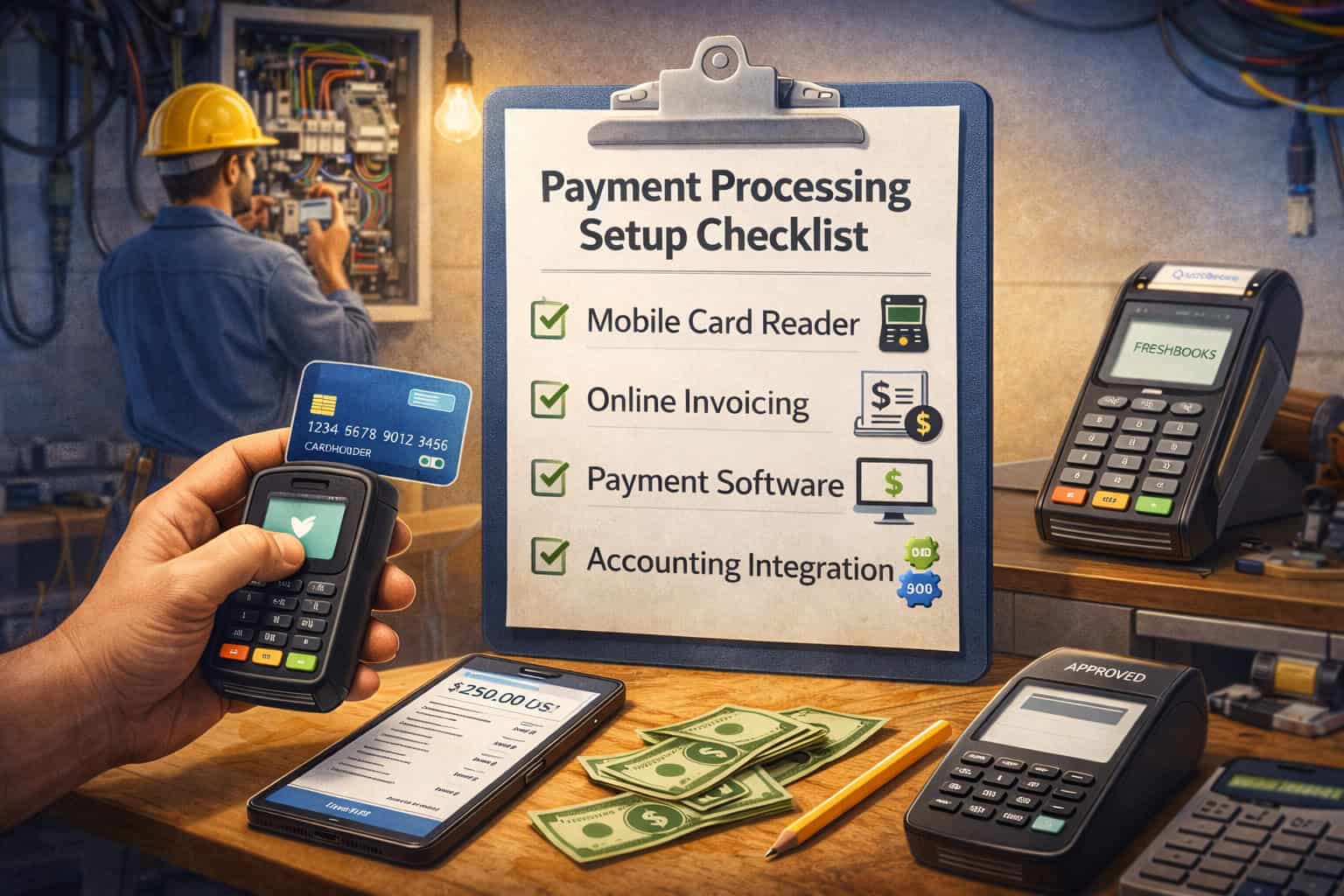
If you run an electrical contracting business, you don’t just “take payments.” You manage cash flow, job deposits, change orders, after-hours service calls, invoices, and tax records—all while protecting customer data.
A payment processing setup checklist for electricians helps you build a system that gets you paid faster, reduces chargebacks, and keeps your bookkeeping clean.
The goal isn’t to buy the fanciest card reader. The goal is a repeatable workflow: quote → deposit → progress billing → final invoice → receipt → reconciliation. When your payment stack is set up right, customers can pay on-site or online in minutes, your team knows exactly what to do, and your accounting records match your bank deposits.
This payment processing setup checklist for electricians is written for service businesses that do residential and commercial work: panel upgrades, EV charger installs, troubleshooting, remodel wiring, emergency calls, maintenance contracts, and more.
You’ll see practical choices (mobile, invoicing, ACH, cards), compliance steps (PCI, surcharging rules, tax reporting), and future-ready ideas (tap-to-pay phones, real-time payments).
Define your payment model before you choose a processor

Before you compare rates, lock in how customers will pay you across the life of a job. This step is often skipped, and it’s why many contractors end up with scattered tools, missed deposits, and confusing statements. A payment processing setup checklist for electricians should start with your job types and billing moments.
Most electricians need at least three payment “moments”:
- Scheduling or deposit payment (to hold a slot and cover materials).
- Progress payment (for multi-day or multi-phase projects).
- Final payment (walkthrough, sign-off, warranty paperwork).
Now decide what you want to accept at each moment: card, ACH, bank transfer, check, financing, or pay-by-link. For example, deposits are usually easier by card or ACH link, but large commercial invoices may be ACH-only with net terms. Emergency service calls often require instant payment on-site.
A strong payment processing setup checklist for electricians also clarifies whether you charge convenience fees, offer cash discounts, or plan to use surcharging. If you plan to surcharge, card brand rules and state laws matter, and your receipts and signage must be correct.
Visa’s merchant surcharging guidance highlights key requirements like disclosures, separate receipt line items, and limits (including that debit/prepaid cannot be surcharged). Mastercard also publishes surcharge rule guidance, including caps and disclosure expectations.
Finally, define your success metrics: faster collections, fewer no-shows, lower processing costs, better invoice tracking, or less admin time. Your processor choice should serve those goals, not just a headline rate.
Business readiness checklist: documents, accounts, and underwriting basics

A payment processing setup checklist for electricians is easier when your business information is consistent. Payment providers will verify your identity, business details, and bank account. If your paperwork is mismatched, approvals slow down and funding can be delayed.
Start with a clean “merchant profile”:
- Legal business name, DBA (if used), and a consistent address
- EIN (or SSN for sole proprietors, if applicable)
- Business bank account in the business name
- Contractor license details (where required)
- Website or online presence that clearly explains services, service area, refund/cancellation policy, and contact info
- Basic financial history: average ticket size, monthly volume, and whether you take deposits
Electricians often have variable ticket sizes (a small service call one day, a panel upgrade the next). Underwriting becomes smoother if you can clearly explain your typical range and your largest expected transaction.
If you plan to accept big-ticket payments (like commercial projects, generator installs, solar/electrical add-ons, or large remodels), note that early. Some providers flag sudden spikes as risk.
A practical payment processing setup checklist for electricians also includes a “refund and dispute plan” upfront. If you sell materials and labor, define what’s refundable and what isn’t, and how change orders are approved. The more clearly this is documented on invoices and customer approvals, the easier it is to defend chargebacks later.
Lastly, get your operational roles straight. Who issues invoices? Who sends payment links? Who closes out jobs and collects final payment? A payment system only works if your team follows the same steps every time.
Choose the right payment mix: cards, ACH, and flexible options

Electricians typically win when they offer multiple payment paths while nudging customers toward the lowest-cost option that still feels easy. This is where your payment processing setup checklist for electricians becomes a revenue tool, not just a technical setup.
Card payments for speed and convenience
Cards are fast and widely preferred for residential work and emergency calls. They reduce “I’ll mail a check” delays and help you collect immediately after the job is done. To keep costs reasonable, consider:
- Encouraging debit (without surcharging) where possible
- Offering ACH for larger invoices
- Using saved payment methods for maintenance plans (with customer consent)
ACH and bank payments for larger invoices
ACH is often cheaper than cards and fits commercial clients and large residential invoices. Many modern platforms allow pay-by-bank links directly on invoices. The key is making it simple: clear instructions, one-click bank login options where available, and automatic receipt delivery.
Pay-by-link and QR codes for field work
A smooth payment processing setup checklist for electricians includes “no-app-needed” options: text a link, email a link, and a QR code on the invoice or estimate. This reduces friction when you’re in a basement, attic, or jobsite and the customer is busy.
Financing and installments
For bigger projects (service upgrades, EV chargers, whole-home rewires), financing can improve close rates. If you add it, keep it integrated: the estimate should show monthly payment options, and the approval process should be fast enough not to stall the sale.
Your best mix usually looks like this: card + ACH + invoicing + mobile acceptance. That combination covers most jobs while protecting margins.
Hardware and on-site acceptance: terminals, mobile readers, and tap-to-pay phones

If you get paid in the field, your on-site setup matters as much as your pricing. A modern payment processing setup checklist for electricians includes at least one reliable in-person method and one backup.
Mobile card readers for trucks and vans
A small Bluetooth reader paired to your phone or tablet is often enough for service calls. Choose hardware that supports:
- Chip (EMV) and contactless (tap)
- Offline mode (if you work in low-signal areas)
- Digital receipts (text/email)
- Tips (if you ever use them) and custom fields like job ID
Full terminals for shops or dispatch offices
If you have a front counter or office payments, a countertop terminal can be faster and more stable than a mobile reader.
Tap-to-pay on phone: fewer devices, faster setup
“Tap-to-pay” turns a compatible smartphone into a contactless acceptance device—useful for teams that don’t want to manage multiple readers. Availability is expanding over time, and major announcements have highlighted broader rollout across regions and platforms.
For electricians, the business value is simple: fewer batteries to charge, fewer devices to lose, and easier onboarding for new technicians. It can also help you take payments in tight spaces where pulling out a terminal is awkward.
A future-proof payment processing setup checklist for electricians also includes a connectivity plan: keep a spare charger, test your cellular coverage in common service areas, and store a backup payment method (like pay-by-link) for dead zones.
Invoicing workflow: estimates, deposits, progress billing, and final payment
Your invoicing workflow is where most payment problems are created—or solved. A strong payment processing setup checklist for electricians treats invoicing as a system, not a single document.
Estimates that convert and pre-approve payment steps
Your estimate should include:
- Scope summary in plain language
- Line items for labor, materials, permits, and travel (if applicable)
- Change order policy
- Deposit amount and when it’s due
- Payment methods accepted
- Expiration date and scheduling terms
If you want deposits consistently, the estimate must make it normal: “To schedule, approve estimate and pay deposit.”
Deposits that reduce cancellations
Deposits reduce no-shows and protect you when special-order materials are involved. Set rules based on job type:
- Small service call: optional pre-auth or card-on-file hold
- Medium job: fixed deposit (e.g., materials portion)
- Large job: staged deposit + progress billing
Progress billing for multi-phase projects
Progress billing keeps cash flow stable and reduces the risk of finishing a big job before being paid. Tie each progress invoice to a milestone:
- Rough-in complete
- Inspection passed
- Trim-out complete
- Commissioning and testing complete
Final invoices that close cleanly
Final invoices should be short and obvious:
- Total, what’s already been paid, and what’s due today
- Warranty note and service contact info
- Receipt issued instantly after payment
- “Paid” stamp and job closeout confirmation
This structured approach is a key part of a payment processing setup checklist for electricians because it standardizes how your team asks for money—without awkwardness.
Pricing, fees, and compliance: surcharging, cash discounting, and transparency
Many electricians want to reduce processing costs. That’s reasonable, but it must be done correctly. A careful payment processing setup checklist for electricians explains the difference between surcharging and cash discounting, and emphasizes clear customer communication.
Surcharging basics (and why rules matter)
Surcharging typically means adding a fee to credit card transactions to offset acceptance costs. Card network rules and state law can restrict how you do this.
Visa’s guidance includes major requirements such as posting disclosures at entry and point of sale, itemizing the surcharge on receipts, and not exceeding certain limits; it also notes that debit and prepaid cards cannot be surcharged. Mastercard provides its own rules and caps, and it expects merchants to follow disclosure and compliance steps.
Because rules change and vary, your payment processing setup checklist for electricians should include a compliance check with your provider and (when needed) a knowledgeable professional. The key operational takeaway: if you surcharge, your system must automatically apply it correctly and print it correctly.
Cash discounting (different structure, similar goal)
Cash discount programs typically advertise a “standard price” and then apply a discount for cash or equivalent methods. This can be simpler for some service businesses, but it must still be communicated clearly to avoid customer complaints.
Customer trust comes from clarity
Electricians rely heavily on reviews and referrals. If your fees feel like a surprise, you’ll lose more in reputation than you gain in savings. Your invoices and estimated language should make pricing transparent, and your technicians should be able to explain payment options in one sentence.
A compliant, customer-friendly fee strategy is a core part of any payment processing setup checklist for electricians.
Security and PCI: protect card data without turning into an IT department
Security isn’t optional, and it doesn’t have to be complicated. The simplest way to reduce risk is to avoid storing or handling sensitive card data yourself. Use reputable payment platforms that tokenize card information.
PCI DSS (the payment card industry security standard) continues to evolve. PCI Security Standards Council communications note that future-dated PCI DSS v4.x requirements become effective on March 31, 2025, emphasizing that organizations should adopt these requirements to be ready.
For electricians, the practical point is that providers and platforms will keep tightening security expectations, and merchants need to follow basic hygiene.
A robust payment processing setup checklist for electricians includes these security steps:
- Use EMV chip and contactless for in-person payments (reduces counterfeit risk)
- Never write card numbers on paper or store them in notes
- Use hosted payment pages for online payments
- Restrict admin access to your payment dashboard (role-based access)
- Enable multi-factor authentication
- Train technicians: what to do if a customer tries to text a card number (answer: don’t accept it)
Also plan for device security. Phones and tablets used for payments should have passcodes, remote wipe enabled, and automatic updates. If a device is lost, you need to be able to lock it quickly.
Security is part of customer trust, and it’s part of a professional payment processing setup checklist for electricians—especially as digital payments keep growing.
Bookkeeping and taxes: reconciliation, 1099-K awareness, and clean records
Payments aren’t finished when the customer taps their card. You still need clean books: deposits must match invoices, fees must be categorized, and refunds must be tracked. A high-quality payment processing setup checklist for electricians includes a bookkeeping workflow that prevents end-of-year chaos.
Reconciliation: match every deposit to invoices
Set a rule: every bank deposit should be traceable to a batch of invoices. If your processor lumps deposits together, use the payout reports to map deposits to paid invoices. If possible, choose a system that syncs with your accounting software.
Fee tracking: know the real cost per job
Processing fees are part of job costing. When you track fees by job type (service call vs. install vs. commercial), you can decide when to push ACH, when to accept cards freely, and when to price accordingly.
1099-K: understand reporting without panic
Many contractors hear about Form 1099-K and worry they’ll be “taxed twice.” The real issue is recordkeeping: third-party payment networks may report certain payment totals, and you still must report income correctly regardless of forms received. The IRS publishes updated Form 1099-K FAQ guidance.
Because thresholds and rules have been in flux, your payment processing setup checklist for electricians should include: keep accurate sales records, separate personal transfers from business payments, and consult your tax professional for your situation—especially if you use multiple apps and platforms.
This is the one place it’s sometimes necessary to be explicit: if you operate in the U.S., 1099-related rules and federal tax expectations apply even when a specific form isn’t issued.
Disputes and chargeback prevention: electrician-specific safeguards
Chargebacks are painful because they take time and can hit your cash flow months after the job. The good news is that electricians can prevent most disputes with documentation and consistent process. A payment processing setup checklist for electricians should treat chargeback prevention as part of daily operations.
Use clear job documentation
Before-and-after photos, a signed estimate, and written change orders are powerful. Many disputes come from “I didn’t approve that extra work.” If your tech discovers a hidden issue, pause and issue a change order approval before proceeding.
Collect signatures and confirmations
For larger jobs, capture:
- Customer signature on the estimate
- Signature on completion
- A digital receipt with job description
Avoid “card-not-present” risk when possible
If you key in cards manually, your fraud risk and dispute risk go up. Encourage customers to pay via invoice link instead, which creates a cleaner electronic record.
Refund policies reduce escalation
When customers know how to request a correction or partial refund, they are less likely to go straight to the bank. Your payment processing setup checklist for electricians should include a simple internal policy: how quickly you respond, who approves refunds, and how you document them.
Chargeback prevention is really customer service plus paperwork. If you do both consistently, disputes drop.
Recurring revenue: maintenance plans, service agreements, and card-on-file done right
Many electricians are adding recurring services: generator maintenance, surge protection checks, panel inspections, smart home monitoring, or commercial maintenance contracts. Recurring billing can stabilize income—but only if you set it up properly.
A recurring-ready payment processing setup checklist for electricians includes:
- A clear authorization agreement for recurring charges
- Transparent billing frequency and cancellation terms
- Tokenized card-on-file (so you’re not storing card data)
- Automatic receipts and failed-payment reminders
- Account updater tools (when available) to reduce declines
The operational advantage is huge: predictable cash flow and fewer manual invoices. The customer advantage is also clear: no hassle, no remembering due dates, no mailing checks.
If you do commercial contracts, you may also want ACH autopay. For residential plans, card-on-file is usually simpler. Either way, the rule stays the same: make it easy to enroll, easy to understand, and easy to cancel (within policy).
Recurring billing is a major “growth lever” in a payment processing setup checklist for electricians, because it changes how you plan staffing and inventory.
Team training and field SOPs: make the system usable in real life
Even the best tools fail if the team doesn’t follow a simple routine. A practical payment processing setup checklist for electricians includes a short standard operating procedure (SOP) that every technician can follow.
A simple payment SOP for service calls
- Confirm scope and price range before starting
- Document any add-ons with customer approval
- Present invoice on-site
- Offer two payment options: card or bank link
- Collect payment and send receipt immediately
- Mark job “closed” and add notes/photos
A simple payment SOP for installs/projects
- Collect deposit to schedule
- Invoice progress milestones same day they’re reached
- Keep change orders separate and approved
- Collect final payment at walkthrough
- Deliver warranty and closeout package
Train for awkward moments
Technicians should have one sentence ready:
“Most customers pay by tap or invoice link—what’s easiest for you today?”
A strong payment processing setup checklist for electricians also includes role-based permissions. Techs should only see what they need. Managers can see reporting and refunds. Owners can change bank accounts and major settings.
When your SOP is consistent, customers experience professionalism—and you get paid faster.
Future predictions: where electrician payments are heading through 2026–2028
Payments are becoming more mobile, more instant, and more automated. A future-ready payment processing setup checklist for electricians doesn’t just solve today’s problems—it keeps you from redoing everything in a year.
Tap-to-pay and software-first acceptance will grow
As phone-based acceptance expands, more contractors will onboard new technicians with minimal hardware. Broader rollouts and announcements show continued momentum for tap-to-pay style approaches. Expect more platforms to treat phones as secure terminals, reducing the need for dedicated readers.
Tighter security expectations will continue
With PCI DSS v4.x future-dated requirements already in effect as of March 31, 2025, payment ecosystems are moving toward stronger authentication, better access controls, and more rigorous monitoring. For electricians, this means: more MFA, more audit logs, and less tolerance for manual card handling.
Faster bank payments and better invoice experiences
Customers increasingly expect bank payments to feel as easy as card payments. Invoice systems will keep adding smoother “pay-by-bank” UX, faster settlement options, and richer remittance data for accounting.
More pricing pressure, more transparency
Customers are getting used to seeing payment options clearly. Businesses that explain pricing and fees simply will win more reviews and referrals than those that spring surprises at the end.
If you build your stack with flexibility—mobile + invoicing + ACH + clean reporting—your payment processing setup checklist for electricians will stay relevant as tools evolve.
FAQs
Q.1: What’s the best payment method for electrician service calls?
Answer: For same-day service calls, card and contactless are usually the fastest. The best setup is mobile acceptance plus a pay-by-link invoice option as backup. A payment processing setup checklist for electricians should include both so you can collect even in low-signal areas or when a customer prefers remote payment.
Q.2: Should electricians accept ACH?
Answer: Yes—especially for larger invoices, commercial clients, and repeat customers. ACH can reduce processing costs and can be embedded in invoice links. Your payment processing setup checklist for electricians should define when you encourage ACH (for example, invoices above a certain amount) so margins stay healthy.
Q.3: Can I add a surcharge to credit card payments?
Answer: Sometimes, but rules vary and you must follow card network requirements and applicable state laws. Visa publishes merchant surcharging requirements such as disclosure rules, receipt itemization, and limits, and it notes debit/prepaid cards cannot be surcharged.
Mastercard also provides surcharge rule guidance. A payment processing setup checklist for electricians should include setting this up through compliant software—not manually.
Q.4: How do I reduce chargebacks as an electrician?
Answer: Use signed estimates, written change orders, clear invoices, and digital receipts. Avoid manual card entry when possible; invoice links create cleaner records. Chargeback prevention is a required section of any payment processing setup checklist for electricians, because disputes cost more than just money—they cost time and reputation.
Q.5: Do I need to worry about PCI compliance if I’m small?
Answer: Yes, but you can keep it simple by using tokenized, hosted payment tools and not storing card data yourself. PCI DSS requirements continue to evolve, and PCI SSC has highlighted the move to newer requirements as of March 31, 2025. A payment processing setup checklist for electricians should include MFA, access controls, and staff training.
Q.6: Will I receive a 1099-K if I use payment apps or card processors?
Answer: It depends on how you get paid and the reporting thresholds in effect for that year. The IRS maintains official Form 1099-K FAQs and updates them over time. Regardless of forms, you’re responsible for accurate income reporting. A payment processing setup checklist for electricians should include clean reconciliation so your records are ready.
Conclusion
A professional payment experience is part of your brand. When customers can approve an estimate, pay a deposit, and settle the final invoice smoothly, they trust you more—and they recommend you more. That’s why a payment processing setup checklist for electricians is not just admin work. It’s a growth system.
If you implement the checklist correctly, you’ll see the results quickly: fewer late payments, fewer awkward collection conversations, lower dispute rates, and cleaner books. You’ll also be ready for what’s next: more tap-to-pay acceptance, tighter security expectations, and faster bank payment experiences.
With PCI standards evolving and milestones like the March 31, 2025 shift to future-dated requirements already in effect, staying organized and compliant is now a normal part of doing business.