
Electricians don’t get paid like a typical retail shop. You might take a deposit today, finish the job next week, collect the balance on-site, then send an invoice for change orders later. You may also run a mix of card-present payments (at the customer’s home or jobsite) and card-not-present payments (invoices, phone payments, online approvals).
That workflow is exactly why choosing credit card processors for electricians is less about “lowest advertised rate” and more about matching your payment setup to how you actually work.
The best credit card processors for electricians usually share a few traits: fast deposits, mobile acceptance, reliable invoicing, easy refunds and partial payments, solid dispute support, and reporting that makes bookkeeping painless.
If you already use accounting software, the “best” option can quickly become the processor that integrates cleanly and reduces admin time. If you do high-ticket projects (panel upgrades, EV chargers, commercial work), pricing structure and risk controls matter even more.
This guide walks through what to look for, which providers typically fit electricians best, how to avoid expensive contract traps, and what’s changing in 2026—like Tap to Pay adoption, stronger security requirements, and ongoing pressure on fees.
Along the way, you’ll see practical recommendations for different business sizes and job types, so you can pick credit card processors for electricians with confidence.
Why electricians need a different kind of payment processor
Electricians often deal with “field-first” payment moments: collecting payment in a driveway, inside a mechanical room, or at a construction trailer. That environment makes mobility and connectivity non-negotiable. If your processor is optimized for a countertop register, you end up with awkward workarounds—manual entry, delayed invoicing, or chasing checks.
Electrician payment flows also include milestones: deposits to schedule labor, progress payments on larger installs, and final payments after inspection.
The best credit card processors make it easy to accept partial payments, save payment methods (with proper permissions), and tie each payment to an estimate or invoice. This reduces “Where did that $1,200 come from?” bookkeeping headaches later.
Risk and disputes matter too. Home-service businesses can get hit with chargebacks if the customer forgets they authorized a deposit, disputes a change order, or claims they didn’t receive what they expected.
A processor with strong documentation tools—signed estimates, invoice history, SMS/email receipts, and clear descriptors—helps you win disputes.
Finally, electricians increasingly need multiple payment rails. Card payments are popular for convenience, but bank transfer options can be essential for big-ticket jobs. Some platforms push ACH options (sometimes with fees) and let customers choose what works best.
For example, QuickBooks documents an ACH convenience-fee scenario for certain invoice settings, which can influence how you configure billing.
Quick checklist: what the best credit card processors for electricians must do
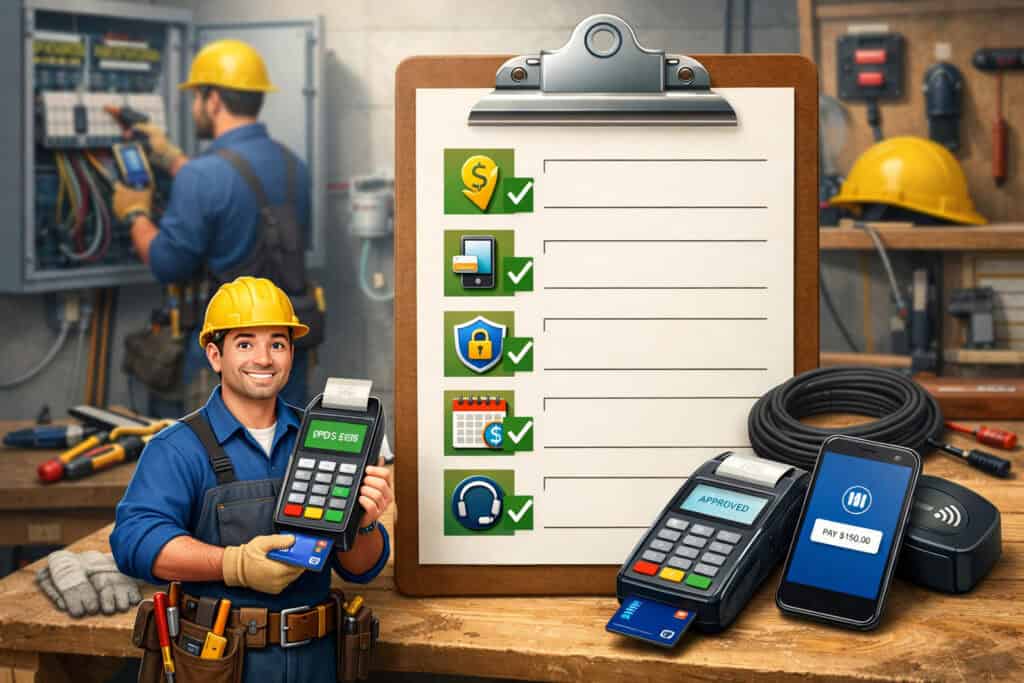
Before comparing brands, anchor on capabilities. For most service contractors, the “best” credit card processors for electricians check these boxes:
1) On-site payments that don’t slow you down: Look for mobile reader support and/or phone-based contactless acceptance. Tap-to-pay options are expanding fast, and Stripe’s Terminal Tap to Pay lets businesses accept contactless payments on compatible phones with no extra hardware in certain setups.
2) Invoicing and estimates that convert to payments: Electricians win when estimates turn into invoices and invoices turn into paid jobs—without retyping. Square positions its contractor tooling around estimates, invoices, reminders, and integrated workflows—exactly the type of flow many electricians need.
3) Transparent pricing that matches your ticket size: Flat-rate pricing can be fine for smaller tickets, but higher-volume or higher-ticket electricians often do better with interchange-plus structures, where you see the underlying interchange plus a markup.
Interchange is set by networks and changes periodically; Visa provides general guidance on fees and rules, and Mastercard publishes program details and rates in official documentation.
4) Fast deposits and strong support: A delayed deposit can mean delayed payroll or materials. Also prioritize real human support when a payment fails or a dispute lands.
5) Security and compliance: PCI DSS updates continue to raise the bar, including requirements that became mandatory after March 31, 2025 for many organizations, and the PCI Security Standards Council maintains the official document library.
Use this checklist as your filter so you’re comparing credit card processors for electricians on what actually impacts cash flow and admin time.
Pricing models explained for electricians: flat-rate vs interchange-plus vs membership
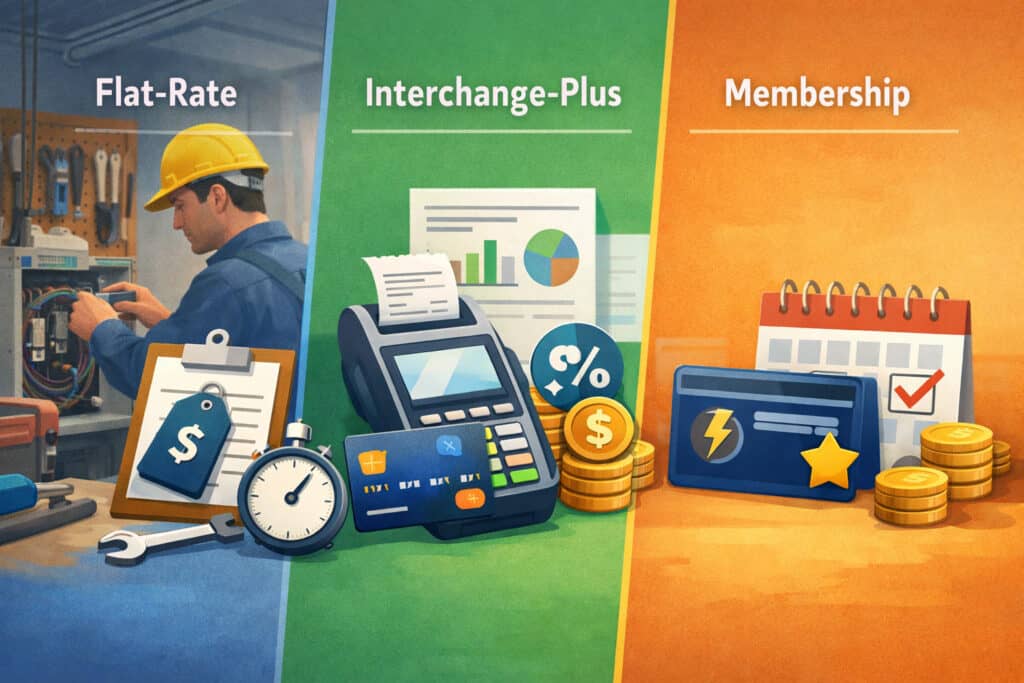
Most electricians see processor pricing in one of three common structures. Understanding them prevents surprises and helps you negotiate.
Flat-rate pricing charges a fixed percentage and cents amount per transaction. It’s simple and predictable, especially when you don’t have time to analyze statements. Many small businesses start here because setup is fast and there are fewer line items.
Third-party summaries commonly show ranges for flat-rate pricing in the market, and Square’s pricing is often discussed in those terms, with NerdWallet describing in-person and online ranges depending on plan tier.
Interchange-plus (cost-plus) separates the underlying interchange and assessments (network costs) from the processor’s markup. This is typically considered one of the most transparent approaches because you can see your wholesale cost and the added margin.
Visa explains interchange and fees at a high level, and Mastercard publishes official rate program documents. The catch: statements can look more complex, so you want a processor that explains the markup clearly in writing.
Membership or subscription pricing usually charges a monthly fee plus very low per-transaction markups. For electricians with consistent volume—especially commercial electricians with repeat billing—this can reduce effective rates. But it only wins if the monthly fee doesn’t outweigh savings.
The “best” pricing model depends on your average ticket, volume, and how many payments are keyed-in (manual entry) versus tap/chip. Keyed-in transactions often cost more and carry more risk, so electricians who do a lot of phone payments should pay special attention to that detail.
Best-fit recommendations: which processors tend to work best for different electrician profiles
There isn’t one universal winner. The best credit card processors for electricians depend on whether you’re a solo tech, a growing shop, or a commercial contractor.
Solo electrician or small crew (speed + simplicity)
If you want to start accepting payments immediately with minimal setup, a flat-rate provider with strong invoicing and mobile acceptance is often the practical move. Square markets contractor workflows that emphasize estimates, invoicing, reminders, and an integrated ecosystem—useful if you don’t want to stitch together multiple apps.
Growing residential shop (workflow + automation)
As you add techs, you’ll care more about user permissions, job tracking, and integration with scheduling/CRM tools. You may also benefit from more configurable invoicing, partial payments, and better reporting. This is usually where electricians start exploring interchange-plus options through a full-service merchant provider to control costs at higher volume.
Commercial electricians and high-ticket jobs (lowest effective cost + controls)
When single invoices can be several thousand dollars (or more), markup clarity, dispute tools, and bank transfer options become more important. You’ll want credit card processors for electricians that handle higher ticket sizes smoothly and provide documentation that helps defend against disputes.
A smart approach is to pick the platform that fits your workflow first, then optimize pricing structure second—because admin time is a real cost.
Square for electricians: strong for estimates, invoices, and on-the-go payments
Square is frequently chosen by service pros because it’s designed for fast setup and an all-in-one operational flow.
For electricians, that typically means you can create estimates, convert them into invoices, accept payment, and send receipts without juggling multiple vendors. Square also promotes contractor-specific workflow benefits like reusable templates, automated reminders, and integrated reporting.
Where Square often shines for electricians:
- Invoicing that customers actually pay: Digital invoices with reminders reduce “check is in the mail” delays.
- Mobile-first acceptance: Easy to take payments in the field.
- Ecosystem simplicity: Less time connecting tools.
Where electricians should be cautious:
- Cost at scale: Flat-rate structures can get expensive if you do high volume or high tickets.
- Keyed-in payments: If you manually type card numbers often, fees are typically higher than tap/chip.
If you’re comparing costs, use reputable breakdowns. NerdWallet’s Square fee overview discusses how pricing varies by subscription tier and transaction type.
Bottom line: Square is often among the best credit card processors for electricians who prioritize speed, simplicity, and strong invoicing—especially early on.
Stripe for electricians: flexible invoicing, online payments, and Tap to Pay possibilities
Stripe is best known as a payments infrastructure platform, but it has become increasingly relevant to field-service businesses through Stripe Terminal and Tap to Pay options that can reduce reliance on extra hardware in some setups.
Stripe’s Terminal Tap to Pay materials describe accepting contactless payments on compatible iPhone or Android devices, supporting physical cards and digital wallets.
Why electricians pick Stripe-based setups:
- Custom workflows: If you have a website, booking flow, or want to build a tailored payment experience, Stripe is strong.
- Online invoicing and payment links: Helpful for collecting deposits and final payments remotely.
- Tap to Pay direction: Reduces friction for taking payments anywhere, especially as more customers expect contactless.
Potential downsides:
- More DIY: Stripe can be simple for basic use, but advanced setups may require technical help.
- Support expectations: If you prefer hands-on onboarding, a traditional merchant provider might feel more direct.
Stripe can be a great choice for electricians who want modern payment experiences, smoother online collections, and future-ready options like Tap to Pay—especially if you already use software that integrates with Stripe.
QuickBooks Payments for electricians: convenient for bookkeeping, watch the fee details
If your business runs on QuickBooks for invoicing and accounting, QuickBooks Payments can feel like the easiest path: you invoice, the customer pays, and records land in the right place with less manual reconciliation.
However, electricians should pay attention to ACH and convenience-fee configurations. QuickBooks support documentation describes a scenario where a customer can pay an invoice by ACH bank transfer and pay an additional convenience fee (e.g., $25) when certain online payment methods are turned off.
QuickBooks also documents other ACH fee behaviors in specific invoice ranges and contexts. Additionally, industry commentary and analysis around QuickBooks Payments pricing changes appears frequently, so you should verify your exact plan details before assuming older pricing still applies.
Where QuickBooks Payments works well for electricians:
- Accounting-first workflow: Less double entry, fewer mismatched payments.
- Invoice-to-payment flow: Customers pay from the invoice, you track status.
Where to be careful:
- Total processing cost: Convenience can come at a premium compared with interchange-plus providers.
- Customer experience: Unexpected convenience fees can surprise customers if not explained clearly.
If you live in QuickBooks all day, QuickBooks Payments can still be one of the best credit card processors for electricians—just be intentional about fee settings and customer messaging.
Traditional merchant accounts and interchange-plus: best for established electricians optimizing cost
At a certain point—usually when you process steady monthly volume—electricians start asking a different question: “How do I reduce effective rates without breaking my workflow?” That’s where a traditional merchant account with interchange-plus pricing can win.
Interchange is the underlying cost set by networks and affected by transaction type (debit vs credit, card-present vs keyed, rewards categories, etc.). Visa provides guidance on interchange and merchant fees at a general level, and Mastercard publishes detailed interchange program documents.
Because interchange updates periodically, transparent pricing helps you see what’s changing and what your provider is actually adding.
Why electricians like interchange-plus:
- Negotiable markup: Your provider’s margin is clearer, which can be reduced as you grow.
- Better fit for high tickets: Flat-rate can be painful on large invoices.
- More control: You can often add features like advanced fraud tools, chargeback support, and specialized terminals.
Tradeoffs:
- More complex statements: You’ll want help understanding categories.
- Contract terms vary: You must review cancellation fees, equipment leases, PCI fees, and monthly minimums.
For established electricians, interchange-plus is often the most cost-effective route—especially if you still want strong field tools (mobile terminal, invoicing, virtual terminal) without consumer-app limitations.
Mobile payments for electricians: Tap to Pay, card readers, and jobsite reliability
Mobile acceptance is no longer optional for most electricians. Customers expect to pay immediately once the job is done, and the faster you collect, the healthier your cash flow is.
You typically have three mobile acceptance paths:
1) Tap to Pay on phone (contactless acceptance): Stripe Terminal describes Tap to Pay as enabling contactless payments directly on compatible iPhones and Android devices, including cards and digital wallets, without extra hardware in certain implementations. This is a big trend because it reduces the “I forgot the reader” problem. (Availability and implementation details vary by platform and integration approach.)
2) Bluetooth card reader + app: This is the familiar route: chip/tap/dip via a compact reader. It’s reliable, often works well in the field, and generally reduces keyed-in transactions.
3) Virtual terminal / keyed entry: Useful for phone payments and card-on-file (with proper permission), but usually higher cost and higher chargeback risk.
For electricians, the best credit card processors support at least two of these so you have a backup. If you work in areas with poor signal, also prioritize offline modes (where available), clear payment confirmation steps, and receipts that send when connectivity returns.
Invoicing, deposits, and progress billing: must-have features for electrician cash flow
Most electricians don’t just “swipe once and done.” You may need:
- Deposits to schedule labor
- Milestone payments for multi-day installs
- Change order billing when scope expands
- Final invoice after inspection
Square’s contractor resources emphasize estimates, invoices, recurring invoices, and automated reminders—features that map well to these realities. Stripe-based systems can also handle payment links and invoice-like workflows, especially if your scheduling or CRM tool integrates to generate payable links.
Key features electricians should demand from credit card processors:
- Partial payments: collect deposit now, remainder later.
- Saved payment methods (properly tokenized): for repeat customers and maintenance plans.
- Receipts and descriptors: clear receipts reduce “I don’t recognize this” disputes.
- Late-payment nudges: automated reminders raise your paid rate.
If you currently chase invoices, improving your invoicing flow can create more profit than shaving a few basis points off processing rates. That’s why the best credit card processors for electricians are often the ones that help you get paid faster, not just “cheaper.”
Chargebacks and disputes for electricians: how to reduce risk and win more cases
Chargebacks hurt twice: you lose the revenue and you waste time. Electricians can reduce chargebacks significantly with process and documentation.
Start with clear authorization. Your estimate should include scope, materials, timeline, and what triggers change orders. When you take a deposit, label it as a “deposit” on the receipt/invoice. For card-not-present payments, send an electronic receipt immediately.
Next, create a paper trail:
- Signed estimates or approvals (digital signatures help)
- Before/after photos (especially for panel work and large installs)
- Invoice notes documenting customer requests
- Delivery confirmation for materials billed separately
Then, make disputes harder to win against you by ensuring your descriptor (what shows on the customer’s statement) is recognizable. Many disputes begin with “I don’t recognize this merchant.”
Finally, use processor tools that support evidence submission and tracking. Even if two processors have similar rates, the one with better dispute workflows can be a better “value” for electricians because it protects revenue.
Legal and compliance: surcharging, convenience fees, and what electricians must watch in 2026
Electricians often ask: “Can I add a fee to cover processing?” The answer is: it depends, and you must follow rules carefully.
Surcharging rules vary by jurisdiction and card brand requirements. Business advocacy and guidance documents note key concepts like advance notice requirements, disclosure at point of entry and point of sale, and limits—plus the important distinction that debit card surcharges are broadly prohibited under network rules.
Many summaries also reference brand caps such as Visa’s 3% cap (as described in various merchant guidance discussions) and broader federal/network constraints. Because state rules vary and can change, state-by-state references are often maintained by industry sources, but you should validate with counsel before implementing.
Convenience fees are different from surcharges and typically apply to alternative payment channels under specific conditions. If you invoice customers through accounting platforms, pay attention to documented convenience fee behavior. QuickBooks, for instance, documents an ACH convenience fee scenario in its support materials.
For electricians, the safest route is often:
- Offer a cash discount program (properly structured) or
- Encourage bank transfer for large invoices (clearly disclosed), while
- Keeping card acceptance simple and transparent for customers.
Security: PCI DSS updates and what they mean for small electrician businesses
Security isn’t just for big companies. If you accept card payments, you’re part of a regulated ecosystem, and compliance expectations have tightened. PCI DSS v4.0.1 is the active standard family, and the PCI Security Standards Council publishes official documents and guidance.
Many of the “new” requirements introduced in PCI DSS v4.0 became mandatory after March 31, 2025 for many organizations, which is why security tools and vendor choices matter more in 2026.
What electricians should do in practical terms:
- Avoid storing card numbers anywhere (notes, text messages, spreadsheets).
- Use processors that provide tokenized card-on-file tools.
- Keep devices updated and locked (PIN/biometric).
- Use strong passwords and unique logins for each employee.
- If you take payments on a website, use approved checkout tools rather than DIY forms.
The best credit card processors for electricians make compliance easier by minimizing how much sensitive data you touch. In plain terms: the less card data you handle directly, the lower your risk.
How to choose: a step-by-step method electricians can use in under an hour
If you want a fast, high-confidence decision, use this method:
Step 1: Map your payment mix: Estimate what % is in-person vs invoice, and what % is keyed-in. If keyed-in is high, prioritize tools that reduce manual entry (Tap to Pay, payment links).
Step 2: Decide your workflow anchor: Are you accounting-first (QuickBooks), field-first (mobile + invoicing), or systems-first (CRM/job management integration)? Your anchor should drive your processor pick.
Step 3: Compare real cost, not teaser rates: Ask each provider for:
- Card-present rate
- Keyed-in rate
- Invoice/online rate
- Monthly fees
- Chargeback fees
- Equipment costs
If a provider offers interchange-plus, get the markup in writing.
Step 4: Test the jobsite experience: Send yourself an invoice, take a test payment, issue a refund, and see how long settlement takes.
Step 5: Validate support: Call support with a basic question. The response quality is often a preview of what happens when a payment is stuck.
This approach consistently leads electricians to the best credit card processors for electricians because it prioritizes fit, speed, and total cost—not marketing.
Future predictions: what’s likely to change for electrician payment processing through 2026 and beyond
Payment tech is evolving in ways that matter directly to field service.
- Tap to Pay adoption will keep accelerating: Providers like Stripe are actively promoting phone-based contactless acceptance as a mainstream option. As reliability improves and more customers default to digital wallets, electricians will increasingly close jobs with a phone tap instead of a reader.
- More pressure on transparency and fee scrutiny: Interchange and assessments remain a core cost, and networks continue publishing detailed program documentation. At the same time, business groups and regulators keep attention on fee impacts, which can influence future market behavior.
- Security requirements will keep tightening: PCI DSS v4.x is pushing better controls, especially for environments that host payment pages or scripts, and official PCI SSC guidance continues to evolve. Even small electricians will feel this through required best practices and platform defaults.
- ACH and account-to-account payments will grow for high-ticket invoices: That shift is driven by cost savings and customer preference on larger amounts, but fee structures (including convenience fees in some platforms) will keep shaping adoption.
For electricians, the practical takeaway is: choose a processor that’s strong today (mobile + invoices) and positioned for tomorrow (Tap to Pay, better security, flexible payment rails).
FAQs
Q.1: What are the best credit card processors for electricians right now?
Answer: The best credit card processors for electricians are usually the ones that match your workflow: strong mobile acceptance, fast invoicing, partial payments, and clear reporting. Square is often chosen for contractor-friendly estimates and invoices.
Stripe is a strong option for flexible online payments and Tap to Pay directions. QuickBooks Payments can be convenient if your invoicing and accounting live in QuickBooks, but review fee behaviors carefully.
Q.2: Should electricians choose flat-rate processing or interchange-plus?
Answer: Flat-rate is simpler and can be great for newer businesses or lower volume. Interchange-plus is often better for established electricians with steady volume or high-ticket jobs because the markup is clearer and frequently negotiable.
Visa and Mastercard publish guidance and program documentation that supports understanding how interchange works at a foundational level.
Q.3: Can I add a surcharge to cover credit card fees?
Answer: Sometimes, but rules vary by jurisdiction and card brand. Guidance documents highlight requirements like disclosure, notice, and caps, and also reinforce that debit surcharging is broadly restricted. Because state rules differ, state-by-state references exist, but you should verify with legal counsel before implementing.
Q.4: Is Tap to Pay a good option for electricians?
Answer: Yes—especially for on-site payments. Stripe’s Tap to Pay materials describe accepting contactless payments directly on compatible devices, reducing reliance on extra hardware in certain setups. The key is to ensure your provider supports your preferred device and your workflow (receipts, invoicing, deposits).
Q.5: What’s the biggest mistake electricians make when choosing a processor?
Answer: Choosing based only on a headline rate. The real cost includes keyed-in rates, monthly fees, chargeback fees, equipment, and the time you spend reconciling payments. The best credit card processors for electricians reduce admin time and improve collection speed—not just percent fees.
Q.6: Do I need to worry about PCI compliance as a small electrician business?
Answer: Yes, but you can keep it manageable by using reputable platforms that minimize card data handling. PCI DSS v4.x requirements and guidance are maintained by the PCI Security Standards Council, and many updated requirements became mandatory after March 31, 2025 for many organizations. Choose processors that keep you out of the business of storing or handling sensitive card data.
Conclusion
The best credit card processors for electricians aren’t defined by one “lowest rate.” They’re defined by fit: how fast you can take payment at the jobsite, how easily you can invoice and collect deposits, how cleanly payments sync with your books, and how well your processor helps you prevent disputes and stay compliant.
If you want the simplest start, an all-in-one platform built around estimates and invoicing can be a strong match for electrician workflows. If you want flexibility and modern payment experiences—especially with contactless acceptance trends—Stripe’s Tap to Pay direction is worth serious attention.
If bookkeeping convenience is your top priority, QuickBooks Payments may reduce admin work, but you should review current fee settings and update notes to avoid surprises. And if you’re scaling volume or doing higher-ticket work, interchange-plus merchant accounts can often deliver better long-term economics—provided the markup and contract terms are clear.
Meta Description –
Find the best credit card processors for electricians with this expert guide covering fees, mobile payments, invoicing, compliance, and future trends for contractors.