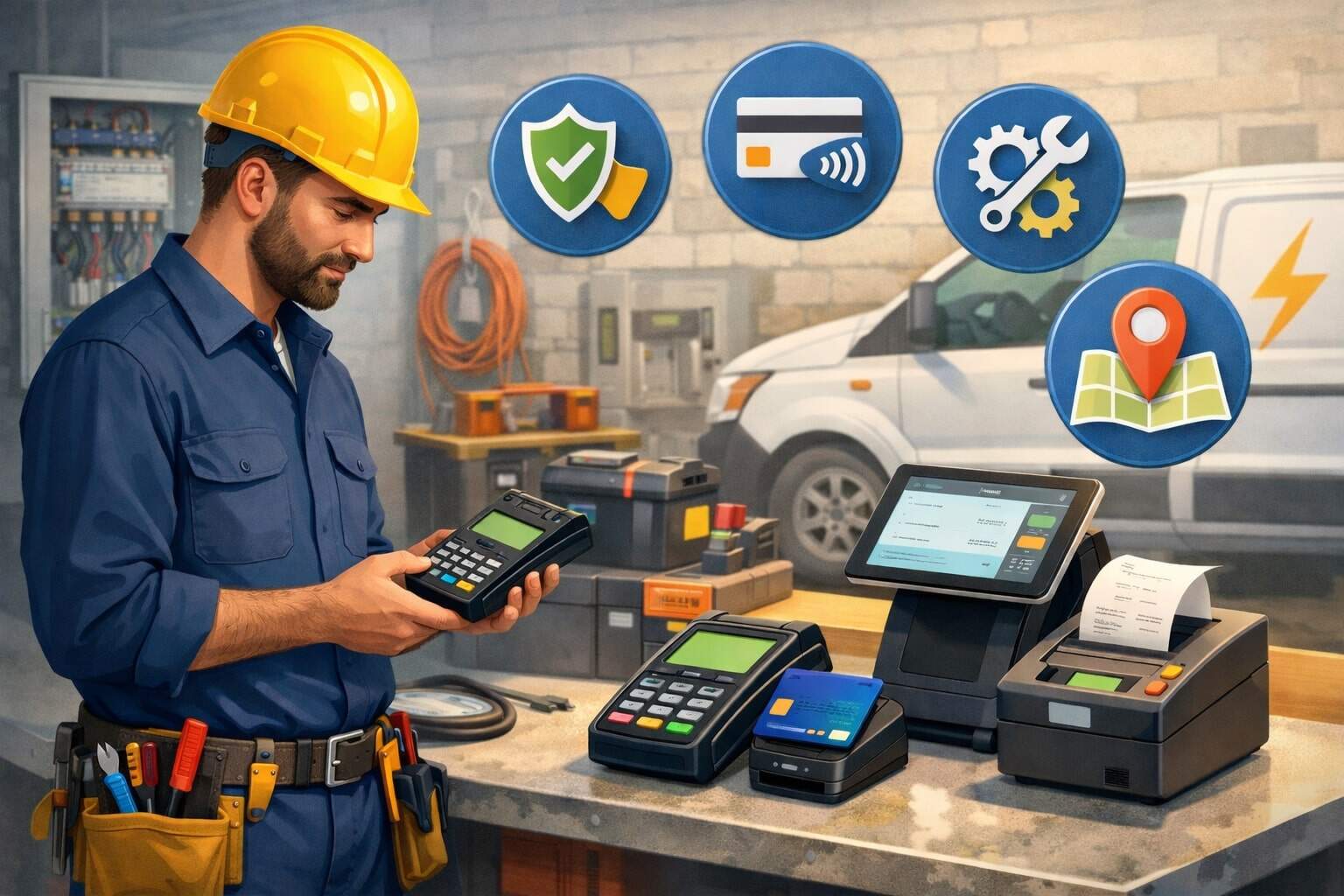
If you run an electrical business, you’re not just completing service calls—you’re managing scheduling, materials, labor hours, customer expectations, and cash flow. The moment you finish a job is also the moment you want to get paid.
That’s where an EMV terminal becomes a practical tool, not just a “payment device.” The right EMV terminal helps you collect payment on-site, reduce disputes, and create a smoother customer experience that feels modern and trustworthy.
Electrical work often involves high-ticket invoices: panel upgrades, rewires, EV charger installs, generator hookups, lighting retrofits, and commercial maintenance contracts.
Those invoices can be large enough that even one chargeback, one delayed payment, or one fraud incident creates a real headache. With an EMV terminal, chip transactions add stronger security than swipe-only payments, and contactless options help customers pay quickly without awkward handoffs.
But not every EMV terminal fits the way electricians work. Some businesses need rugged hardware for outdoor jobsites. Others need a compact mobile setup for residential work. Many need invoicing and job-costing integrations so every payment ties back to a specific work order.
This guide breaks down how to choose an EMV terminal that matches your workflow, protects your revenue, and supports where payments are heading next—without drowning you in jargon.
Why an EMV Terminal Matters in Electrical Contracting

Electrical businesses face a unique mix of payment challenges: jobs happen in homes, basements, rooftops, construction sites, and commercial facilities.
That means you’re often collecting money away from an office, sometimes in low signal areas, and sometimes while the customer is in a hurry. A reliable EMV terminal solves the “How do I get paid right now?” problem while also reducing the risk that comes with card-present transactions.
A modern EMV terminal supports chip and often contactless payments. Chip-based payments are designed to reduce counterfeit card fraud compared to magstripe swipes. In practical terms, that can mean fewer fraudulent transactions turning into lost revenue.
It also means fewer awkward moments when a card is declined repeatedly due to a worn magstripe. Customers notice when your checkout experience is smooth.
There’s also a professional perception factor. When an electrical business uses an up-to-date EMV terminal with tap-to-pay and digital receipts, it signals that the company is organized, tech-forward, and legitimate.
That perception matters when you’re charging premium rates for skilled labor. The same customer who might question a handwritten receipt is far less likely to question an invoice paid through a secure EMV terminal.
Finally, speed matters. Electrical service schedules are tight. If your technician can complete payment in two minutes instead of chasing a check later, you improve cash flow and reduce administrative follow-up. Over time, the right EMV terminal can reduce aging receivables and make your daily operations feel calmer.
EMV Security Basics and the Liability Shift (What It Means for You)
Understanding the security value of an EMV terminal doesn’t require you to become a payments expert. The key idea is that chip transactions are dynamic: the card and terminal create unique transaction data each time.
That makes it harder for criminals to clone cards and reuse stolen data. For an electrical business, that matters because jobs are often completed on-site, where you want the strongest “card-present” protections available.
The “liability shift” is a major reason businesses moved to EMV terminal acceptance. In many cases, if fraud happens on a chip-capable card but the business processed it as a swipe because they didn’t have a functioning EMV terminal, the business may be more likely to carry the loss.
This isn’t about blaming anyone—it’s about having the right tools so you don’t get stuck paying for fraud you didn’t cause.
In day-to-day operations, the biggest win is fewer fraudulent approvals turning into chargebacks. Electrical invoices can be large enough that fraudsters target them, especially for “urgent” work requests.
A proper EMV terminal can help you confidently accept card payments at the time of service, while the customer is present, with strong transaction authentication.
Also consider contactless. Tap transactions often use tokenization and additional security layers. When your EMV terminal supports tap, you’re offering a faster checkout that can also reduce physical handling of cards—useful when your crew is wearing gloves or working in dusty environments.
Customer Trust, Disputes, and Getting Paid the Day the Job Is Done
Electrical customers usually care about three things: safety, professionalism, and clarity on cost. The payment moment is part of that experience.
A dependable EMV terminal helps you present a clean final step: confirm the invoice, take the payment, and send a receipt. That lowers the chance of “I didn’t authorize this” claims because the process is standardized and documented.
Disputes and chargebacks often come down to confusion. Maybe the customer forgot the final total included materials. Maybe they expected a different scope. Maybe they didn’t recognize the business name on their statement.
When you use an EMV terminal that supports itemized receipts, signature capture (when needed), and consistent descriptor settings, you reduce that confusion.
For field service electrical companies, fast payment also protects scheduling. If you’re booking jobs daily, you don’t want office staff calling customers for overdue balances.
A technician with an EMV terminal can collect immediately and keep moving to the next job. That reduces downtime and improves your ability to take on more calls.
It’s also about customer convenience. Some clients don’t carry checks. Others want to use a card for rewards or financing flexibility. If your EMV terminal supports chip, tap, mobile wallets, and digital receipts, you become easier to do business with—and that can directly affect reviews and referrals.
Types of EMV Terminals That Fit Electrical Business Workflows
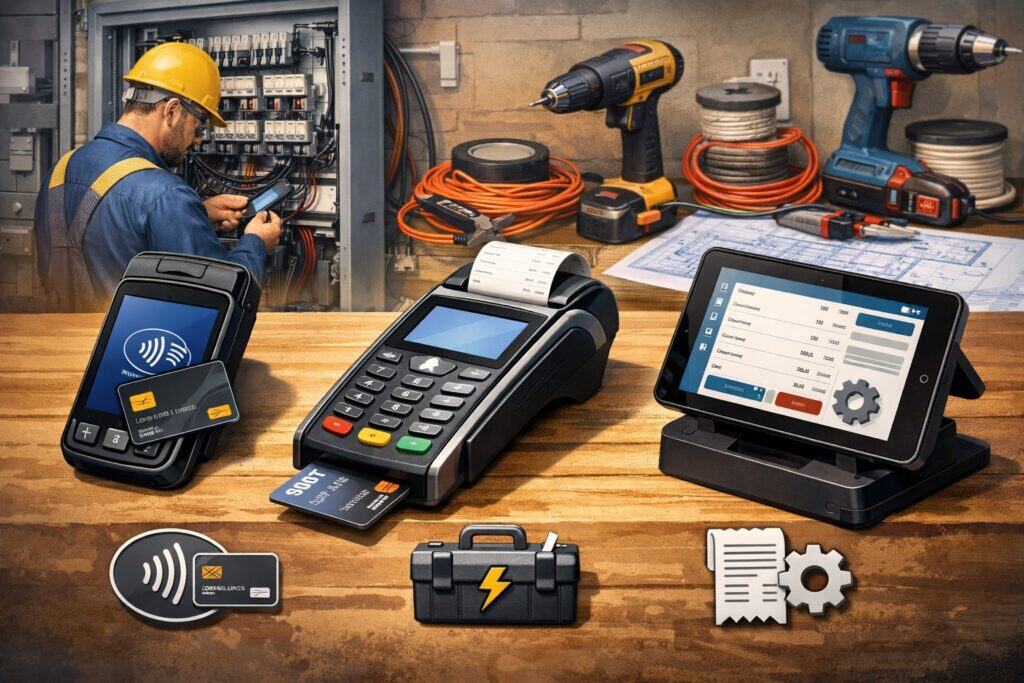
Not all electrical businesses operate the same way. Some have a shop office where customers pay for permits, parts, or service plans. Others are almost entirely field-based. Choosing the right EMV terminal starts with choosing the right category of terminal for your workflow, then narrowing down features.
A “one-size-fits-all” approach can backfire. A countertop unit may be perfect for an office but frustrating on job sites. A mobile EMV terminal may be perfect for a technician but less efficient for high-volume service plan renewals at the front desk.
Many electrical companies end up with a hybrid approach: one countertop EMV terminal for the office and several mobile EMV terminal devices for the field.
Your choice also impacts reliability. Job sites can be hard on equipment. Dust, heat, cold, rain, and drops are common realities. A fragile EMV terminal might look sleek, but a rugged model can save money by avoiding replacements and downtime.
Beyond hardware, think about how payments connect to your systems. Some EMV terminal models work best as standalone units.
Others integrate tightly with invoicing, dispatching, and accounting tools. If you want the payment to automatically mark a job as paid and trigger a receipt, your EMV terminal selection should prioritize integration.
Countertop EMV Terminal for the Office, Shop, or Service Desk
A countertop EMV terminal is a strong choice when you collect payments in a fixed location—your office, shop counter, or warehouse desk.
These devices typically plug into power and connect via Ethernet or Wi-Fi. Because they’re stationary, they often deliver highly consistent performance and can be easier to support.
For an electrical business, a countertop EMV terminal helps in several scenarios: collecting deposits, processing service plan renewals, selling parts, taking payments for inspections, and handling walk-in requests.
If your office staff processes payments daily, a countertop setup can be faster than mobile devices and can support peripherals like receipt printers and cash drawers if needed.
Countertop models also tend to be comfortable for customers. They’re familiar, with clear prompts and stable chip readers. That can reduce the time spent explaining how to pay.
If your business sometimes takes payments over the phone and then runs a card-present transaction when the customer arrives, having a reliable countertop EMV terminal improves consistency.
When evaluating countertop options, look for strong receipt customization and easy settlement reporting. Your office team should be able to reconcile transactions quickly, export batches, and match payments to invoices.
A countertop EMV terminal is often the “hub” of clean bookkeeping—especially if your field team occasionally drops payments into the office workflow.
Mobile and Wireless EMV Terminal for Field Technicians and On-Site Jobs
For many electricians, the best EMV terminal is the one that can ride in a tool bag and work anywhere. A mobile EMV terminal is designed for field service: built-in battery, compact body, and wireless connectivity (Wi-Fi, cellular, or both). If your business completes work at customer locations, this category is often the primary choice.
A field-ready EMV terminal reduces delayed payments. Your technician completes the job, walks the customer through the invoice, and takes payment immediately. That’s a big improvement over “We’ll email you an invoice” when the goal is faster cash flow.
It also reduces check-handling risks like bounced checks, misplaced checks, or drivers forgetting to bring checks.
Connectivity is the big factor. If you work in areas with unreliable Wi-Fi, choose a mobile EMV terminal with cellular capability. If you do a lot of work inside commercial buildings with restricted cell reception, Wi-Fi fallback matters. The most practical setups support multiple connection methods so the EMV terminal can keep working.
Also think about the reality of job sites. A mobile EMV terminal should be easy to use with one hand, readable in sunlight, and durable enough to survive drops.
If you frequently work in dusty or wet conditions, prioritize rugged construction and protective cases. The right mobile EMV terminal can pay for itself simply by preventing one or two “I couldn’t run the card” situations per week.
Key Features to Look for in an EMV Terminal for Electricians
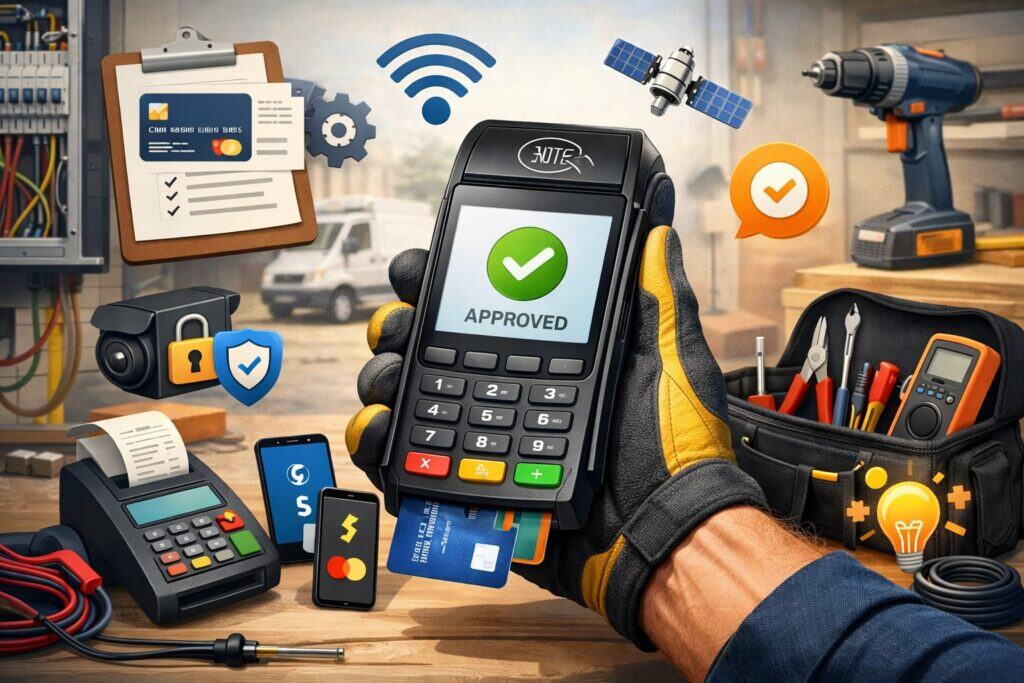
Once you’ve chosen the general category—countertop, mobile, or hybrid—the next step is evaluating features. The best EMV terminal for an electrical business isn’t just secure; it’s practical. It should match how your team works, reduce friction at checkout, and help the office reconcile payments without extra manual labor.
A smart selection focuses on real-world needs: job site connectivity, battery life, durability, receipt options, security certifications, and integration with invoicing tools. It also includes customer-facing experience: screen clarity, tap-to-pay support, and clear prompts. An EMV terminal that confuses customers slows everything down.
Security should not be treated as a checkbox. Electrical invoices can be large. You want a secure EMV terminal that supports modern encryption, tokenization, and up-to-date PCI-aligned practices. You also want the payment environment to reduce chargebacks by keeping records clean.
Finally, consider scalability. If you’re growing from two technicians to ten, you don’t want to replace your EMV terminal fleet because the system can’t handle multiple users, roles, or reporting needs. The right EMV terminal choice supports growth without forcing a full overhaul later.
Connectivity, Battery, and Offline Capabilities (Real Job-Site Reality)
Connectivity is often the make-or-break feature for a field EMV terminal. If your technicians can’t reliably process payments, they’ll revert to invoicing later—and you lose the point of on-site acceptance.
For mobile setups, prioritize an EMV terminal that supports multiple connection types: cellular data plus Wi-Fi, or Wi-Fi plus hotspot support. This gives you a backup plan when one network fails.
Battery life matters more than many businesses expect. Electrical crews often work long days, sometimes in extreme temperatures that reduce battery performance. A strong EMV terminal should last through a full shift with typical usage.
If you run multiple transactions per job, choose a model known for solid battery performance, fast charging, and dependable power management.
Offline mode can also help, but it needs careful handling. Some systems allow “store and forward” where a transaction is captured and processed later when connectivity returns. This can be useful in basements, remote sites, or large facilities with poor signal.
However, offline acceptance can increase risk because approval isn’t always guaranteed until later. If you plan to use offline features, set clear rules: maximum ticket size, customer verification steps, and a process for what happens if a transaction fails later. A good EMV terminal provider will explain these limits clearly.
For office terminals, Ethernet is often the most stable connection. If your service desk is busy, wired connectivity reduces random Wi-Fi issues. Whether office or field, the best EMV terminal is the one that stays connected when it matters.
Durability, Display, and Technician-Friendly Design
Electrical work is hands-on. Devices get set down on ladders, stacked near toolboxes, and used in garages, attics, and outdoor panels. A fragile EMV terminal can become a hidden cost through repairs, replacements, and downtime. For field use, prioritize durability: tough casing, drop resistance, and protective accessories.
Screen readability is also a practical concern. A glossy screen that’s unreadable in sunlight will slow checkout. Choose an EMV terminal with a bright display, responsive touch, and clear prompts. Customers should be able to see the amount, choose tip options (if you use them), and complete tap or chip steps without confusion.
Button layout and speed matter too. Some technicians prefer touchscreen-only devices, while others prefer a physical keypad for quick entry. If your crew frequently wears gloves, a keypad can be more reliable.
A technician-friendly EMV terminal should be quick to wake, quick to connect, and easy to navigate without a long training curve.
Receipt handling also affects usability. Some mobile EMV terminal devices print receipts; others send digital receipts via text or email.
Digital receipts often reduce hassle, but printing can still be valuable for certain customers or commercial clients that require paper records on the spot. The right EMV terminal choice supports both, or at least offers a workflow that won’t frustrate your team.
Security and Compliance Features You Should Not Compromise On
Security is one of the main reasons to invest in a modern EMV terminal, so it deserves a deeper look. At minimum, the EMV terminal should support chip transactions and strong encryption.
Many modern systems also support tokenization, where sensitive card data is replaced with tokens that are safer to store and use for follow-up payments.
Look for a security stack that helps reduce your operational exposure. Features like end-to-end encryption and point-to-point encryption (often called P2PE) can reduce the chance that card data is exposed during processing.
For an electrical business, this matters because you may have multiple devices in the field, multiple technicians, and less centralized control than a retail counter. The right EMV terminal setup makes it easier to keep security consistent across your team.
Also pay attention to access control. Can you assign user roles? Can you require passcodes? Can you restrict refunds to managers? These controls reduce internal errors and help prevent unauthorized activity. Your EMV terminal isn’t just a payment tool—it’s part of your financial control system.
Finally, keep an eye on updates. Payment security standards evolve. A strong EMV terminal provider offers firmware updates, security patches, and ongoing compliance support.
If your terminal is outdated, you may run into compatibility issues or increased risk over time. A future-ready EMV terminal is one that can stay current without forcing hardware replacement every couple of years.
Matching the EMV Terminal to How You Bill, Quote, and Close Jobs

Electrical businesses don’t sell “items” the way a retail shop does. You quote work, you scope materials, you change orders, you invoice labor and parts, and you often collect deposits or progress payments. That means your EMV terminal should fit your billing style—not fight it.
If you mainly do residential service calls, you may want fast invoicing and immediate payment at job completion. If you do commercial work, you may need partial payments, purchase order references, and detailed receipts.
If you run a mix of service and project work, the right EMV terminal should support both quick checkout and more complex invoice handling.
Integrations are the difference between “payments are easy” and “payments create extra admin work.” A well-matched EMV terminal can link payments to invoices, mark jobs as paid, and push data into accounting software. That reduces manual entry and the chance of errors.
Also consider how you handle deposits. Many electrical businesses collect a deposit at scheduling and the remainder after completion. A good EMV terminal workflow supports these split payments cleanly and keeps records clear for both the customer and your office team.
Integration with Invoicing, Field Service Software, and Accounting
If your team uses field service software for scheduling and job tracking, your EMV terminal choice should align with that ecosystem. The goal is simple: create the invoice once, take payment once, and have everything reconciled automatically. When payments flow back into your invoicing system, it reduces the time your office spends chasing paperwork.
For an electrical business, integration also improves clarity. When a technician takes payment through an integrated EMV terminal workflow, the customer’s receipt can include job details, company branding, and invoice references. That reduces confusion later if the customer reviews their statement and wonders what the charge was for.
Accounting integration matters just as much. If payments export cleanly to your bookkeeping platform, you reduce end-of-month stress.
Look for a setup where each EMV terminal transaction includes metadata: technician ID, job number, customer name, and location. This helps you analyze which services generate the best margins and which crews close payments fastest.
Also consider multi-user management. As your team grows, you want to manage multiple EMV terminal devices, assign them to technicians, and control permissions. A system that supports centralized reporting and device management will save time and reduce mistakes, especially when refunds or voids occur.
Receipts, Customer Communication, and Reducing “I Don’t Recognize This Charge”
Many disputes start with a simple problem: the customer doesn’t recognize the charge. A well-configured EMV terminal can reduce this by ensuring your business name appears clearly and consistently. It can also provide digital receipts that customers can search later.
For electrical work, receipts should do more than show a total. They should reference the invoice number, job address (when appropriate), and a short description of services. When your EMV terminal supports custom receipt fields or integrates with your invoicing system, you reduce the chance of confusion.
Digital receipts are especially useful for service calls. Customers often misplace paper, but they keep texts and emails. A good EMV terminal setup can send a receipt immediately and optionally include a link to the full invoice. This improves customer satisfaction and reduces follow-up calls to the office.
Customer communication also supports repeat business. If your receipt includes your service number, website, and a reminder about maintenance services, it can become a subtle marketing tool. The EMV terminal isn’t just for getting paid—it’s also a touchpoint that can reinforce professionalism and drive referrals.
Understanding Costs: Hardware, Processing, and Total Cost of Ownership
Cost is more than the price tag on an EMV terminal. Electrical businesses should evaluate the full cost of accepting payments: hardware, software, processing rates, chargeback exposure, support, and time spent reconciling transactions.
The cheapest EMV terminal can become expensive if it fails on job sites, causes billing errors, or lacks the reporting you need.
Start by separating one-time costs from ongoing costs. Hardware might be purchased upfront or provided under a monthly program. Software might include monthly fees for reporting, invoicing features, or device management. Processing costs depend on your pricing model and transaction mix.
Electrical businesses often have higher average ticket sizes than many retail shops. That changes the math. A small difference in processing rate can add up quickly over a year.
At the same time, reliability and security matter more because one lost transaction can be significant. The best approach is to choose an EMV terminal solution that balances cost with operational stability.
Also consider the cost of delayed payments. If a better EMV terminal allows your technicians to collect on-site instead of invoicing later, your cash flow improves. That’s a real financial benefit that often outweighs small differences in monthly fees.
Buying vs. Renting an EMV Terminal (and What to Watch For)
Many providers offer multiple ways to obtain an EMV terminal: purchase outright, finance, or rent under a monthly plan. Buying can be cost-effective over time, especially if you keep devices for years. Renting can reduce upfront costs and may include replacements, updates, or support.
For an electrical business, renting can be attractive if you want to scale quickly. If you’re adding technicians, you can add an EMV terminal as needed without large upfront spending. Renting also helps if you prefer predictable monthly expenses.
However, watch for contract details. Some rental agreements lock you into long terms, and total cost can be much higher than buying. Also check whether the rented EMV terminal is truly modern and upgradeable, or if you’re paying monthly for older hardware.
If you buy, confirm the device is compatible with your chosen processor and supports future payment methods like contactless and mobile wallets. Buying an EMV terminal that becomes obsolete too soon can force early replacement.
A practical approach for many electrical businesses is a blended strategy: purchase countertop units for the office and use a managed plan for field devices that take the most physical wear. That way, the EMV terminal fleet stays reliable without surprise replacement costs.
Processing Pricing Models Electricians Commonly Encounter
Processing costs are where many businesses feel confusion. Your EMV terminal is the hardware, but the merchant account and pricing model determine what you pay per transaction. Common pricing structures include flat-rate, interchange-plus, and tiered pricing.
For an electrical business with higher ticket sizes, interchange-plus is often considered because it can be more transparent. Flat-rate can be simpler, especially for small teams or low transaction volume, but it can cost more as volume grows.
Tiered pricing can be harder to evaluate because “qualified” and “non-qualified” categories aren’t always predictable.
Also consider how you accept payments. Chip and contactless transactions through an EMV terminal often qualify for better card-present categories than keyed-in transactions.
If your technicians frequently key in cards because the EMV terminal isn’t convenient, you may pay higher fees and increase risk. That’s another reason to choose the right EMV terminal for field use.
Ask about additional fees that affect total cost: monthly minimums, statement fees, PCI program fees, chargeback fees, and equipment support charges. A good EMV terminal solution should come with clear, readable pricing so you can project costs accurately.
Deployment and Training: Rolling Out EMV Terminals Without Disrupting Work
A new EMV terminal system should make life easier, not create confusion. Deployment is where many businesses stumble: devices arrive, settings aren’t standardized, technicians do different things in the field, and the office can’t reconcile transactions cleanly. A thoughtful rollout prevents that.
Start with a standardized workflow. Decide how the technician will present the invoice, confirm the total, and process payment. Decide when signatures are collected, when receipts are sent, and how tips (if any) are handled. Then configure each EMV terminal to follow the same prompts and receipt format.
Training should be practical and short. Most technicians don’t want a lecture on payments. They want a reliable checklist: how to connect, how to run chip vs tap, what to do if the EMV terminal can’t connect, and how to handle refunds or voids properly. A short “field guide” can prevent expensive mistakes.
Also plan for support. If a device fails during a busy day, your team needs a backup process. That might be a second EMV terminal, a hotspot, or a phone-based payment option for emergencies. Your goal is continuity—so payment collection doesn’t depend on perfect conditions.
Day-One Setup Checklist for Field and Office Use
When you deploy an EMV terminal, you want day-one to be smooth. For office units, confirm network stability first. Ethernet is usually best. For Wi-Fi, ensure the signal is strong where the EMV terminal sits and that the network doesn’t require frequent re-authentication.
For field units, confirm each EMV terminal is paired properly, activated, and tested in real conditions. Run a test transaction in the parking lot, not just inside the office. Check cellular connectivity, Wi-Fi fallback, and receipt delivery. Confirm the device can send receipts via text or email and that the branding looks correct.
Next, set up user roles. If technicians should not issue refunds without approval, configure the EMV terminal permissions accordingly. This protects your business from accidental or unauthorized refunds.
Then align reporting. Decide how the office will reconcile daily batches. If you have multiple EMV terminal devices, ensure each transaction includes a technician identifier or device label. That makes it easier to track payments and resolve questions quickly.
Finally, document the workflow. A one-page guide in each truck helps. When the EMV terminal is treated like any other tool—with a standard process—your team will adopt it faster and make fewer mistakes.
Troubleshooting, Chargeback Prevention, and Recordkeeping
Troubleshooting is inevitable. The difference is whether it becomes a minor annoyance or a major operational problem. Common issues include connectivity drops, low battery, incorrect tax settings, and receipt delivery failures. A good EMV terminal provider will offer clear support channels and fast replacement options.
Chargeback prevention is mostly about documentation. Make sure your process includes clear customer authorization. Chip and contactless through an EMV terminal already help, but you should also maintain job notes, signed estimates when appropriate, and clear invoices.
When disputes happen, your ability to show what was done, when it was done, and how the customer approved payment can make a huge difference.
Recordkeeping should be simple. Your EMV terminal system should support exporting transactions, filtering by technician, and matching payments to invoice numbers. If you do commercial work, store purchase order references and customer contact details for follow-up.
Also keep a consistent refund policy. If a customer disputes an amount, it’s better to resolve it quickly with proper adjustments than to let it escalate. A well-managed EMV terminal workflow supports professional dispute resolution without chaos.
Future-Proofing: Where EMV Terminals and Field Payments Are Headed
Choosing an EMV terminal isn’t just about today. Payment technology is evolving fast, and electrical businesses should choose tools that won’t feel outdated in a year or two. The biggest direction is mobility: more payments happen in the field, more customers expect tap-to-pay, and more businesses want systems that reduce hardware dependency.
Contactless is continuing to grow. Customers increasingly expect to tap a card or phone. A future-ready EMV terminal should support tap and popular mobile wallets. That’s not just convenience—it also reduces friction and can speed up checkout at the end of a job.
Another trend is “software-based acceptance,” where a phone can become a payment device. This doesn’t eliminate the need for an EMV terminal in every scenario, but it can become a useful backup or a flexible option for new technicians. If your provider supports both dedicated hardware and phone-based acceptance, you gain resilience.
Real-time systems and smarter fraud controls are also changing expectations. Businesses want faster funding, better reporting, and automated risk checks. A forward-looking EMV terminal solution should come with modern dashboards, faster settlement options when available, and security features that improve over time through updates.
Tap-to-Phone (SoftPOS) as a Backup or Expansion Option
Tap-to-phone, sometimes called SoftPOS, is one of the most important future trends for service businesses. Instead of carrying a separate EMV terminal, a technician may be able to accept contactless payments directly on a compatible phone. For an electrical business, this can be valuable in a few ways.
First, it’s a backup. If a dedicated EMV terminal battery dies or a device is lost, the technician can still collect payment. Second, it can help scaling. When you hire a new technician, you can get them to accept payments immediately while you deploy another EMV terminal.
That said, SoftPOS doesn’t replace every situation. Some customers still prefer chip insertion. Some job sites require printed receipts. Some businesses want the durability of a dedicated EMV terminal. The best strategy is often a hybrid: dedicated devices for daily use, plus phone-based acceptance as a flexible option.
If you want to be future-proof, ask your provider whether your account supports both. A modern setup treats the EMV terminal as one part of a broader payments toolkit rather than a single point of failure.
Smarter Security, Faster Funding, and Customer Expectations
Security improvements are moving toward stronger authentication, better tokenization, and more advanced fraud detection. Over time, an EMV terminal will increasingly be part of a broader security environment that includes device monitoring, anomaly detection, and tighter controls on refunds and manual entry.
Faster funding is another direction. Many service businesses want quicker access to revenue so they can buy materials, pay crews, and manage cash flow. While funding speed depends on your provider and banking relationships, choosing an EMV terminal ecosystem with modern settlement options can give you more flexibility.
Customer expectations will keep rising. More homeowners and property managers want instant digital receipts. More commercial clients want invoice references tied to payments. More customers want tap-to-pay as the default. The EMV terminal you choose today should help you meet those expectations without constant workarounds.
A good future-ready approach is to choose an EMV terminal solution that updates regularly, supports multiple acceptance methods, and provides clean integrations. That way, as the payments landscape evolves, you’re not forced into disruptive changes just to keep up.
FAQs
Q.1: What is the best EMV terminal setup for a small electrical business with 1–3 technicians?
Answer: For a small electrical business, the best setup is usually one reliable mobile EMV terminal per working technician, plus an optional countertop EMV terminal if you take deposits or walk-in payments at the office.
The reason is simple: cash flow improves when each technician can close out invoices on-site. You avoid the lag of emailing invoices and waiting days for payment.
A small team should prioritize simplicity and reliability. Choose a mobile EMV terminal that supports chip and contactless, has strong battery life, and offers both Wi-Fi and cellular options if you work in varied areas. If you only choose one connectivity type, you’ll eventually run into a job site where it fails.
Also consider your admin time. A good EMV terminal solution should provide an easy dashboard for daily totals and exports. When your office work is limited, clean reporting prevents reconciliation headaches.
If your job management software supports payment integration, choosing an EMV terminal ecosystem that syncs invoices and payments can save hours each month.
Q.2: Do electricians really need contactless, or is chip enough?
Answer: Chip acceptance is essential, but contactless support is increasingly expected. A modern EMV terminal that supports both chip and tap gives you flexibility and improves the customer experience. Many customers now prefer tapping a card or phone because it’s fast and feels familiar.
For electricians, contactless is especially practical in the field. Customers can pay quickly at the end of a job without extended handling of cards. In dusty environments or when gloves are involved, tap can be smoother than inserting a chip.
It also helps when a chip reader struggles with a damaged card. If your EMV terminal supports tap, you have an alternate path to complete payment.
From a business standpoint, reducing checkout friction means fewer “Can you send me an invoice instead?” moments. And fewer delayed payments usually equals better cash flow. In most cases, choosing an EMV terminal without contactless today is like buying a work vehicle without enough cargo space—you’ll feel the limitation sooner than you expect.
Q.3: Can a mobile EMV terminal work in basements or large commercial buildings with weak signals?
Answer: A mobile EMV terminal can work in challenging environments, but only if you plan for connectivity. Basements and large commercial buildings can block cellular signals. That’s why a dual-connection strategy is valuable: choose an EMV terminal that supports both cellular and Wi-Fi, and train technicians to switch when needed.
If Wi-Fi is available (for example, the customer’s network), you can connect temporarily if your policies allow it. In commercial settings, guest Wi-Fi may be restricted. In those cases, a hotspot or a second connectivity option can keep your EMV terminal online.
Offline modes exist in some systems, but they should be used carefully. If your EMV terminal stores a transaction to process later, you may face risk if the transaction fails after you leave.
For higher-ticket electrical invoices, many businesses set limits on offline acceptance or require alternative verification. The safest approach is to choose an EMV terminal solution with strong multi-network support so you rarely rely on offline workarounds.
Q.4: How do EMV terminals help reduce chargebacks for electrical services?
Answer: Chargebacks often come from fraud, misunderstanding, or documentation gaps. An EMV terminal helps in two major ways: stronger card-present security and clearer evidence of payment authorization.
Chip and contactless transactions are generally more defensible than keyed-in transactions because the card (or device) was present at the time of payment.
For electrical services, documentation is the other half of the solution. If your EMV terminal system ties payments to invoices, includes invoice numbers on receipts, and supports digital receipt delivery, customers are less likely to forget what the charge was for. That reduces “I don’t recognize this” disputes.
When a chargeback does occur, having accurate records matters. A strong EMV terminal setup supports transaction logs, time stamps, device identifiers, and receipt copies.
Pair that with your work order notes, signed approvals (when used), and clear scope documentation, and you significantly improve your ability to respond. The key is choosing an EMV terminal that supports clean records rather than forcing you into manual tracking.
Q.5: Should an electrical business choose a standalone EMV terminal or an integrated system?
Answer: It depends on how you run operations, but many electrical businesses benefit from integration. A standalone EMV terminal can be simple and reliable for basic payments. If you mainly do quick service calls and don’t need deep reporting, standalone may be enough.
However, integration becomes valuable when you want payments to automatically match invoices, update job statuses, and sync with accounting.
Electrical businesses often manage multiple technicians, multiple job types, deposits, change orders, and material-heavy invoices. In those cases, an integrated EMV terminal workflow reduces admin time and mistakes.
If you’re scaling, integration can pay off fast. Instead of manually entering payments, you get cleaner books and better visibility into revenue per technician and job type. The best long-term approach is often choosing an EMV terminal solution that can operate standalone if needed but offers integrations as you grow—so you’re not boxed into one workflow.
Conclusion
Choosing the right EMV terminal for your electrical business is about matching technology to real work conditions. The best EMV terminal is the one that helps your team get paid immediately, reduces disputes, holds up on job sites, and keeps records clean for the office.
Start with your workflow: office-only, field-first, or hybrid. Then prioritize reliability—connectivity, battery life, and durability—because a payment tool that fails in the field creates delayed invoices and lost time.
Next, treat security and documentation as revenue protection. A modern EMV terminal that supports chip and contactless, strong encryption, and good reporting reduces risk and improves customer trust. If you can integrate payments with invoicing and accounting, you reduce admin labor and prevent reconciliation errors—especially as you add technicians.
Finally, think ahead. Customer expectations are moving toward tap-to-pay, digital receipts, and faster checkout everywhere. Future-friendly options like tap-to-phone can serve as a backup and help you scale. If your EMV terminal solution can evolve through updates and supports multiple ways to accept payments, you’ll be in a strong position for the next phase of field service payments.