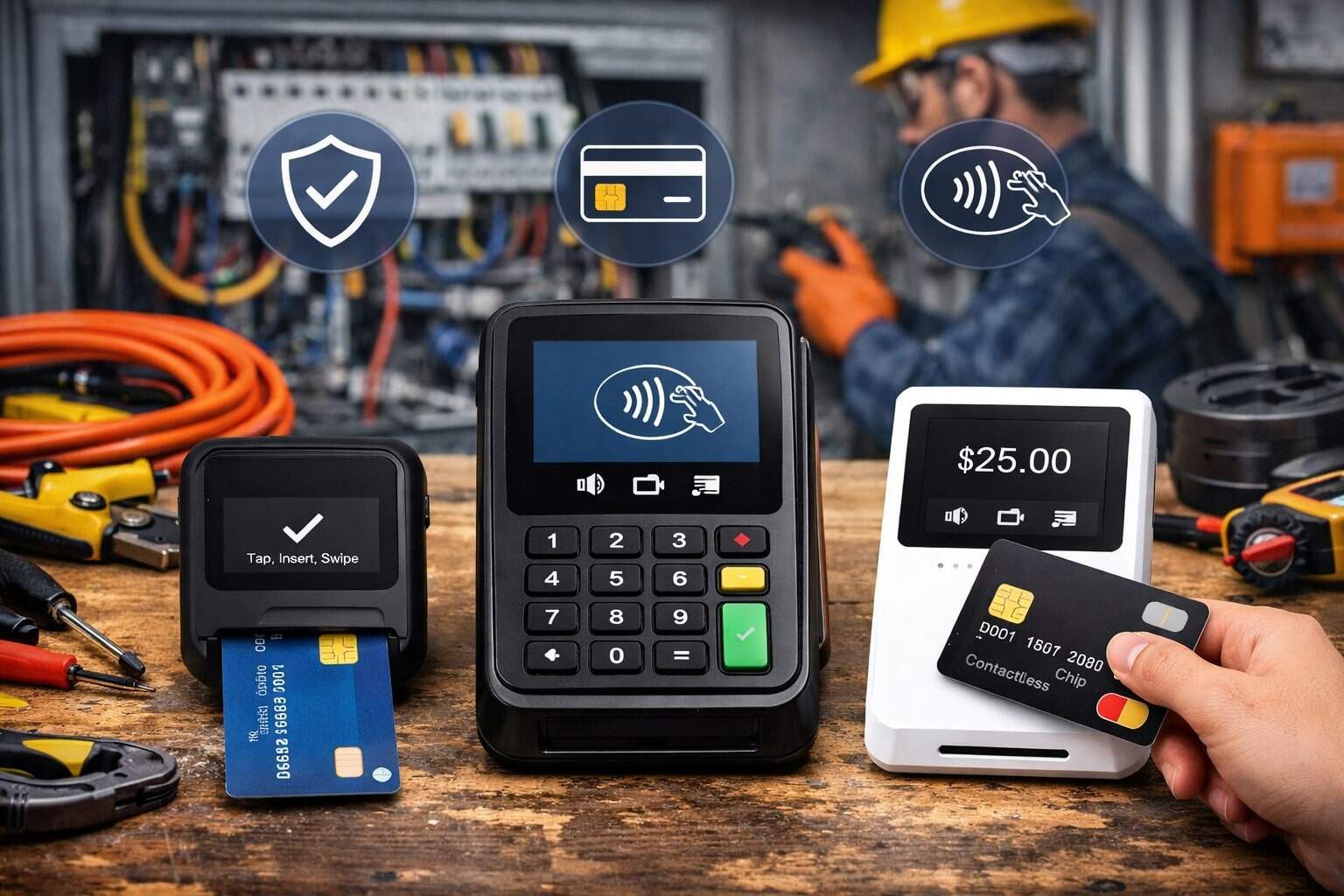
If you run electrical service calls, you already know the hard part isn’t collecting payment—it’s collecting payment on time, on site, and without friction. That’s where EMV-compliant readers for electricians earn their keep.
“EMV” refers to chip-card payment standards designed to make in-person payments more secure and consistent across cards and terminals. EMV specifications help standardize the interaction between payment products and the point of sale, supporting secure, reliable card-present payments.
For electricians, the “best” reader is rarely the fanciest one. The best EMV-compliant readers for electricians are the ones that survive daily jobsite reality: dusty trucks, glove-friendly workflows, spotty signals, deposits and partial payments, and customers who want to tap their phone and move on.
You want fast “dip or tap” acceptance, clean receipts, quick invoice matching, and fewer chargebacks or disputes.
This guide breaks down what EMV compliance actually means in the field, what features matter most for electrical contractors, and which EMV-compliant readers for electricians are practical picks today—plus where card acceptance is heading next (like phone-based tap acceptance and software-only terminals).
What “EMV-Compliant” Means for an Electrician in the Field

When you’re choosing EMV-compliant readers for electricians, “EMV-compliant” should translate into one clear outcome: you can accept modern chip and contactless payments in a way that aligns with current security expectations.
EMV is the standard behind chip cards, and it’s a major reason counterfeit fraud is harder at the point of sale than it used to be. Chip transactions create a more secure interaction than older swipe-only payments, which is why chip acceptance became the baseline expectation for card-present businesses.
In electrician terms, think of EMV like code compliance: it’s not just a box to check—it changes what’s considered “safe and acceptable” by the industry. Customers recognize chip and tap as normal. If you’re still using swipe-only tools, you’ll look outdated, and you may expose yourself to greater payment risk and customer friction (especially on higher-ticket work).
There’s also a practical side: EMV-capable readers typically support NFC contactless, meaning Apple Pay and other mobile wallets. That matters on service calls where customers are juggling kids, pets, or a busy schedule.
Tapping a phone is faster than digging out a card, and speed directly impacts how quickly you can wrap up a job and move to the next one.
Finally, EMV compliance is part of a bigger security ecosystem that includes how payment data is handled and protected. Many modern solutions reduce the amount of sensitive card data you ever touch, which is good for your risk profile.
Why EMV-Compliant Readers Fit Electrician Workflows Better Than Traditional Options

The biggest reason EMV-compliant readers for electricians beat older payment setups is simple: electricians don’t sell “products”—they sell time, expertise, and results.
That means payment often happens at the finish line, when the customer sees the lights turn on or the panel is safely upgraded. If your checkout process slows down, you increase the odds of “I’ll pay later,” “Send me an invoice,” or “Can you come back tomorrow?” Those delays hurt cash flow.
EMV-capable readers are designed for modern in-person payments, which usually makes them faster and more reliable than legacy swipe solutions.
Chip acceptance signals professionalism: it reassures homeowners and property managers that your business uses the same secure payment methods they see everywhere else. That matters when the invoice is $450 for a troubleshooting call or $7,800 for a service upgrade.
For electricians, another practical advantage is flexibility. Many field jobs involve deposits, change orders, and partial payments. A good EMV setup supports quick “take a deposit now” payments and makes it easy to send a receipt immediately.
That helps eliminate misunderstandings later—especially when a customer asks what they paid, when they paid it, and what it covered.
And don’t overlook the jobsite environment. Electricians move between basements, attics, garages, and commercial sites. A compact reader plus phone beats hauling a full terminal around, and contactless acceptance is often faster with customers who prefer mobile wallets.
Must-Have Features in EMV-Compliant Readers for Electricians
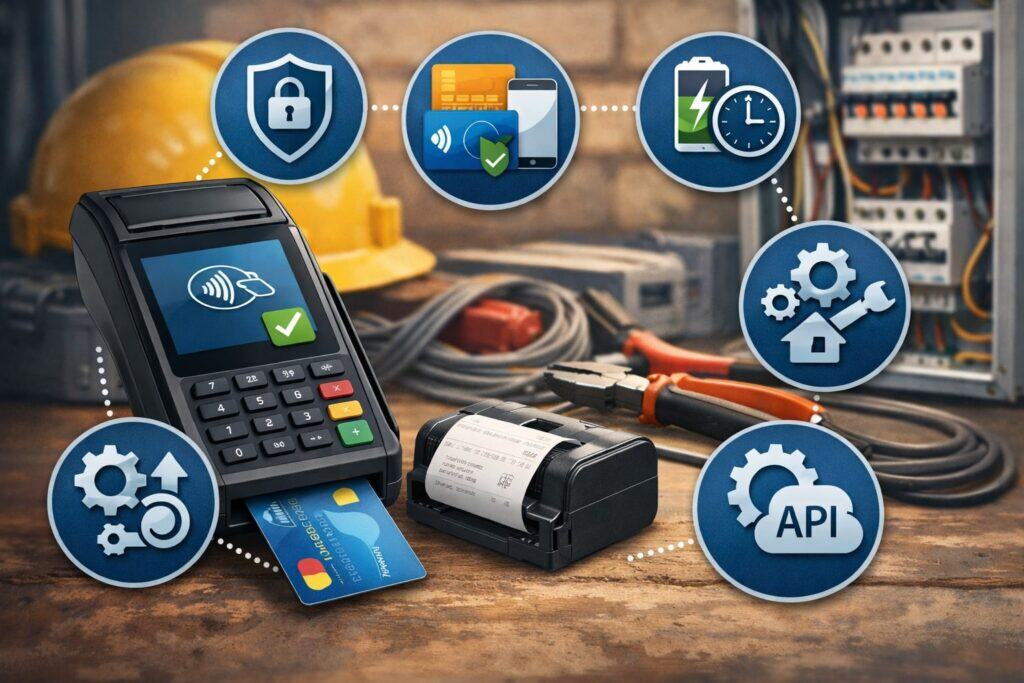
Picking EMV-compliant readers for electricians is less about brand loyalty and more about jobsite performance. Here are the features that matter most when you’re collecting payment next to a breaker panel or at the kitchen counter.
First, you want chip + contactless acceptance as the baseline. Customers expect to tap a phone or use a contactless card, and you want the option to dip a chip card when needed. Many modern readers explicitly support contactless and chip acceptance and are built for mobile use.
Second, prioritize reliable connectivity. Bluetooth readers are common because they keep your setup light and portable. But not all Bluetooth experiences are equal—look for readers known for stable pairing and quick reconnection.
If you spend two minutes fiddling with pairing in front of a customer, you lose the “professional finish” you worked hard to earn during the job.
Third, demand strong receipt and proof-of-payment options. Electricians benefit from instant SMS/email receipts, plus simple notes like “Panel upgrade deposit” or “Change order: additional circuit.” That documentation reduces disputes later and keeps your records clean.
Fourth, focus on battery life and durability. You don’t need a ruggedized industrial device for every business, but you do want something that can survive daily truck life, occasional drops, and long workdays. Devices advertised with improved battery life and secure payment handling can reduce headaches across a busy week.
Finally, evaluate whether you need a PIN pad. Many small readers rely on tap or signature, but if you regularly run debit transactions where PIN entry matters, a reader with a PIN pad can be a better fit. The right feature set depends on your average ticket size and customer payment preferences.
Best EMV-Compliant Readers for Electricians
This section highlights practical, widely used EMV-compliant readers for electricians and explains why each one works in real field-service situations. These are not “one-size-fits-all.” Think of them as tool categories: pick the one that matches your job type, ticket size, and back-office workflow.
Square Reader for Contactless and Chip
Square’s contactless + chip reader is popular for mobile service businesses because it’s small, straightforward, and designed for quick in-person acceptance. Square states the reader accepts contactless cards, chip cards, and mobile wallets, and it’s positioned for “on the go” use with improvements like faster pairing and longer battery life compared with earlier versions.
For electricians, the main win is speed: you can quote, complete the job, and take payment immediately without shifting into a complicated POS workflow.
Square’s ecosystem also tends to be friendly for simple catalogs (common services like “Service Call,” “Ceiling Fan Install,” “Panel Upgrade Deposit”), which helps you standardize tickets and reduce end-of-day bookkeeping.
Where this shines:
- Solo electricians and small crews
- Residential service calls
- Businesses that want a low-friction setup with clean receipts
Watch-outs:
- As you scale into heavier commercial workflows, you may want more advanced invoicing, purchase order matching, or job-costing integrations.
Overall, Square is a solid “grab-and-go” choice if your priority is turning completed work into captured revenue fast—and that’s exactly why it remains a top pick among EMV-compliant readers for electricians.
Stripe Terminal with WisePad 3 (and similar supported readers)
If your business has a more custom workflow—like a field-service app, a tailored invoice flow, or a specialized checkout—Stripe Terminal is worth a look. The BBPOS WisePad 3 is described by Stripe as a compact, battery-powered Bluetooth reader with a display and PIN pad that accepts chip and contactless payments.
For electricians, Stripe Terminal is most valuable when you want payments to connect tightly to your existing software—especially if you’re working with a developer or using a platform that builds on Stripe.
The advantage isn’t just “taking cards.” It’s building a payment step that matches your exact operations: deposits, staged payments, change orders, and final invoice settlement in one consistent system.
Where this shines:
- Multi-tech operations that want a standardized, software-driven flow
- Businesses with custom quoting/invoicing platforms
- Companies that want a PIN-capable device and more controlled checkout UX
Watch-outs:
- Stripe Terminal is powerful, but it can be more “system” than “gadget.” If you want the simplest possible plug-and-play option, other EMV-compliant readers for electricians may feel easier.
If you’re ready to treat payments as part of your broader workflow automation, Stripe Terminal can be a strong long-term foundation.
Clover Go (mobile reader + app)
Clover Go is built for taking payments anywhere you have a phone, and it supports chip and contactless acceptance. Clover’s materials emphasize accepting chip/dip and contactless payments (including mobile wallets) and position Clover Go as a mobile solution paired with an app.
For electricians, Clover Go can work well if you want a mobile reader but also like the idea of growing into a broader Clover ecosystem later (additional devices, countertop options, or more POS structure). Many electricians start mobile and later add a more “front counter” setup for a shop, warehouse, or office—Clover is one path that can scale from field to fixed-location.
Where this shines:
- Electricians who want mobile now but may add more POS later
- Teams that want more structured itemization and reporting
- Businesses that prefer a provider-led ecosystem
Watch-outs:
- Depending on your plan and provider relationship, pricing and features can vary. Make sure your chosen setup supports your invoice style and doesn’t force extra steps at checkout.
Clover Go is a practical choice among EMV-compliant readers for electricians when you want mobility today and room to expand tomorrow.
PayPal Reader (simple hardware, familiar brand)
PayPal’s reader is positioned as a straightforward way to accept in-person card and contactless payments, including mobile wallets like Apple Pay and Google Pay. PayPal also publishes reader pricing and hardware information directly through its business POS pages, including a standard card reader price referenced in its pricing materials.
For electricians, PayPal’s strength is familiarity—many customers already trust the PayPal brand. If you also invoice or take remote payments through PayPal, pairing that with a jobsite reader can simplify your overall payment toolkit. It’s especially useful when you want an easy on-site “tap/dip” option without adopting a full POS platform.
Where this shines:
- Owner-operators who want a familiar ecosystem
- Businesses that sometimes take remote payments and sometimes take in-person payments
- Jobs where quick “tap and go” is the priority
Watch-outs:
- If you need deeper field-service workflows, you may want a platform more focused on contractor operations.
As EMV-compliant readers for electricians go, PayPal is a reasonable fit when simplicity and customer trust matter most.
Helcim Card Reader (cost-conscious processing approach)
Helcim is often discussed as a no-monthly-fee, transparent-pricing-oriented provider, and third-party reviews note its reader supports EMV and contactless acceptance. Business.com’s review, for example, describes the Helcim Card Reader as supporting magstripe, EMV, and contactless payments and working with Helcim’s app for syncing and receipts.
For electricians, Helcim can be appealing if you’re looking closely at processing costs and want a provider that emphasizes straightforward pricing.
In service work, margins can be excellent—but cash flow timing matters. If your payment solution helps you keep more per transaction, that can add up across a year of service calls and upgrade projects.
Where this shines:
- Electricians who care deeply about processing economics
- Businesses that want a clean, simple mobile payment flow
- Companies that don’t want to pay monthly software fees just to take payments
Watch-outs:
- Always confirm hardware availability, compatibility, and the exact features you need (PIN, offline modes, integrations).
Helcim deserves a spot on the shortlist of EMV-compliant readers for electricians when controlling total payment costs is a top priority.
How to Choose the Right EMV-Compliant Reader for Your Electrical Business
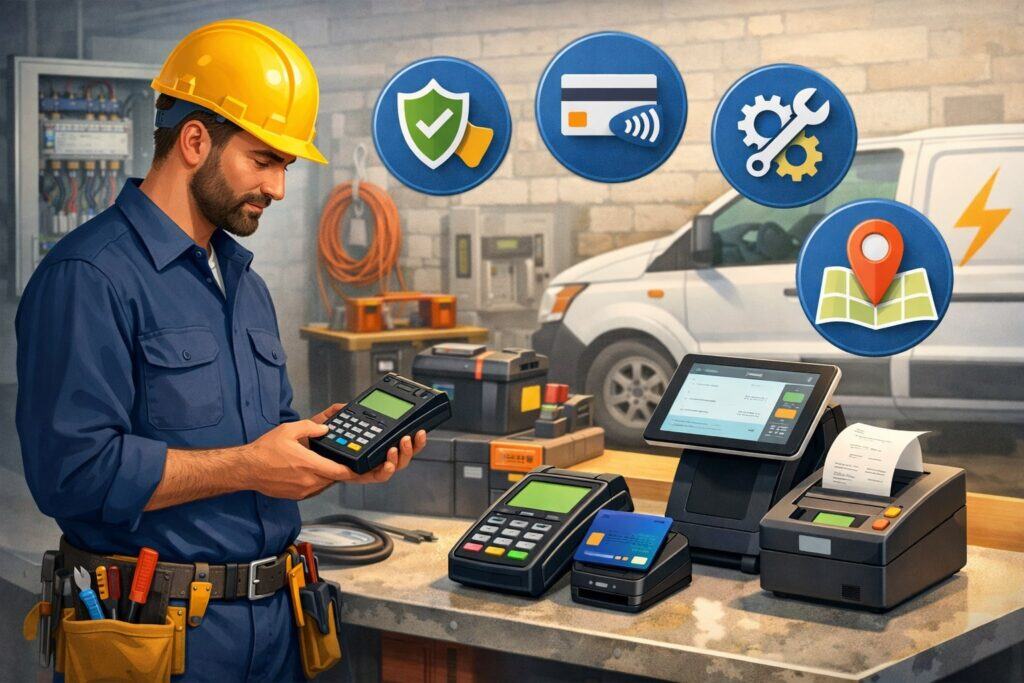
Choosing among EMV-compliant readers for electricians gets easier when you stop thinking “Which is the best reader?” and start thinking “Which is the best workflow?” A reader is only useful if it matches how you quote, dispatch, complete, and close out jobs.
Start with your average ticket size and payment style. If most jobs are under a few hundred dollars and you usually take full payment at completion, a compact contactless + chip reader is perfect.
If you routinely take deposits, progress payments, and final balances, then invoicing features and partial-payment handling become more important than the reader’s physical design.
Next, consider where your “source of truth” lives. Do you live inside accounting software? A field-service app? A spreadsheet? Your payment solution should reduce double-entry, not create it. If your team has to retype invoices, you’re inviting mistakes and slowing down collections.
Then, think about connectivity and environment. Jobsites vary—some basements have weak signals, some commercial sites block certain connectivity, and some customers want receipts immediately.
Your system should function smoothly under real conditions. That means stable pairing, fast checkout, and a reliable way to send proof of payment.
Also consider the customer experience. Homeowners and property managers notice how you finish a job. A professional payment flow—tap, confirm, receipt—creates confidence and reduces awkward “How do you want to pay?” conversations. It also supports referrals, because customers remember the entire experience, including the checkout moment.
Finally, plan for growth. The best EMV-compliant readers for electricians aren’t just good today—they won’t box you in if you add techs, trucks, or service lines next year.
EMV Compliance, PCI Standards, and What Electricians Should Actually Worry About
Most electricians don’t want a deep dive into payment security frameworks—and you shouldn’t have to. But if you’re using EMV-compliant readers for electricians, you should understand the basics of what keeps you safer and what still requires good habits.
EMV is about how chip and contactless transactions are handled at the point of sale. PCI standards are broader and focus on protecting payment data across the ecosystem. The PCI Security Standards Council maintains security standards and resources designed to protect payment data.
For electricians, the practical takeaway is: choose reputable providers and avoid workflows where you manually handle card data. Don’t write down card numbers. Don’t store card details in notes. Don’t ask a customer to text a card number. Use tokenized, provider-supported payment methods.
The industry is also moving toward solutions that let phones accept payments directly under defined security programs.
For example, PCI SSC has standards related to PIN entry on commercial off-the-shelf devices (like phones/tablets) and notes newer related standards in this area. This matters because it’s part of why “tap to pay on phone” solutions are expanding—reducing reliance on separate hardware for some use cases.
What should you worry about most?
- Use approved hardware and official apps.
- Keep devices updated.
- Control access (don’t let random staff share admin logins).
- Use strong passwords and MFA where available.
- Train techs to recognize suspicious situations (rushed customers, odd payment requests).
If you do those things, your EMV-compliant readers for electricians will do most of the heavy security lifting for you.
Future Predictions: Where EMV-Compliant Payments for Electricians Are Headed Next
The future of EMV-compliant readers for electricians is increasingly “less hardware, more software”—without sacrificing security. Over the next few years, expect these shifts to matter for field-service trades.
Tap-to-pay directly on phones will become a standard backup (and sometimes the default)
Phone-based acceptance is expanding because it removes a key failure point: the missing reader, the dead battery, the forgotten cable.
Apple describes Tap to Pay on iPhone as a way for merchants to accept contactless payments using an app on iPhone without connecting external hardware. Visa has also publicly discussed growth in phone-based tap acceptance (Tap to Phone), highlighting rapid adoption trends.
For electricians, this will likely become the “always available” option. Even if you prefer a dedicated reader for chip insert or PIN, phone tap acceptance can save the day when hardware fails mid-route.
Contactless use will keep rising, pushing more customers toward tap-first habits
Customer behavior keeps trending toward faster checkout methods—especially contactless cards and mobile wallets. Industry reporting and statistics sources continue to emphasize that contactless payments are growing and becoming more normal across everyday purchases.
For electricians, that means your checkout experience should be tap-friendly, quick, and confident. The fewer steps, the fewer delays in getting paid.
More contractor-friendly integrations will become a competitive differentiator
The reader itself will matter less than what it connects to: estimates, invoices, dispatch, job notes, warranties, membership plans, and financing options. Providers that tighten these integrations will win in field service.
Electricians should expect more “job-to-cash” automation: finish job → send invoice → collect tap payment → auto-sync to accounting → close ticket.
In short: the best EMV-compliant readers for electricians will increasingly be the ones that support both a reliable hardware option and a phone-based fallback, while keeping records clean and payment steps minimal.
FAQs
Q.1: What is the simplest setup for an electrician who only does service calls?
Answer: The simplest setup for EMV-compliant readers for electricians is usually: a compact Bluetooth reader + your phone + a clean receipt flow. You finish the job, open the invoice (or create a quick line item), and let the customer tap or dip. That’s it.
The reason simplicity matters is that service calls are time-sensitive. You might be running five to eight stops in a day, and every extra minute spent troubleshooting a payment app steals time from the next job.
Look for a setup that:
- Accepts contactless and chip
- Reconnects quickly to your phone
- Sends receipts by text/email automatically
- Lets you add notes (service call, deposit, change order)
Also consider having phone-based tap acceptance enabled as a backup if your provider supports it. Some accounting/payment platforms now let you accept contactless payments directly on certain phones, which can reduce dependency on hardware for tap transactions.
For most solo electricians, the “best” setup is the one you can operate in under 30 seconds in front of a customer—because speed and confidence at checkout lead to fewer unpaid invoices.
Q.2: Do I need a reader with a PIN pad for my electrical business?
Answer: Not always—but sometimes it helps. Many EMV-compliant readers for electricians handle most transactions through tap or chip with signature/verification handled in the normal card-network flow.
However, certain debit transactions and customer preferences may make PIN entry important. If you frequently work with customers who prefer debit, or you do commercial work where policy requires PIN verification, a reader with a PIN pad can reduce friction.
Readers like the WisePad 3 are positioned as having a display and PIN pad while accepting chip and contactless payments. That kind of device can feel more “full terminal” while still staying mobile.
That said, a PIN pad isn’t a magic upgrade. If it makes your setup bulkier, slower, or harder to maintain, it can backfire. A good rule: if PIN-related issues come up rarely in your business, you’ll probably prefer a lighter reader plus strong tap acceptance. If they come up weekly, it may be worth getting PIN-capable hardware.
Q.3: Can I rely on tap-to-pay on my phone instead of carrying a reader?
Answer: In many cases, yes—for contactless payments. Tap-to-pay on phone solutions are designed so merchants can accept contactless payments using an app without connecting external hardware, at least for the tap use case. This is especially useful for electricians because it reduces gear, reduces failure points, and speeds up checkout.
But there are two big caveats. First, phone tap acceptance generally covers contactless payments, not every possible chip insert scenario. Second, availability depends on your provider, your phone model, and your app setup.
For many electricians, the best approach is hybrid: keep a dedicated reader for maximum coverage, and enable phone tap acceptance as a backup (or as the default for small tickets).
This hybrid approach also helps with crew operations. If one tech forgets a reader, the phone-based option can still close the job and prevent delayed payments.
As the industry keeps pushing mobile acceptance forward, expect phone taps to become a more normal part of EMV-compliant readers for electricians setups—sometimes even replacing hardware for certain teams and ticket sizes.
Q.4: What’s the biggest mistake electricians make with card readers?
Answer: The biggest mistake is choosing a reader based only on hardware price instead of workflow fit. Cheap hardware that causes slow checkouts can cost you far more in delayed payments, awkward customer interactions, and end-of-month reconciliation headaches.
Another common mistake is keeping swipe-only tools active too long. Swipe-only acceptance isn’t aligned with modern customer expectations, and chip + tap acceptance is the practical baseline for credibility and smoother checkout.
Operationally, electricians also make mistakes by not standardizing how payments map to services. If your techs type “misc work” for everything, your records become useless for tracking profitability. A better approach is to set up common service items (diagnostic fee, service call, change order, deposit) so payments align cleanly with jobs.
Lastly, many small contractors underinvest in training. Even the best EMV-compliant readers for electricians can fail if techs don’t know the basics: how to reconnect Bluetooth, how to send a receipt, how to issue a refund properly, and how to handle a declined tap without panic. A 30-minute training session can save hours of chaos later.
Conclusion
The right EMV-compliant readers for electricians do more than accept cards—they help you finish jobs professionally, collect payment immediately, and keep your records clean.
In field service, the payment moment is the last impression you leave with a customer. A fast chip/tap checkout with an instant receipt reinforces trust and reduces the odds of delayed payment or disputes.
If you want the simplest “get paid on-site” workflow, a compact reader like Square’s contactless + chip option is built for quick mobile acceptance and emphasizes on-the-go usability.
If you need deeper customization or want payments tightly integrated into a software-driven workflow, Stripe Terminal and readers like the WisePad 3 can support a more structured approach with features like a PIN pad.
Clover Go and PayPal Reader are practical choices when you want a familiar ecosystem and scalable options for mobile acceptance. And if processing economics are central to your decision, Helcim is often considered for straightforward pricing and mobile acceptance.
Looking ahead, expect “tap to pay on phone” to become a standard part of electrician payment toolkits—either as a fallback or, for some businesses, a primary method—because it reduces hardware dependency while keeping checkout fast.