
By Joseph Bryson December 20, 2025
Accepting payments for large electrical projects isn’t just “send an invoice and wait.” On high-ticket jobs—service upgrades, industrial installs, data-center electrical work, multi-site retrofits, solar + storage tie-ins, or long-duration commercial builds—your payment strategy directly affects profit, cash flow, risk, and even whether a client awards you repeat work.
Accepting payments for large electrical projects also has unique operational wrinkles: progress billing, retainage, change orders, lien releases, compliance, fraud exposure, and the reality that a single delayed payment can stall payroll, materials, and subcontractors.
The good news is that accepting payments for large electrical projects can be predictable and scalable when you design it like a system.
That system includes: (1) contract terms that remove ambiguity, (2) the right payment rails (ACH, wire, card, virtual card, bank-to-bank), (3) controls that reduce chargebacks and disputes, (4) job-cost and accounting alignment so you know what you actually earned, and (5) a client experience that makes it easy for customers to pay—without sacrificing your margins.
This guide breaks down accepting payments for large electrical projects into practical decisions you can implement: how to structure deposits and milestones, how to protect against nonpayment, which payment methods fit which project types, what underwriting and compliance to expect from processors, and how to future-proof your payments as faster bank transfers and real-time rails become the norm.
Why accepting payments for large electrical projects is different from standard contracting

Accepting payments for large electrical projects is different because the payment “surface area” is bigger: larger invoices, more stakeholders, more approvals, more documentation, and more opportunities for disputes.
A typical residential service call can be settled with a card reader on-site. But accepting payments for large electrical projects often depends on procurement policies, accounts payable cycles, pay-when-paid clauses, retainage, and inspection sign-offs. One missing lien waiver or an unclear change order can push payment out by weeks.
Another major difference is risk distribution. When accepting payments for large electrical projects, you’re frequently fronting labor and materials before the final payment arrives. Copper, conduit, switchgear, panels, generators, and specialty gear can create serious cash strain.
If your contract and invoice cadence don’t match your cost curve, you can be “profitable” on paper and still run short on cash. That’s why accepting payments for large electrical projects requires aligning billing milestones with real spend: mobilization, rough-in completion, equipment delivery, energization, commissioning, and punch-list completion.
Also, clients paying large invoices often prefer bank-based methods. If accepting payments for large electrical projects relies too heavily on cards, you may face high processing fees, card limits, or compliance restrictions around surcharges and convenience fees.
Meanwhile, if you only accept checks, you accept slow delivery, stop-payment risk, and reconciliation headaches. A strong approach to accepting payments for large electrical projects offers multiple methods while steering clients toward lower-cost rails like ACH.
Finally, disputes and chargebacks can be more complex. When accepting payments for large electrical projects by card, a chargeback isn’t just a “refund.”
It can become a documentation battle involving signed work orders, contractual scope, proof of authorization, inspection reports, and correspondence. Building a dispute-ready paper trail is part of accepting payments for large electrical projects responsibly.
Building payment terms that protect cash flow without scaring clients away

Accepting payments for large electrical projects starts with contract language that sets expectations and reduces friction. Clear payment terms are not aggressive—they’re professional.
The goal is to make it obvious when you bill, what triggers payment, how clients can pay, and what happens if payment is late. When clients understand your process, accepting payments for large electrical projects becomes routine instead of adversarial.
Start by matching billing milestones to measurable deliverables. Avoid vague triggers like “50% upon substantial completion” unless you define “substantial completion” in writing.
Use objective milestones: “upon completion of rough-in inspection,” “upon delivery of switchgear to site,” or “upon energization of service.” This makes accepting payments for large electrical projects less dependent on subjective opinions. It also speeds approvals because project managers can confirm milestones quickly.
Include a deposit or mobilization fee whenever you’re committing labor, pulling permits, ordering materials, or reserving production time.
In many cases, accepting payments for large electrical projects works best with a mobilization invoice that covers planning, permitting, engineering coordination, and initial procurement. For material-heavy jobs, consider a separate “materials deposit” aligned to supplier lead times.
Retainage should be addressed explicitly. If the project requires retainage, negotiate the percentage and the release conditions.
Tie retainage release to clear events: “passed final inspection,” “as-builts delivered,” “O&M manuals delivered,” or “commissioning report accepted.” Accepting payments for large electrical projects becomes safer when retainage doesn’t turn into an open-ended holdback.
Also include change order rules. Many payment delays come from unapproved changes. A simple policy—“no work proceeds without written change order approval”—dramatically improves accepting payments for large electrical projects.
If the client insists on time-and-material changes, define the authorization workflow and require periodic sign-offs.
Choosing the best payment methods for large invoices and long project timelines

Accepting payments for large electrical projects means choosing payment methods that balance cost, speed, security, and client preference. The right approach is rarely “one method only.”
Instead, you create a menu that includes low-cost bank transfers for big invoices, optional cards for convenience, and structured options for deposits and progress payments. Your goal is to make accepting payments for large electrical projects easy for clients while protecting your margins.
ACH transfers for progress billing and predictable reconciliation
For many contractors, ACH is the backbone of accepting payments for large electrical projects because it’s cost-effective and fits accounts payable workflows. ACH is especially strong for recurring milestones and progress billing.
Clients can pay from their bank, approvals can be documented, and you can reconcile invoices cleanly. When you set up accepting payments for large electrical projects via ACH, the biggest win is fee control: ACH fees are usually lower than card processing on high-ticket transactions.
To use ACH well, provide clients with a secure payment link or a dedicated portal—not just routing and account numbers via email. A portal supports authentication, logging, and receipts, which reduces disputes and helps with audit trails. It also improves client experience: they can pay in minutes instead of printing checks.
Operationally, ensure you can support same-day or faster variants when clients need urgency. Many payment platforms support expedited bank transfers even if standard ACH takes longer. If your materials supplier requires quick payment, you can structure accepting payments for large electrical projects to receive bank funds sooner and keep production moving.
Finally, align ACH payments to invoice numbering and job codes. That sounds small, but it’s huge. When accepting payments for large electrical projects, clean remittance data prevents hours of back-and-forth between your office and the client’s AP team. Make remittance instructions clear: invoice number, project name, and purchase order reference.
Wires for very large deposits, equipment purchases, and time-sensitive releases
Wire transfers shine when accepting payments for large electrical projects involving very large sums, tight deadlines, or one-time equipment payments. Wires are often used for deposits tied to switchgear, generators, transformers, specialty panels, or long-lead procurement.
They can be faster and more final than other methods, reducing the risk of reversals compared to some bank transfer types.
Because wires can be expensive and prone to fraud (especially business email compromise), your process matters. When accepting payments for large electrical projects by wire, use verified instructions delivered through secure channels.
Add a “call-back verification” policy: confirm wire details by phone using a known number, not one provided in an email thread. This protects both you and the client.
You can also use wire transfers strategically: request wire for the initial materials deposit, then use ACH for progress draws. That structure can make accepting payments for large electrical projects more stable because the highest-risk funding portion is received quickly and with clear confirmation.
Also, ensure your team knows how to produce wire receipts and confirmations that clients can attach to their internal payment approvals. When accepting payments for large electrical projects, speed is often limited by paperwork, not the payment rail itself.
Card payments, virtual cards, and when they actually make sense
Card payments can be helpful in accepting payments for large electrical projects, but they must be used intentionally. Some clients prefer cards for points, float, or procurement policy reasons. Others use virtual cards generated for a specific invoice amount.
The challenge is fee impact and chargeback risk. Accepting payments for large electrical projects by card can be expensive if you’re paying percentage-based processing on large tickets.
If you offer card acceptance, define when it’s allowed and whether a convenience fee is permitted by your local rules and card brand guidelines.
If convenience fees or surcharges are allowed in your area and properly implemented, they can protect margins. If not, consider setting a card cap (for example, cards only up to a certain amount) and steering larger invoices to ACH or wire.
Virtual cards are common in B2B payments. They can simplify accepting payments for large electrical projects when clients want control: they issue a virtual number tied to the exact invoice amount, sometimes with a short expiration.
For you, the benefit is immediate authorization and simpler remittance. The downside can be higher interchange categories, depending on how the client issues the card.
If you accept cards, strengthen documentation. Use signed contracts, approved change orders, milestone sign-offs, and delivery confirmations. Accepting payments for large electrical projects by card becomes safer when you can prove “authorized services delivered as agreed.”
Setting up progress billing, milestone invoicing, and retainage the smart way
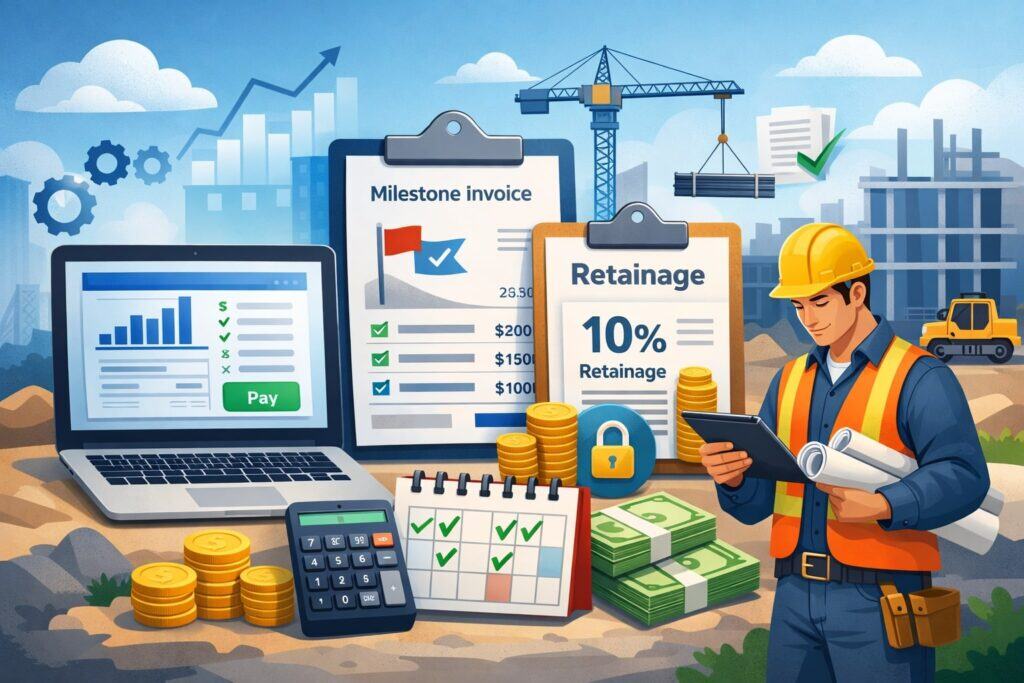
Accepting payments for large electrical projects becomes dramatically smoother when your invoicing mirrors how projects actually run. Large electrical work is rarely linear.
You might have early mobilization, a long permitting phase, multiple inspections, supply chain delays, and bursts of labor tied to coordination with other trades. If your invoices don’t match this rhythm, approvals get stuck and cash flow swings.
A practical framework for accepting payments for large electrical projects is the “front-middle-back” structure: (1) mobilization + early materials, (2) progress billing tied to measurable milestones, and (3) completion + retainage release.
Mobilization should cover the real cost of launching the project: engineering coordination, permitting, project management setup, and initial procurement. This reduces the pressure to finance the job yourself while keeping terms reasonable.
For the middle phase, use milestone invoices that map to inspections or deliverables. Examples include: rough-in complete, cable pulls complete, panel installation complete, service upgrade ready, equipment set, energization, and commissioning.
Each invoice should reference the contract line item, purchase order, and the specific milestone. When accepting payments for large electrical projects, clarity accelerates approvals.
Retainage should be treated as its own workflow. Provide the documentation clients need to release it: closeout packages, as-builts, warranties, test reports, O&M manuals, and final lien waivers.
Many retainage delays happen because contractors treat closeout as a scramble. Make closeout a milestone with checklist-based delivery. Accepting payments for large electrical projects becomes more predictable when retainage release is procedural.
Also account for change orders. Use a standard change order template that includes scope, price, schedule impact, and signature lines. Attach photos, sketches, or markups when relevant. Bundle smaller changes weekly or biweekly so the client isn’t flooded.
This keeps accepting payments for large electrical projects aligned with actual scope and reduces disputes.
Managing risk: fraud, disputes, chargebacks, and nonpayment prevention
Accepting payments for large electrical projects involves financial risk that grows with ticket size. That risk isn’t only “client won’t pay.” It also includes fraud (especially wire fraud), disputes about scope, and chargebacks when cards are involved.
A risk-aware payment system doesn’t assume bad intent; it assumes complexity and builds safeguards that keep everyone aligned.
Start with identity and authorization. Confirm who has authority to approve change orders and payments. Keep written proof. When accepting payments for large electrical projects, disputes often come from “I didn’t approve that” rather than “the work wasn’t done.” Make approvals explicit and stored in a central folder tied to the job.
Next, strengthen documentation at every milestone. Capture inspection pass reports, delivery receipts for equipment, commissioning logs, and progress photos.
For work that gets covered (like rough-in), photos and inspection results are invaluable. Accepting payments for large electrical projects becomes easier when you can prove the work existed at the time billed.
For card payments, reduce chargeback vulnerability by using invoices that clearly describe services, dates, and acceptance. If possible, obtain written confirmation of milestone acceptance before charging.
Always send receipts and keep communication professional and timely. Accepting payments for large electrical projects by card should be the exception, not the default, unless your margins can handle the fees and you have strong controls.
For wire fraud prevention, implement a strict policy: never accept wire instruction changes via email alone. Use a verified call-back number and document verification. Many businesses lose money to wire redirection scams; accepting payments for large electrical projects safely requires treating wire instructions like sensitive credentials.
Finally, address late payments proactively. Use automated reminders and a standard escalation path: reminder, call from AR, notice of work pause per contract, and formal demand if needed. Most clients pay faster when the process is consistent. Accepting payments for large electrical projects becomes less stressful when late payment steps aren’t improvised.
Processor approval, underwriting, and compliance realities for high-ticket electrical work
Accepting payments for large electrical projects often triggers extra scrutiny from payment providers because high-ticket transactions and staged delivery increase risk. This is normal. A good setup anticipates underwriting questions and prepares the documentation needed to get approved, maintain stable processing, and avoid surprise fund holds.
Underwriting typically evaluates your business model, average ticket, maximum ticket, refund and dispute risk, and the time gap between payment and project completion.
If accepting payments for large electrical projects means collecting large deposits months before final delivery, some providers may impose reserves or rolling holds. You can reduce that friction by showing a clear contract structure, milestone billing, and a track record of completion.
Prepare a basic underwriting packet: license information, sample contracts, sample invoices, project timeline examples, proof of insurance, and a short description of typical clients and job types.
When accepting payments for large electrical projects, being transparent about ticket size is critical. If you understate volume or ticket size, you risk sudden account reviews later.
Compliance also matters. If you accept cards, you must follow PCI requirements. Use secure, tokenized payment links and avoid storing card data in spreadsheets or email threads.
If accepting payments for large electrical projects includes recurring billing (like monthly progress draws), use a system that stores payment credentials securely and generates audit-friendly logs.
Also consider tax reporting and reconciliation. Some payment methods generate platform reporting that needs to match your books. When accepting payments for large electrical projects at scale, clean data flow into accounting software reduces end-of-year chaos and protects your financial reporting accuracy.
Pricing, fees, and profitability: how to avoid losing margin on payment costs
Accepting payments for large electrical projects can quietly erode profit if you don’t manage payment costs. On high-ticket invoices, small percentages become large dollars. The difference between a low-cost bank transfer and a card payment can be the difference between hitting your margin target and missing it.
First, know your true blended cost by method. For bank transfers, costs are often flat or modest. For cards, costs are usually percentage-based and may vary by card type, rewards level, and how the card is processed.
If accepting payments for large electrical projects includes virtual cards, you may see different fee patterns than standard cards. Track payment costs as a job expense category so you can price accordingly.
Second, design “payment steering” ethically and transparently. Offer multiple payment methods, but make the preferred method the easiest for big invoices.
For example: include an ACH link prominently, list wire instructions for large deposits, and offer card payments as an optional convenience method. Accepting payments for large electrical projects becomes more profitable when clients naturally choose lower-cost rails.
Third, understand when additional fees are allowed. Rules around surcharges and convenience fees can vary by jurisdiction and card brand policy. If you use them, implement them correctly with clear disclosure.
If you can’t or don’t want to add fees, consider adding payment cost expectations into your pricing model. Accepting payments for large electrical projects may require slightly different markup strategies depending on typical client payment behavior.
Finally, negotiate smarter with vendors and subs. If you receive payment by ACH quickly, you may be able to capture early-pay discounts or avoid rush shipping. Payment speed can have upstream cost benefits.
Accepting payments for large electrical projects isn’t only about collecting money—it’s about reducing total project cost through better cash timing.
Workflow and tools: invoicing, payment portals, approvals, and reconciliation
Accepting payments for large electrical projects becomes scalable when you reduce manual steps. Manual invoicing, email chains, and spreadsheet tracking create avoidable delays and errors.
The best systems integrate estimating, project management, invoicing, and payments so everyone sees the same truth: what was billed, what was paid, what’s outstanding, and what’s approved.
A modern workflow for accepting payments for large electrical projects starts with standardized invoice templates. Each invoice should include: project name, site address, purchase order reference, contract line item, milestone description, percentage complete if applicable, and documentation attachments.
This minimizes the back-and-forth that slows approvals. Keep paragraphs short and use clear bullet points so AP teams can review quickly. Accepting payments for large electrical projects is faster when invoices read like checklists.
Use a payment portal that supports bank transfers, card payments (if offered), downloadable receipts, and remittance notes. Portals reduce friction, especially for multi-location clients. They also create an audit trail that helps resolve disputes. When accepting payments for large electrical projects, logs matter: who initiated payment, when it was authorized, and which invoice it matched.
Approvals are the hidden bottleneck. Help clients approve faster by offering “invoice packets” that include required documents in one click: lien waivers, certified payroll (if needed), insurance certificates, inspection reports, and change order approvals.
If the client uses a vendor portal, learn its requirements early. Accepting payments for large electrical projects often fails because contractors ignore the client’s internal process until it’s too late.
Finally, streamline reconciliation. Ensure payment references include invoice numbers and job codes. Integrate payments into accounting software so deposits match invoices automatically when possible.
Accepting payments for large electrical projects becomes less time-consuming when your AR team isn’t manually matching bank deposits to PDFs.
Future-proofing: faster bank payments, real-time rails, and what to expect next
Accepting payments for large electrical projects is evolving as faster bank-to-bank payment options expand. The long-standing pain points—slow checks, unpredictable clearing times, and limited remittance data—are being addressed by modern bank rails that move money faster and carry richer payment details.
In the near term, expect broader adoption of instant and near-instant bank transfers for B2B invoices. This will make accepting payments for large electrical projects more responsive to field realities: urgent material releases, rapid mobilization needs, and last-minute commissioning schedules. Faster bank payments can reduce reliance on cards for speed, which is good for margins.
Also expect more automation around approvals and remittance. Payment platforms are increasingly focused on attaching invoice metadata, purchase order matching, and job-level reconciliation. For accepting payments for large electrical projects, this means fewer “mystery deposits” and less time chasing payment references.
Security will continue to tighten, especially for wires and high-value transfers. Multi-factor authentication, verified payee lists, and stronger confirmation workflows will become common. Accepting payments for large electrical projects safely will require adopting these controls rather than resisting them.
Finally, keep an eye on how procurement departments pay. More organizations are standardizing virtual card programs, automated ACH, and vendor portals.
Accepting payments for large electrical projects will increasingly involve adapting to client payment ecosystems while still protecting your business. The winners will be contractors who offer flexible methods, secure workflows, and clean documentation—so paying you becomes the easiest part of the project.
FAQs
Q.1: What is the best way to structure deposits when accepting payments for large electrical projects?
Answer: The best deposit structure for accepting payments for large electrical projects depends on how quickly you must commit costs. If you’re pulling permits, reserving crews, ordering long-lead equipment, or locking in material pricing, a mobilization invoice plus a materials deposit is often the most practical approach.
Mobilization covers real early work—project setup, engineering coordination, permitting administration, and scheduling—while a materials deposit protects you from financing the client’s procurement.
When accepting payments for large electrical projects, deposits should be tied to clear deliverables and timelines. Clients are more comfortable paying a deposit when they understand what it funds and when it will be applied against later invoices.
Spell out how deposits are credited in progress billing, and identify any non-refundable components if allowed by your contract rules. Also, avoid “one big deposit” if it makes clients uneasy.
Breaking it into mobilization + materials often feels more reasonable while still protecting cash flow. The key is transparency: accepting payments for large electrical projects becomes smoother when deposits are framed as standard project mechanics, not negotiation tactics.
Q.2: Should I accept credit cards for large electrical invoices?
Answer: You can accept cards while accepting payments for large electrical projects, but it should be a strategic option, not the default.
Cards can speed up payment and satisfy client procurement preferences, especially when virtual cards are used. However, card fees can be significant on large invoices, and chargeback processes can be disruptive.
If you decide to accept cards for accepting payments for large electrical projects, consider guardrails: allow cards up to a certain amount, encourage ACH for higher invoices, and use clear authorization steps.
Make sure invoices reference signed contracts and approved milestones, and retain documentation that proves delivery. Also learn your local rules on surcharges or convenience fees before implementing them.
The healthiest approach is offering cards as a convenience path while guiding major project payments toward bank-based methods. That balance helps accepting payments for large electrical projects stay fast without sacrificing margin.
Q.3: How do I reduce payment delays caused by approvals and paperwork?
Answer: The fastest way to reduce delays in accepting payments for large electrical projects is to package everything the client needs before they ask. Many payment delays are not about money—they’re about missing documents.
Create an invoice packet standard: invoice, milestone completion note, relevant inspection evidence, approved change orders, and lien waiver status. If the client requires specific forms, request them at kickoff.
Also, make invoices easy to read. Use short paragraphs, clear milestone labels, and consistent formatting. Include purchase order references and project identifiers. When accepting payments for large electrical projects, AP teams often pay dozens of vendors; they prioritize invoices that are easy to approve.
Finally, automate reminders and status checks. A portal that shows paid/unpaid status and allows clients to attach remittance details reduces back-and-forth. Accepting payments for large electrical projects becomes predictable when your process is more “system” and less “email thread.”
Q.4: What should I do if a client disputes scope or refuses to pay a milestone invoice?
Answer: Disputes are common enough that accepting payments for large electrical projects should assume they’ll happen occasionally and build a response plan. First, avoid escalating emotionally.
Gather documentation: the signed contract scope, the milestone definition, inspection results, photos, daily logs, and any communications about completion. Present a short, factual summary that ties the invoice to the agreed milestone.
If the dispute involves changes, focus on change order approval records. Many conflicts arise when work is performed under verbal direction. Going forward, enforce written approvals.
For current disputes, propose a path: partial payment for undisputed scope, plus a written change order or time-and-material reconciliation for disputed items. Accepting payments for large electrical projects improves when you separate “work delivered” from “work debated” and keep the project moving.
If needed, follow the escalation steps in your contract: notice, meeting, mediation/arbitration provisions, and formal demand. The goal is resolution, not drama. Accepting payments for large electrical projects is safest when disputes are handled like project controls, not personal conflicts.
Q.5: How can I make accepting payments for large electrical projects easier for clients without increasing risk?
Answer: Client ease and contractor safety can coexist. The simplest way to improve accepting payments for large electrical projects is to offer a secure portal with multiple payment options and clear invoice packets. Clients want speed, receipts, and predictable workflows. You want documentation, verification, and reliable reconciliation. A portal can do both.
Use standardized milestones, consistent invoice numbering, and clear remittance instructions. Provide quick access to certificates, warranties, and closeout documents. For large payments, offer ACH and wire with secure verification procedures. If offering cards, use tokenized payment links and avoid storing sensitive data internally.
Also, align invoicing cadence with the client’s pay cycle. Some organizations cut checks or process AP on specific days. If you time invoices to those cycles, accepting payments for large electrical projects becomes smoother without adding financial risk. Ease is not about being lax; it’s about removing friction while keeping controls intact.
Conclusion
Accepting payments for large electrical projects works best when you stop treating payments as a one-off event and start treating them as a repeatable system. That system begins with clear contract terms—milestones, deposits, change orders, and retainage release conditions.
It continues with payment methods that match high-ticket realities: bank transfers for big invoices, wires for time-sensitive deposits, and cards only when the economics and controls make sense.
Just as important, accepting payments for large electrical projects requires operational discipline: documentation at each milestone, secure workflows that prevent fraud, and tools that simplify approvals and reconciliation.
When you design the process correctly, you get paid faster, disputes shrink, and margins stay intact—without creating a difficult experience for clients.
Looking ahead, faster bank payments and more automated remittance will make accepting payments for large electrical projects even more streamlined. Contractors who adopt secure portals, clean invoice packets, and flexible payment options will be positioned to win better clients and scale confidently.
In other words: the easiest way to protect your business isn’t to chase payments harder—it’s to build a payment engine that makes paying you the simplest step in the entire project.